
If you get the emulsion type wrong, nothing else matters. A margarine that flips from water-in-oil to oil-in-water during processing isn’t margarine anymore — it leaks water, loses spreadability, and fails on the line. Oil-in-water gives you lightness and drinkability. Water-in-oil gives you richness and spreadability. At FoodEmul, we manufacture both sides of the equation: sorbitan esters (Span) for the oil phase and polysorbates for the water phase. This guide covers how to identify which emulsion type your product needs, which Span/Polysorbate ratios deliver it, and how to keep it stable.
For CMC micelle chemistry and essential oil solubilization, see our Polysorbate Solubilizers Guide.
The Emulsion Type That Defines Your Product
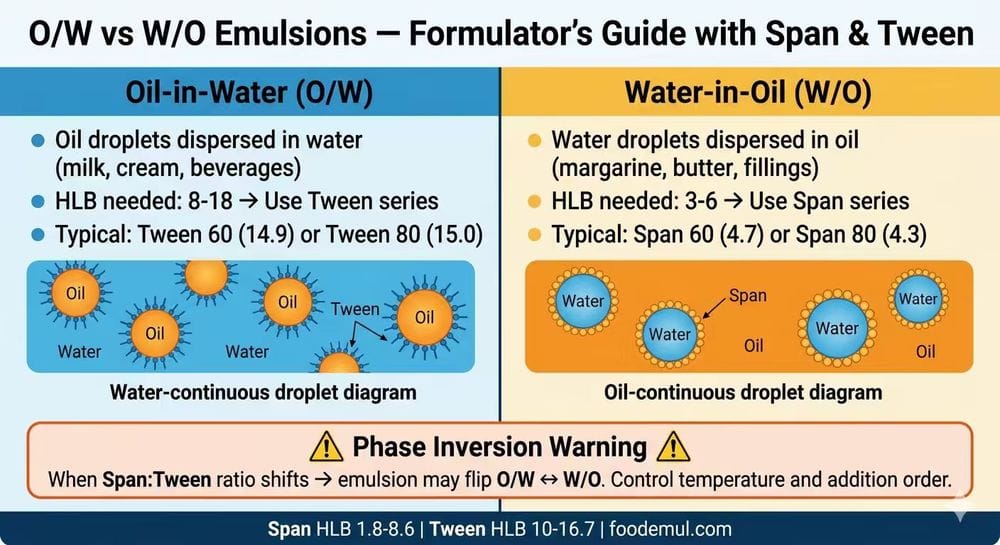
Every food emulsion is either oil-in-water (O/W) — oil droplets dispersed in a continuous water phase — or water-in-oil (W/O) — water droplets dispersed in a continuous oil phase. This single structural decision determines mouthfeel, processing behavior, fat content, and which emulsifier system will work.
| Characteristic | O/W Emulsion | W/O Emulsion |
|---|---|---|
| Continuous phase | Water | Oil / fat |
| Dispersed phase | Oil droplets | Water droplets |
| Typical fat content | 3-40% | 60-85% |
| Texture | Light, fluid, pourable | Rich, thick, spreadable |
| Required HLB range | 8-18 | 3-6 |
| Key Span/Polysorbate pair | Polysorbate-dominant (Span 20-30%) | Span-dominant (Span 60-85%) |
| Food examples | Milk, mayonnaise, ice cream, dressings, beverages | Butter, margarine, chocolate, shortening |
If you are new to food emulsifiers, start with our guide to food emulsifier functions.
The emulsion type is not a formulation detail — it is the defining structural decision. A margarine that flips from W/O to O/W during processing literally becomes a different product.
The Span/Polysorbate Framework for Both Systems
Span (sorbitan esters) and Polysorbate emulsifiers are uniquely suited to covering both O/W and W/O systems because they span the full practical HLB range from 2.1 to 16.7. A real-world O/W example: pure milk at HLB 9.0 — our milk stability formulation walkthrough covers the GMS/Span 60/polysorbate 80 blend from first principles to finished formula. A single supplier’s portfolio — Span 60, Span 80, Polysorbate 60, Polysorbate 80 — can solve both emulsion types.
How the HLB System Predicts Emulsion Type
The Hydrophilic-Lipophilic Balance (HLB) system, developed by Griffin and refined over decades of food applications, assigns an HLB number from 0 to 20. Emulsifiers with higher HLB values (>10) are predominantly hydrophilic and favor O/W emulsions; those with lower HLB values (<9) are predominantly lipophilic and favor W/O emulsions (Hu et al., 2011).
| HLB Range | Emulsion Type | Behavior | Span/Polysorbate Dominance |
|---|---|---|---|
| 3-6 | W/O (strong) | Water droplets in continuous fat | Span-dominant (Span:Polysorbate = 3:1 to 6:1) |
| 6-8 | W/O (weak) or W/O/W double | Transitional zone — fat crystallization matters most | Span:Polysorbate = 1.5:1 to 3:1 |
| 8-12 | O/W (general purpose) | Reliable oil-in-water for most food systems | Balanced (Span:Polysorbate = 1:1 to 1:2.5) |
| 12-15 | O/W (strong) | Fine droplet emulsions, beverage systems | Polysorbate-dominant (Span:Polysorbate = 1:3 to 1:6) |
| 15-18 | O/W (maximum stability) | Flavor emulsions, clear beverages | Polysorbate-only or trace Span |
Span: The W/O Anchor
Span emulsifiers — particularly Span 60 (HLB 4.7) and Span 80 (HLB 4.3) — are the primary W/O emulsifiers in the Span/Polysorbate system. Their low HLB values mean they dissolve preferentially in the oil phase and position themselves at the oil side of the water-oil interface. In margarine and shortening, Span 60’s stearic acid chain co-crystallizes with solid fat, physically locking water droplets in place.
Our Sorbitan Esters formulation guide covers Span selection for different fat systems in detail.
Polysorbate: The O/W Engine
Polysorbate emulsifiers — Polysorbate 20 (HLB 16.7), Polysorbate 60 (HLB 14.9), and Polysorbate 80 (HLB 15.0) — drive O/W emulsion formation. Their polyoxyethylene chains extend into the aqueous phase, creating a steric barrier that prevents oil droplets from approaching each other. In beverage flavor emulsions, Polysorbate 80 at 0.05-0.2% produces oil droplets under 5 µm that remain suspended for months.
Our Polysorbate 80 formulation guide provides HLB calculation methodology and dosage data.
The Compound Blend Advantage
Real food emulsions rarely succeed with a single emulsifier. The Span/Polysorbate compound blend — our Compound Emulsifiers guide covers the science — creates a denser, stronger interfacial film than either component alone:
- For O/W emulsions: 70-80% Polysorbate + 20-30% Span. The Polysorbate provides HLB and steric stabilization; the small Span fraction densifies the interfacial film for long-term shelf stability.
- For W/O emulsions: 60-85% Span + 15-40% Polysorbate. The Span anchors the fat phase and co-crystallizes with solid fat; the Polysorbate fraction helps disperse water droplets finely during mixing.
Key Differences That Drive Formulation Decisions
Conductivity — The Quick Emulsion Type Test
The single most reliable way to determine whether an emulsion is O/W or W/O is electrical conductivity. O/W emulsions conduct electricity (continuous water phase carries current). W/O emulsions do not (continuous oil phase is non-conductive). A simple conductivity meter test costs seconds and prevents expensive formulation errors.
Dilution Behavior
An O/W emulsion can be diluted with water without breaking — the added water simply joins the existing continuous phase. A W/O emulsion cannot be diluted with water; adding water causes phase inversion or separation. Conversely, W/O emulsions dilute readily with oil. This principle helps troubleshoot manufacturing problems: if your product separates when you add water, you may have unintentionally created a W/O system.
Texture and Mouthfeel
O/W emulsions deliver a light, cooling mouthfeel because water — the continuous phase — contacts the palate first. W/O emulsions deliver richness and fat perception because oil contacts the palate directly. This is why a salad dressing (O/W) feels light while margarine (W/O) feels rich, even when both contain similar emulsifier blends.
For product-specific guidance, see our Ice Cream Emulsifier Systems Guide (O/W with partial coalescence) and Margarine & Shortening Guide (W/O).
Emulsifier Selection by Emulsion Type
O/W Systems: When Oil Disperses in Water
Best Span/Polysorbate choices:
| Emulsifier | HLB | Best O/W Application |
|---|---|---|
| Polysorbate 80 | 15.0 | Beverage flavor emulsions, ice cream |
| Polysorbate 60 | 14.9 | Cake batter, whipped toppings |
| Polysorbate 20 | 16.7 | Protein drinks, low-fat dressings |
| Span 80 (supplementary) | 4.3 | Ice cream fat network reinforcement |
| Span 60 (supplementary) | 4.7 | Cake foam stability |
Ratio guidance: Polysorbate:Span = 3:1 to 6:1. The Polysorbate fraction provides the HLB for O/W orientation; the Span fraction densifies the interfacial film for long-term stability.
W/O Systems: When Water Disperses in Oil
Best Span/Polysorbate choices:
| Emulsifier | HLB | Best W/O Application |
|---|---|---|
| Span 60 (Sorbitan Monostearate) | 4.7 | Margarine, shortening, bakery fats |
| Span 80 (Sorbitan Monooleate) | 4.3 | Spreads, fat-based fillings |
| Span 65 (Sorbitan Tristearate) | 2.1 | High-stability systems, chocolate |
| Polysorbate 60 (supplementary) | 14.9 | Fine water droplet dispersion |
Ratio guidance: Span:Polysorbate = 3:1 to 6:1. The Span fraction anchors the W/O interface; a small Polysorbate addition helps produce finer water droplets — but too much Polysorbate risks phase inversion.
Phase Inversion — What Happens When the Emulsion Flips
Phase inversion occurs when the continuous and dispersed phases swap — an O/W emulsion becomes W/O, or vice versa. In food manufacturing, this is usually undesirable: a margarine that inverts to O/W loses its functionality entirely.
What Triggers Inversion
| Trigger | Mechanism | What Happens |
|---|---|---|
| Temperature change | Fat melting/crystallization shifts the effective HLB balance | Hot-filled sauce inverts during cooling if fat crystallizes into a continuous network |
| Adding too much of the dispersed phase | Beyond ~74% dispersed phase, the system becomes geometrically unstable | High-oil mayonnaise becomes O/W/O double emulsion, then W/O |
| Wrong emulsifier ratio | Effective HLB shifts across the inversion boundary | Adding too much Polysorbate to a W/O margarine: inverts to O/W, water leaks out |
| Shear during cooling | Mechanical energy favors the phase with higher volume fraction becoming continuous | W/O emulsion inverted by aggressive homogenization during cooling |
How to Prevent Unwanted Inversion
- Stay well within the HLB range for your target emulsion type. For W/O, keep effective HLB below 6. For O/W, keep it above 8.
- Control cooling rate. Fat crystallization stabilizes W/O emulsions — rapid cooling produces small fat crystals that lock in the W/O structure.
- Add the dispersed phase gradually. Dumping all the water into the oil phase at once risks inversion. Staged addition gives the emulsifier time to orient.
Our Span & Polysorbate formulators guide covers phase behavior in depth.
Stability: What Makes Emulsions Last
The Span/Polysorbate Interfacial Film
The strongest stability mechanism in Span/Polysorbate-stabilized emulsions is the mixed interfacial film. Span molecules (compact, cyclic sorbitan head group) pack tightly at the oil side of the interface. Polysorbate molecules (extended polyoxyethylene chains) extend into the water phase, creating steric hindrance between droplets. Together they form a film that resists both coalescence and Ostwald ripening.
Fat Crystallization in W/O Systems
In W/O emulsions — margarine and shortening — fat crystallization provides an additional stability mechanism. Span 60’s stearic acid chain (C18:0, melting point ~53 °C) co-crystallizes with the surrounding solid fat, forming a rigid shell around each water droplet. This is why Span 60 outperforms Span 80 (liquid oleic acid chain, C18:1) in W/O systems that require solid fat stability.
Common Stability Failures and Fixes
| Problem | System Type | Likely Cause | Span/Polysorbate Fix |
|---|---|---|---|
| Oil separation (creaming) | O/W | Insufficient HLB or film density | Increase Polysorbate proportion; add 10-20% Span for film densification |
| Water leakage | W/O | Emulsifier ratio too close to inversion boundary | Increase Span proportion to push effective HLB below 6 |
| Grainy texture | O/W | Droplet coalescence during storage | Add small Span fraction (5-10%) to strengthen interfacial film |
| Melt instability | O/W (ice cream) | Protein-stabilized emulsion overheats | Increase Span 80 to reinforce fat crystal network. See our Ice Cream guide |
| Temperature cycling failure | Both | Emulsifier crystallizes at low temperature, desorbs from interface | Use Span/Polysorbate pair with lower melting point: Span 80/Polysorbate 80 for frozen-distribution products |
Pure dairy milk is a textbook oil-in-water emulsion. See our guide on milk emulsification stability for the full formulation breakdown.
Practical Emulsion Design Checklist
- Determine the continuous phase. What touches the palate first? If water > 60%, start with O/W. If fat > 60%, start with W/O.
- Calculate the required HLB for your oil phase using the HLB additive principle. Oils have known required HLB values — butterfat ~9, vegetable oil ~7, cocoa butter ~4.
- Select the Span/Polysorbate pair whose fatty acid chain matches your dominant fat (stearic for bakery, oleic for dairy).
- Set the initial ratio using the HLB weighted average formula. Our Compound Emulsifiers guide walks through the calculation.
- Test 3 ratios around the calculated value (±10%) and evaluate by centrifugation and shelf-hold.
- Confirm emulsion type by conductivity testing before scale-up.
Emulsion type is the foundation. Everything else — emulsifier selection, HLB, process parameters, stability strategy — builds from the decision of which phase is continuous. The Span/Polysorbate family gives formulators a single coherent toolkit to build both O/W and W/O systems, reducing ingredient complexity without sacrificing performance. For product-specific formulation, see our application guides for beverage, ice cream, and margarine systems.
Need help with your emulsion system? We manufacture Span 60, Polysorbate 80, and the full range — reach out for technical support or samples.