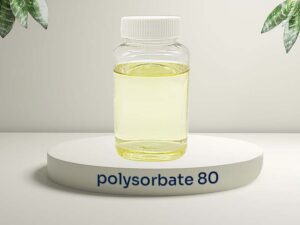

Polysorbate 80 — E433, CAS 9005-65-6, HLB 15.0, oleic acid backbone — is the most widely specified synthetic emulsifier in food, cosmetics, and pharmaceuticals. At FoodEmul, it is our highest-volume product, shipped to manufacturers worldwide. This technical guide covers the full specification: chemistry, physical properties, regulatory status, safety data, and supplier qualification criteria.
Quick Reference: Key Properties
| Property | Value | Property | Value |
|---|---|---|---|
| CAS Number | 9005-65-6 | Molecular Weight | 1,310.65 g/mol |
| Molecular Formula | C₆₄H₁₂₄O₂₆ | HLB Value | 15.0 |
| Density (25°C) | 1.06–1.10 g/cm³ | Viscosity (25°C) | 300–500 mPa·s |
| Pour Point | ~–20°C | Boiling Point | >100°C (decomp. >250°C) |
| Flash Point | >150°C | Melting Point | <–20°C (liquid at room temp.) |
| Water Solubility | Fully soluble | Shelf Life | 24 months |
| Food Code | E433 (EU), INS 433 | FDA Status | 21 CFR 172.840, GRAS |

For FDA application limits and product-by-product compliance data, see our Polysorbate 80 B2B Applications & Regulatory Guide. For a general overview, see our What Is Polysorbate 80? pillar guide. For safety data, see the Polysorbate 80 Safety & Compliance Guide.
Chemical Identity
| Parameter | Value |
|---|---|
| IUPAC Name | Polyoxyethylene (20) sorbitan monooleate |
| Common Synonyms | Polysorbate 80, Polysorbate 80, Kolliphor PS 80, Montanox 80, Alkest TW 80 |
| Food Additive Code | E433 (EU), INS 433 (Codex) |
| CAS Number | 9005-65-6 |
| HS Code | 3402.19.00 |
| Molecular Formula | C₆₄H₁₂₄O₂₆ (nominal; actual is a distribution) |
| Molecular Weight | 1,310.65 g/mol (average) |
| SMILES | CCCCCCCC/C=C\\CCCCCCCC(=O)OCC1C(C(C(O1)OCCO)OCCO)OCCO with ~20 EO units distributed across four arms |
Chemical Structure
Polysorbate 80 is a non-ionic surfactant consisting of a sorbitan core (a cyclic ether derived from sorbitol dehydration) esterified with one oleic acid molecule and ethoxylated with approximately 20 moles of ethylene oxide distributed across the remaining three hydroxyl positions. The resulting molecule has:
- Lipophilic tail: The C18:1 oleic acid chain (monounsaturated, with a cis double bond at C9) provides oil compatibility and contributes to the molecule’s liquid physical state at room temperature.
- Hydrophilic head: Three polyoxyethylene chains (totaling ~20 EO units) extend into the aqueous phase, creating a thick steric barrier that prevents droplet coalescence in O/W emulsions. Each EO chain is terminated with a hydroxyl group capable of hydrogen bonding with water.
- Architecture: The asymmetric distribution of EO units across the sorbitan ring creates a wedge-shaped molecular geometry that favors oil-in-water emulsion formation. This is in contrast to Span 80 (sorbitan monooleate, HLB 4.3), whose single hydroxyl head and single oleate tail produce a more cylindrical geometry favoring W/O emulsions.
Unlike small-molecule surfactants with a defined molecular weight, Polysorbate 80 is a polymeric surfactant — the ethoxylation step produces a distribution of oligomers with varying EO chain lengths. The molecular weight of 1,310.65 g/mol represents the nominal structure with exactly 20 EO units; commercial product has a distribution centered around this value. This polydispersity contributes to the product’s broad emulsification capability across a range of oil types.
What the Name Means
The “80” designates the fatty acid: oleic acid (C18:1, monounsaturated). This distinguishes it from other polysorbates:
| Polysorbate | Fatty Acid | Chain | Physical Form @25°C |
|---|---|---|---|
| Polysorbate 20 | Lauric acid | C12, saturated | Clear liquid |
| Polysorbate 40 | Palmitic acid | C16, saturated | Viscous liquid |
| Polysorbate 60 | Stearic acid | C18, saturated | Waxy semi-solid |
| Polysorbate 80 | Oleic acid | C18:1, unsaturated | Viscous liquid |
Physical Properties
| Property | Value | Test Method |
|---|---|---|
| Appearance | Clear to slightly hazy, amber to golden-yellow viscous liquid | Visual |
| Odor | Characteristic, mild fatty odor | Olfactory |
| HLB Value | 15.0 (highly water-soluble, O/W emulsifier) | Griffin method |
| Viscosity (25°C) | 300–500 mPa·s | Brookfield |
| Density (25°C) | 1.06–1.10 g/cm³ | USP <841> |
| Melting Point | < –20°C (does not crystallize; remains liquid) | DSC |
| Pour Point | Approximately –20°C (pumpable in cold storage) | ASTM D97 |
| Boiling Point | > 100°C at atmospheric pressure; thermal decomposition begins above 250°C | TGA |
| Flash Point | > 150°C (Cleveland open cup) | ASTM D92 |
| Refractive Index (25°C) | 1.470–1.474 | USP <831> |
| Surface Tension (0.1% aq., 25°C) | ~42 mN/m | Du Noüy ring |
| Critical Micelle Concentration (CMC) | ~0.012 mM (1.6 × 10⁻² g/L) | Surface tension isotherm |
Solubility Profile
| Solvent | Solubility | Notes |
|---|---|---|
| Water | Fully soluble | Forms clear to slightly hazy solutions; solubility decreases above 70°C (cloud point effect) |
| Ethanol | Soluble | Fully miscible at all concentrations |
| Isopropanol | Soluble | — |
| Ethyl acetate | Soluble | — |
| Propylene glycol | Soluble | Common co-solvent in cosmetic formulations |
| Vegetable oils | Dispersible to soluble | Solubility increases with temperature; fully dispersible above 60°C |
| Mineral oil | Dispersible | Limited solubility; use Span 80 as co-emulsifier for mineral oil systems |
Chemical Specifications by Grade
| Parameter | Food Grade (FCC/USP) | Pharma Grade (USP/Ph. Eur.) | Industrial Grade |
|---|---|---|---|
| Acid Value (mg KOH/g) | ≤ 2.0 | ≤ 2.0 | ≤ 7.5 |
| Saponification Value (mg KOH/g) | 45–55 | 45–55 | 45–60 |
| Hydroxyl Value (mg KOH/g) | 65–80 | 65–80 | 60–85 |
| Oxyethylene Content (%) | 65.0–69.5 | 65.0–69.5 | 65.0–70.0 |
| Water Content (%, Karl Fischer) | ≤ 0.5 | ≤ 0.3 | ≤ 1.0 |
| Peroxide Value (meq/kg) | ≤ 5 | ≤ 2 | ≤ 10 |
| Heavy Metals (as Pb, ppm) | ≤ 10 | ≤ 10 | Not specified |
| Arsenic (ppm) | ≤ 1 | ≤ 1 | Not specified |
| 1,4-Dioxane (ppm) | ≤ 10 | ≤ 10 | Not specified |
| Ethylene Oxide (ppm) | ≤ 1 | ≤ 1 | Not specified |
Pharma-grade note: For parenteral and ophthalmic applications, verify peroxide value and impurity profile against the relevant pharmacopeia monograph (USP-NF / Ph. Eur. / JP). Oxidative degradation of the oleic acid chain can introduce reactive species that compromise API stability. The tighter peroxide limit (≤ 2 meq/kg vs. ≤ 5 for food grade) reflects this heightened sensitivity.
Stability and Storage
| Condition | Behavior |
|---|---|
| pH Stability | Stable across pH 4–10; optimal performance at pH 5–7. At pH < 3 or > 11, ester bond hydrolysis accelerates significantly |
| Thermal Stability | Stable up to 100°C for short durations; avoid prolonged heating above 150°C. Autoclaving (121°C, 15 min) is acceptable for pharma-grade material |
| Oxidative Stability | Oleic acid chain susceptible to oxidation at the C9 double bond — store under nitrogen headspace for bulk tanks. Addition of 0.01–0.05% BHT or tocopherol extends oxidative stability |
| Microbial Stability | Resistant to microbial growth when stored sealed and dry; water activity below 0.6 |
| Storage Recommendation | Cool (15–30°C), dry, ventilated area; keep containers tightly closed; protect from direct light and UV exposure |
| Shelf Life | 24 months from date of manufacture in original sealed container. Retest acid value and peroxide value after 18 months |
| Cold Storage Behavior | Remains liquid and pumpable at temperatures as low as –20°C. Unlike Polysorbate 60 (which solidifies below 25°C), Polysorbate 80 requires no pre-heating before use in cold-process or refrigerated manufacturing environments |
Incompatibilities
- Strong oxidizing agents (peroxides, hypochlorites) — accelerate oleic acid degradation
- Strong acids and alkalis at elevated temperatures — catalyze ester hydrolysis
- Certain phenolic preservatives (parabens) — micellar encapsulation by Polysorbate 80 can reduce free preservative concentration and compromise antimicrobial efficacy. Verify preservative efficacy testing (PET) in Polysorbate 80-containing formulations
- Iodine and iodophors — addition across the oleic acid double bond can consume active iodine
Standard Packaging
| Pack Size | Container | UN/DOT Classification |
|---|---|---|
| 25 kg | HDPE jerry can | Not regulated |
| 50 kg | HDPE jerry can | Not regulated |
| 200 kg | HDPE drum (tight-head) | Not regulated |
| 1,000 kg | IBC tote (HDPE with steel cage) | Not regulated |
Custom packaging and private labeling available on request. All containers are UN-certified for food-grade materials.
Related Technical Resources
- FDA application limits & compliance: Polysorbate 80 B2B Applications & Regulatory Guide
- Safety, toxicology & dietary certifications: Polysorbate 80 Safety & Compliance Guide
- Chemistry overview & industry applications: What Is Polysorbate 80? Pillar Guide
- PS60 vs Polysorbate 80 comparison: Polysorbate 60 vs. 80 Selection Guide
- Product page (TDS, SDS, quotation): Polysorbate 80 Product Page
Contact FoodEmul.com for Certificate of Analysis (COA), Technical Data Sheet (TDS), Safety Data Sheet (SDS), or to request a sample.
Need Polysorbate 80? We manufacture it to food-grade specifications with Kosher and MUI Halal certification — reach out for technical documentation or samples.