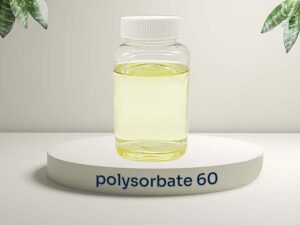

Polysorbate 60 and Polysorbate 80 sit 0.1 HLB units apart — but they are not interchangeable. The stearic acid chain on Polysorbate 60 (C18:0) behaves differently from the oleic acid chain on Polysorbate 80 (C18:1) — and if you need to replace either one, we have a dedicated Polysorbate 60 substitute selection guide covering five alternatives by application, and that single double bond changes everything: melt point, fat phase compatibility, and crystallization behavior. At FoodEmul, we manufacture both. This guide compares them head-to-head so you know which one belongs in your formulation.
PS20 vs. PS60 vs. Polysorbate 80: When to Choose Each
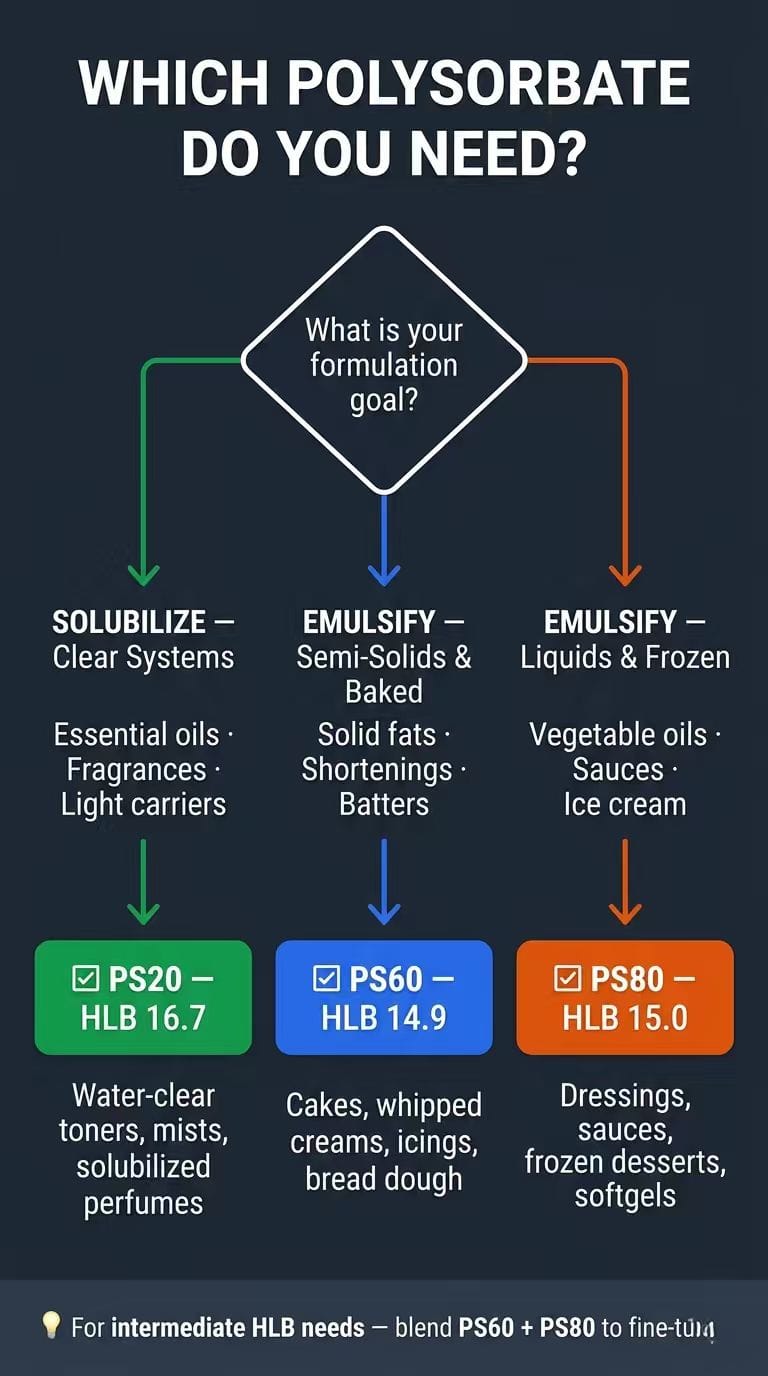
Formulators often face a choice among three polysorbates — PS20, PS60, and Polysorbate 80 — rather than a simple two-way comparison. Below is a practical decision framework based on formulation chemistry and industrial experience in emulsifier manufacturing.
Choose Polysorbate 20 (HLB 16.7) When:
- Your formulation requires a clear, transparent water-based product — PS20’s high HLB and lauric acid tail make it ideal for solubilizing fragrances and essential oils into aqueous systems.
- You are working with light essential oils, perfumes, or low-viscosity carriers (isopropyl myristate, caprylic/capric triglyceride).
- Your primary goal is solubilization rather than heavy-duty emulsification — toners, body sprays, and flavored beverages.
- For a deeper dive, see our complete PS20 vs Polysorbate 80 comparison guide.
Choose Polysorbate 60 (HLB 14.9) When:
- You need aeration and foam stability — PS60 is the polysorbate of choice for whipped toppings, cake batters, and aerated desserts where air incorporation and retention are critical.
- Your formula benefits from a semi-solid emulsifier that contributes body and structure — PS60’s paste/gel form at room temperature adds viscosity that liquid emulsifiers cannot.
- You are formulating baked goods and confectionery where the saturated stearic acid chain provides better heat stability and crumb softening.
Choose Polysorbate 80 (HLB 15.0) When:
- Your formulation requires a liquid, pumpable emulsifier — Polysorbate 80’s oleic acid tail keeps it fluid at room temperature, making it easier to meter and disperse in large-scale production.
- You are working with unsaturated oils (vegetable oils, salad dressings) — the oleic acid in Polysorbate 80 has better compatibility with unsaturated oil phases than PS60’s saturated stearic acid.
- You need ice cream stabilization — Polysorbate 80 is the industry standard for preventing ice crystal formation and ensuring smooth, creamy texture in frozen desserts. This application is documented in detail in the Chinese food emulsifier textbook.
Quick Selection Table
| Requirement | Best Polysorbate | Reason |
|---|---|---|
| Clear aqueous system (fragrance/essential oil) | PS20 (16.7) | Highest HLB, best solubilization |
| Whipped toppings, cake batter, aeration | PS60 (14.9) | Paste form, foam stability |
| Ice cream, dressings, liquid O/W emulsion | Polysorbate 80 (15.0) | Liquid, oleic acid compatibility |
| High-temperature baking | PS60 (14.9) | Saturated chain, heat-stable |
| Blending for target HLB (8–12) | Mix Polysorbate 80 + Span | Widest blending window |
For a complete comparison between just PS60 and Polysorbate 80, continue to the next section. For the full Span and Polysorbate formulation framework, see our Definitive Guide to Span and Polysorbate.
Understanding the Polysorbate Family (Polysorbate Series)
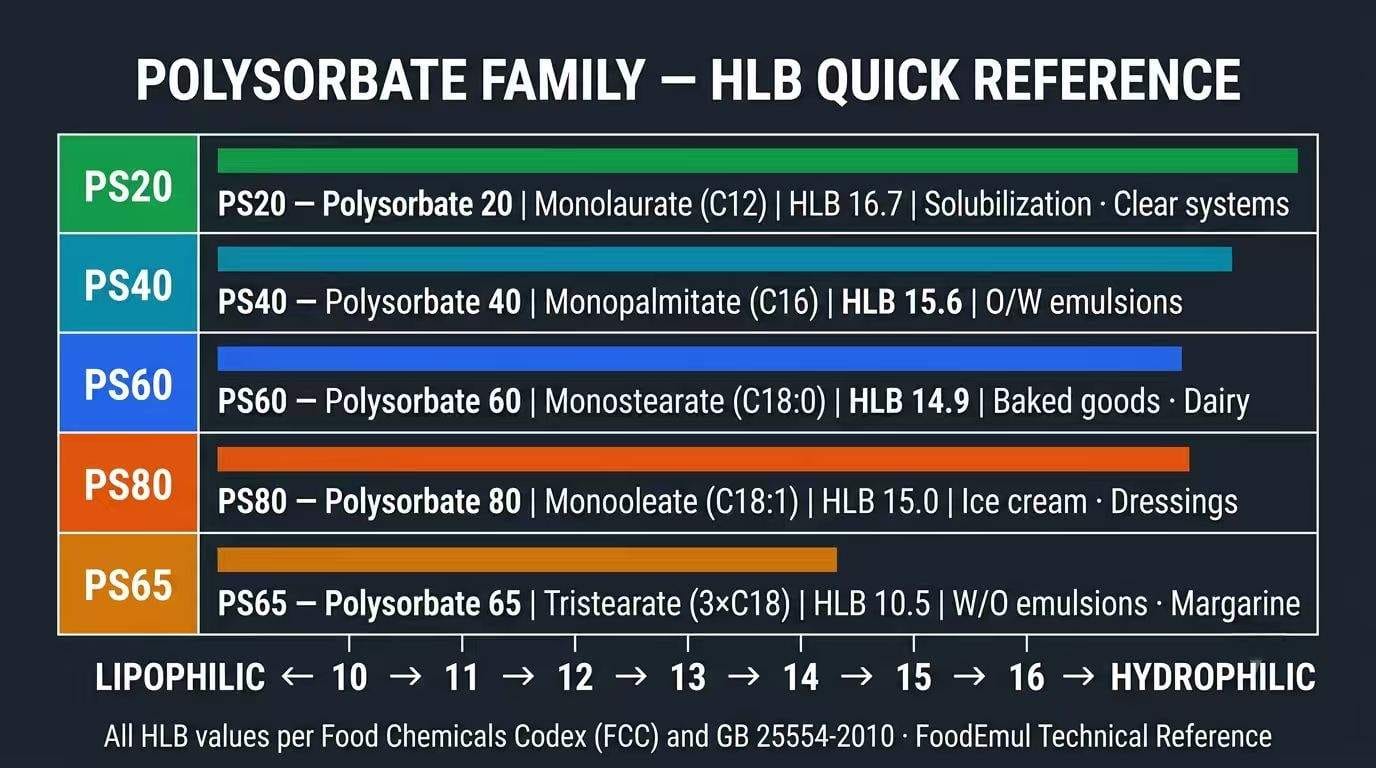
Polysorbate Family HLB Quick-Reference Table
Every polysorbate in the Polysorbate family occupies a specific position on the HLB scale, determined by the fatty acid attached to the polyoxyethylene sorbitan backbone. Understanding where PS60 and Polysorbate 80 sit relative to their siblings helps formulators select the right emulsifier or calculate blend ratios for a target HLB.
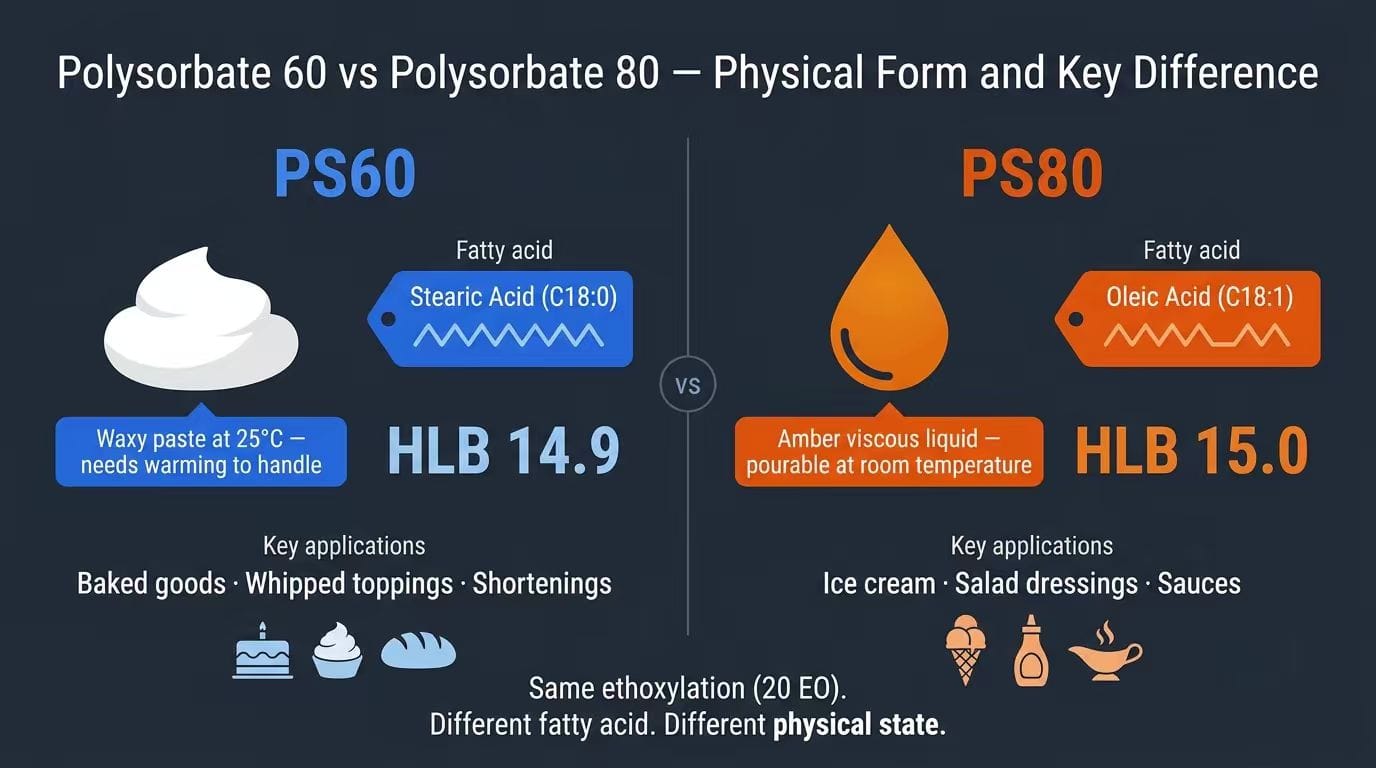
PS60 is esterified with stearic acid (C18 saturated), while Polysorbate 80 uses oleic acid (C18:1 unsaturated). This single unsaturation — a cis double bond at the Δ9 position — is the sole structural difference between the two molecules, yet it shifts the HLB from 14.9 to 15.0 and changes the physical state from a semi-solid paste (PS60) to a liquid (Polysorbate 80) at room temperature.
| Emulsifier | Fatty Acid | HLB | Physical State (25°C) | Primary Role |
|---|---|---|---|---|
| Polysorbate 20 | Lauric (C12) | 16.7 | Oily liquid | Solubilization, clear systems |
| Polysorbate 40 | Palmitic (C16) | 15.6 | Oily liquid | O/W emulsification, moderate HLB |
| Polysorbate 60 | Stearic (C18) | 14.9 | Semi-solid paste/gel | O/W emulsification, aeration |
| Polysorbate 80 | Oleic (C18:1) | 15.0 | Viscous liquid | O/W emulsification, ice cream |
The HLB values above align with the FCC (Food Chemicals Codex) monograph and the EFSA ANS Panel re-evaluation of E432–E436, as documented in the Chinese food emulsifier textbook. The key takeaway for formulators: PS60 and Polysorbate 80 have nearly identical HLB values (14.9 vs 15.0), so the choice between them rarely comes down to HLB alone — it is driven by the physical form (paste vs liquid), the specific fatty acid compatibility with your oil phase, and the application’s texture requirements.
Before diving into a direct comparison, it’s crucial to understand the chemical foundation of the Polysorbate family, commercially known as the Polysorbate series. Polysorbates are non-ionic surfactants produced by the ethoxylation of sorbitan esters. The process begins with a sorbitan ester (a Span series emulsifier), which is then reacted with ethylene oxide. This creates a molecule with a water-loving (hydrophilic) polyoxyethylene head and an oil-loving (lipophilic) fatty acid tail, making them exceptional oil-in-water (O/W) emulsifiers and solubilizers.
The numerical designation (20, 40, 60, 80) in a polysorbate’s name directly corresponds to the type of fatty acid esterified to the sorbitan core:
- Polysorbate 20 (Polysorbate 20): Lauric Acid (C12)
- Polysorbate 40 (Polysorbate 40): Palmitic Acid (C16)
- Polysorbate 60 (Polysorbate 60): Stearic Acid (C18)
- Polysorbate 80 (Polysorbate 80): Oleic Acid (C18:1, monounsaturated)
Beyond the standard 20-EO series, specialty variants include Polysorbate 61 (Polysorbate 61) — a low-EO stearate with lower water solubility — and Polysorbate 65 (Polysorbate 65), a tristearate with an HLB of 10.5 for frozen dessert stabilization. The fatty acid component is the single most important variable dictating the performance differences between each grade.
Polysorbate 60 vs. Polysorbate 80: Key Differences
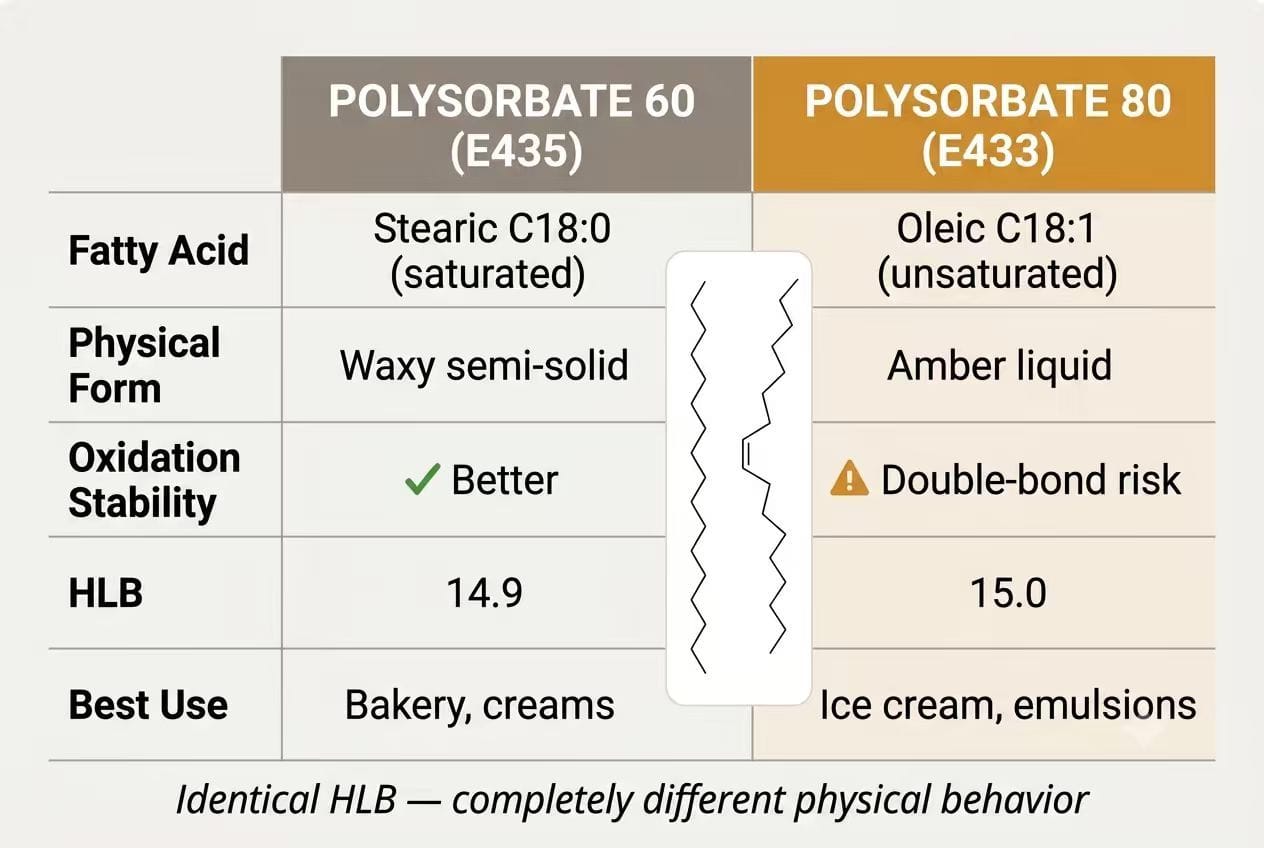
The comparison of polysorbate 60 vs polysorbate 80 is one of the most common queries among formulators.
Fatty Acid Source: Stearate (PS60) vs. Oleate (Polysorbate 80) — The fundamental chemical difference is the fatty acid tail. PS60 uses stearic acid (C18:0, saturated, melting point ~70°C), giving it a waxy semi-solid form at room temperature. Polysorbate 80 uses oleic acid (C18:1, unsaturated, liquid at RT), which keeps it as an amber liquid. This single double-bond in the oleic acid chain explains why Polysorbate 80 stays liquid while PS60 is solid — the cis-double bond creates a kink that prevents crystallization. This also affects oxidation stability: PS60 (saturated) resists rancidity better than Polysorbate 80 (unsaturated).
While chemically similar—both are based on an 18-carbon fatty acid—the presence of a single double bond in Polysorbate 80’s oleic acid tail creates significant functional distinctions.
| Feature | Polysorbate 60 (Polysorbate 60) | Polysorbate 80 (Polysorbate 80) |
|---|---|---|
| Fatty Acid Source | Stearic Acid (Saturated) | Oleic Acid (Unsaturated) |
| Physical Form | Semi-solid / Paste | Viscous Liquid |
| HLB Value | 14.9 | 15.0 |
| Best For | Aeration, Whipping, Bread dough | Solubilizing oils, Clear drinks, Softgels |
| Temperature | Better for high-temp processing | Better for cold-process liquids |
Comparing HLB Values and Emulsification Strength
The Hydrophilic-Lipophilic Balance (HLB) system is a scale that indicates a surfactant’s relative affinity for water or oil. Higher HLB values (8-18) signify better solubility in water and a preference for creating oil-in-water emulsions.
- The polysorbate 60 HLB value is approximately 14.9.
- The HLB value for Polysorbate 80 is approximately 15.0.
With nearly identical HLB values, one might assume they are interchangeable. However, the true difference between polysorbate 60 and 80 lies in their molecular geometry. The saturated, straight-chain stearic acid in Polysorbate 60 allows for tighter packing at the oil-water interface, creating a more rigid, stable film. This is particularly effective for incorporating air and stabilizing crystalline fats. The unsaturated oleic acid in Polysorbate 80 has a “kink” in its chain, creating a less ordered film that is more fluid and adaptable, making it a more efficient emulsifier for a broader range of liquid oils.
Viscosity and Solubility Factors
The structural difference directly impacts the physical properties of these two surfactants. Polysorbate 60 (derived from saturated stearic acid) is typically a waxy, semi-solid paste at room temperature. In contrast, Polysorbate 80 (from unsaturated oleic acid) is a viscous, amber-colored liquid. This makes Polysorbate 80 generally easier to handle, disperse, and incorporate into liquid systems without pre-heating.
In terms of solubility, both are water-soluble. However, Polysorbate 80’s fluid nature often gives it a slight edge in solubilizing actives, flavors, and vitamins in aqueous solutions.
Best Use Cases: When to Swap 60 for 80
Choosing between Polysorbate 60 and 80 depends entirely on the desired function and final product matrix.
Choose Polysorbate 60 for:
- Aeration & Crumb Structure: In baked goods like cakes and breads, its interaction with saturated fats (shortening, butter) creates a fine, uniform crumb structure and improves volume.
- Whipped Toppings & Icings: It promotes and stabilizes the air bubble network, leading to a stiff, stable foam.
- Coffee Whiteners: Provides excellent emulsion stability and whitening power in powdered formulations.
Choose Polysorbate 80 for:
- Salad Dressings & Sauces: Its superior ability to emulsify a wide range of vegetable oils prevents separation and ensures a consistent texture.
- Ice Cream & Frozen Desserts: Controls overrun and creates a smoother texture by preventing the formation of large ice crystals.
- Vitamin & Flavor Solubilization: It is the industry standard for solubilizing fat-soluble vitamins (A, D, E, K) and flavor oils into aqueous systems like beverages and supplements.
Ultimate Guide to Polysorbate 60
New to Polysorbate 60? Explore our comprehensive pillar guide covering properties, technical specifications, and global industry applications of E435.
Ultimate Guide to Polysorbate 80
New to Polysorbate 80? Explore our complete guide covering what it is, how it works, and where it’s used in food, cosmetics, and pharmaceuticals.
Polysorbate 60 vs. Polysorbate 20 and 40
When comparing polysorbate 60 vs polysorbate 20 or polysorbate 60 vs polysorbate 40, the primary differentiator is the length of the fatty acid chain. This has a profound effect on their performance, particularly in solubilization tasks.
The Impact of Fatty Acid Chain Lengths
As the fatty acid chain length decreases (from Stearic C18 in PS60 to Palmitic C16 in PS40, to Lauric C12 in PS20), the molecule becomes progressively more hydrophilic. This is reflected in their HLB values:
- Polysorbate 20 (C12): HLB ≈ 16.7
- Polysorbate 40 (C16): HLB ≈ 15.6
- Polysorbate 60 (C18): HLB ≈ 14.9
A shorter fatty acid tail (lipophile) relative to the large polyoxyethylene head (hydrophile) makes the molecule a more potent solubilizer and less of a traditional emulsifier for heavy oils.
Solubilizing Essential Oils vs. Heavy Fats
This is where the selection becomes clear. Polysorbate 20, with its high HLB and small lipophilic tail, excels at wrapping around small oil molecules. It is the ideal choice for solubilizing essential oils, fragrances, and carrier oils into water-based systems like cosmetic mists, toners, and room sprays. It creates micro-emulsions that appear clear and transparent.
Polysorbate 60, with its longer C18 tail, is much better suited for emulsifying larger, heavier molecules like vegetable oils, butters, and waxes. It creates the classic, milky-white emulsions seen in lotions, creams, and food products. Using Polysorbate 60 to solubilize an essential oil would likely result in a cloudy, unstable mixture, while using Polysorbate 20 to emulsify a heavy vegetable oil would require a very high concentration and yield a weak emulsion.
If you decide Polysorbate 60 is right for your formula, check our Detailed Formulation Guide for best practices. For sourcing, visit the Polysorbate 60 product page or the Polysorbate 80 product page.
Related Reading
- Polysorbate 20 vs. Polysorbate 80: Key Differences
- Span 80 vs. Polysorbate 80: Key Differences and When to Blend
- The Definitive Guide to Span and Polysorbate in Formulations
- Polysorbate 60 Product Specifications & COA
Related: For the complete safety, regulatory, and storage guide, see our Polysorbate 80 Safety & Compliance Guide — covering FDA, EFSA, Halal, Kosher, and shelf-life specifications.
Four-way comparison: For the complete polysorbate family overview comparing Polysorbate 20, 40, 60, and 80 with a decision framework, see our Polysorbate Emulsifiers Complete Guide.
Not sure which Polysorbate fits your system? We manufacture PS60 and Polysorbate 80 alongside Span 60 — reach out for technical guidance or samples.