
Polysorbate 80 in an oil cleanser does one thing no other emulsifier does as well: it rinses clean with water while leaving zero residue. HLB 15.0, liquid at room temperature, compatible with nearly every oil phase — it is the default choice for rinse-off formulations. At FoodEmul, we supply Polysorbate 80 to cosmetic formulators alongside the full sorbitan ester range. This guide covers how it works in oil cleansers, what ratios to use, and how to pair it with Span emulsifiers for balanced cleansing systems.
Why Use Polysorbate 80 for Oil Cleansing?
In cosmetic formulation, the efficacy of a polysorbate 80 oil cleanser relies on surfactant chemistry. While traditional oil cleansing uses “like dissolves like” to solubilize sebum and makeup, it fails at the removal stage — leaving a greasy residue that requires physical scrubbing.
Incorporating polysorbate 80 for oil cleansing transforms a carrier oil into a “hydrophilic oil.” Polysorbate 80 has an HLB of 15.0, indicating strong water affinity. In the bottle, Polysorbate 80 remains dissolved in the oil phase. When water hits the product during rinsing, the surfactant molecules reorient: lipophilic tails anchor into the oil and dissolved sebum, while hydrophilic heads extend into the rinse water. This creates an oil-in-water (O/W) emulsion — micelles that encapsulate dirt and oil, rinsing away cleanly without scrubbing.
Benefits for Makeup Removal and Double Cleansing
- High solubilizing capacity: The oleic acid moiety (C18:1) makes Polysorbate 80 particularly effective at dissolving heavy, oil-based foundations and waterproof mascara — outperforming shorter-chain surfactants like Polysorbate 20 (C12).
- Rinse-off efficacy: Unlike lower HLB surfactants like Span 80, Polysorbate 80 ensures a clean finish.
- Versatility: Compatible with a wide range of carrier oils, from non-polar mineral oils to polar vegetable oils (jojoba, hemp seed). For ultra-mild formulations, Sorbitan Sesquioleate (Span 83) offers a gentler alternative for sensitive skin.
Formulator’s Note: Always verify raw material purity. Foodemul.com Polysorbate 80 meets FCC/USP standards, minimizing by-products that can cause irritation in leave-on facial applications.
Polysorbate 80 vs. Alternatives
| Component | Physical Form | Primary Use | Rinse-Off Profile |
|---|---|---|---|
| Polysorbate 80 | Viscous liquid | Liquid cleansing oils, bath oils | Excellent — turns milky instantly |
| Polysorbate 20 | Thin liquid | Essential oil solubilization, toners | Good, but less effective for heavy oils |
| Cromollient SCE | Liquid | Mild cleansing oils, sensitive skin | Very good — gentler but more expensive |
| Emulsifying Wax NF | Solid waxy pellets | Lotions, creams, solid balms | Requires heating; creates thicker emulsions |
Cromollient SCE vs. Polysorbate 80
Cromollient SCE (Di-PPG-2 Myreth-10 Adipate) is the most common alternative to Polysorbate 80 in oil cleansers. Key differences:
- Mildness: Cromollient SCE is slightly gentler — preferred for ultra-sensitive and baby skincare lines. Polysorbate 80 at 15% can feel slightly drying on very dry skin; Cromollient SCE at the same percentage leaves a softer after-feel.
- Emulsification speed: Polysorbate 80 emulsifies faster and more completely on contact with water. Cromollient SCE produces a slower, creamier emulsification — some formulators prefer this for a more luxurious rinse experience.
- Cost: Cromollient SCE is 3–5× the raw material cost of Polysorbate 80. For commercial-scale production, Polysorbate 80 offers better margin without sacrificing performance for most skin types.
- Viscosity: Polysorbate 80 is noticeably thicker (300–500 mPa·s) — Cromollient SCE is thinner and easier to pour, which simplifies small-batch production.
- Verdict: Use Polysorbate 80 for standard cleansing oils and commercial production. Reserve Cromollient SCE for premium “sensitive skin” lines, baby products, or when the marketing story justifies the cost premium.
For solid formats, emulsifying wax NF remains the standard, but Polysorbate 80 is superior for liquid formulations — it requires no heating (cold process) and maintains the fluidity of the carrier oil.
Safety Profile: Is Polysorbate 80 Non-Comedogenic?
Polysorbate 80 is generally considered low-risk for comedogenicity in rinse-off products. Because it is designed to be washed away completely, it does not remain on the skin long enough to cause pore occlusion. The Cosmetic Ingredient Review (CIR) Expert Panel has concluded Polysorbate 80 is safe for cosmetic use at typical concentrations.
However, comedogenicity in the final product is primarily determined by the carrier oils. For acne-prone formulations, pair Polysorbate 80 with low-comedogenic oils: Hemp Seed Oil, Grapeseed Oil, or Safflower Oil (High Linoleic).
How to Make an Oil Cleanser with Polysorbate 80
Step-by-Step Mixing Protocol
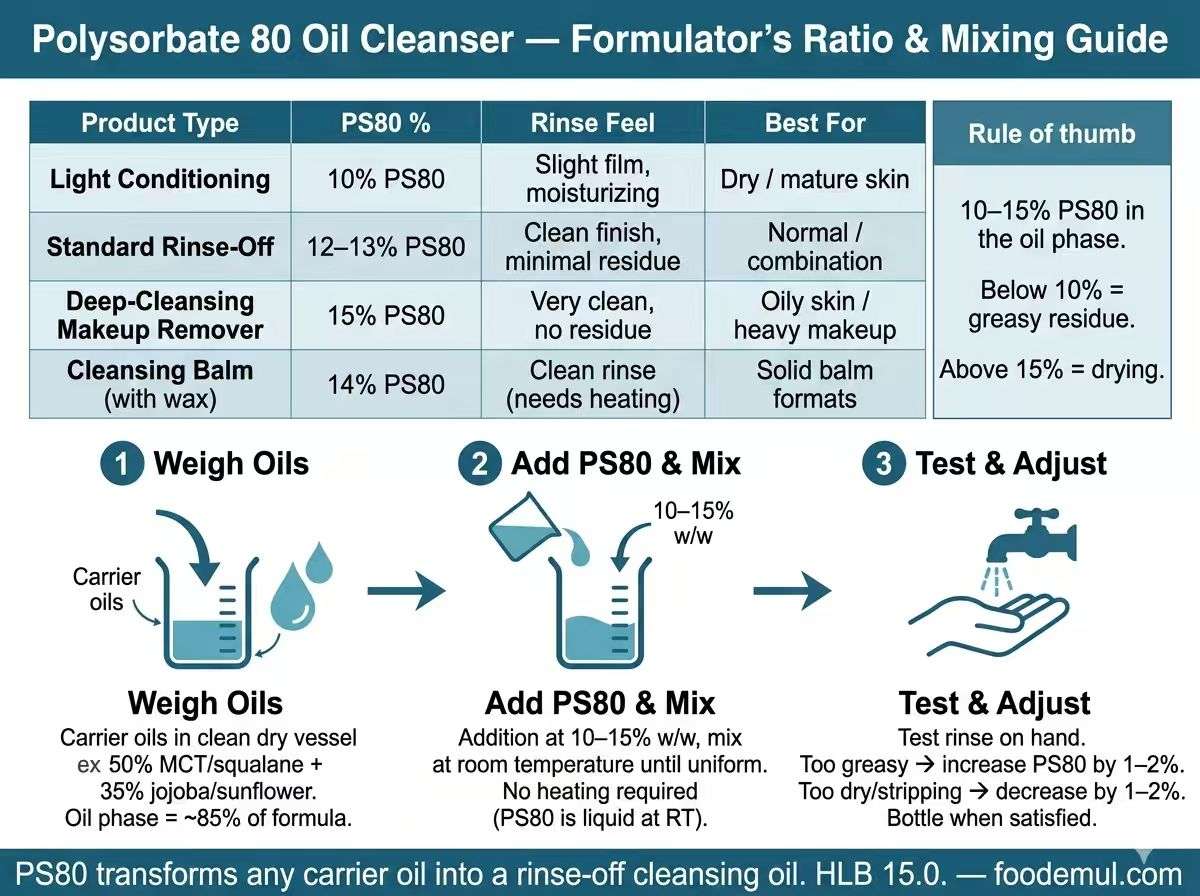
- Weigh your oils: Add carrier oils to a clean, dry vessel. Common blends: 50% lightweight oil (MCT, squalane) + 35% nourishing oil (jojoba, sunflower). This is your oil phase.
- Add Polysorbate 80: Pour in 10–15% Polysorbate 80 (use the Quick Reference table above to choose your ratio). Polysorbate 80 is viscous — pour slowly and scrape the sides.
- Mix thoroughly: Stir by hand for 2–3 minutes, or use an overhead stirrer at 200–400 RPM for 5 minutes. Polysorbate 80 disperses readily but needs adequate agitation for uniform distribution. The mixture should appear clear and homogeneous.
- Add antioxidant: Incorporate 0.5% Tocopherol (Vitamin E) to protect the oleic acid in Polysorbate 80 from oxidation. Stir 1 minute.
- Test: Place a drop of the finished product on your palm, add water, and rub. It should turn milky white immediately and rinse clean.
- Package: Fill into airtight, opaque bottles. Protect from UV light to extend shelf life (Polysorbate 80’s unsaturated tail is photosensitive).
Standard Liquid Cleanser Formula
| Phase | Ingredient | % | Function |
|---|---|---|---|
| A | Caprylic/Capric Triglycerides (MCT) | 50.0% | Lightweight carrier |
| A | Sunflower or Jojoba Oil | 34.5% | Nourishing lipid |
| A | Polysorbate 80 | 15.0% | Emulsifier / solubilizer |
| B | Tocopherol (Vitamin E) | 0.5% | Antioxidant |
Procedure: Combine all Phase A ingredients, stir until clear. Add Phase B, mix. No heat required. Scale linearly for production batches.
Cleansing Balm Formula
For a solid balm format, add a wax thickener and apply gentle heat:
- Carrier oils: 70% (e.g., 40% MCT + 30% shea butter or camellia oil)
- Thickener: 15% cetyl alcohol or emulsifying wax NF
- Polysorbate 80: 14%
- Antioxidant: 1% Tocopherol
Heat oils and wax to 70°C until fully melted. Cool to 40°C, add Polysorbate 80 and antioxidant while stirring. Pour into jars before the mixture sets.
Troubleshooting
Separation or cloudiness in the bottle
- Check oil polarity: Highly polar oils may require a co-emulsifier or slight adjustment in Polysorbate 80 ratio. If cloudiness appears, increase Polysorbate 80 by 1–2%.
- Water contamination: Even trace moisture can trigger premature emulsification inside the bottle. Ensure all equipment is bone-dry before production.
- Insufficient mixing: Polysorbate 80 is viscous — it needs 3–5 minutes of thorough agitation to disperse evenly in light carrier oils. A quick stir is not enough.
Greasy residue after rinsing
Increase Polysorbate 80 by 2–3%. If residue persists above 15%, the carrier oil blend may be too heavy — replace a portion with a lighter oil like MCT or squalane.
Product feels drying
Reduce Polysorbate 80 to 10% and increase the nourishing oil fraction. Alternatively, switch to Cromollient SCE for a milder surfactant profile.
Frequently Asked Questions
How much polysorbate 80 to use in an oil cleanser?
The standard range is 10–15% of the total formula. At 10%, a slight conditioning film remains — desirable for dry skin. At 15%, the rinse is completely clean — ideal for oily skin or heavy makeup. Exceeding 20% provides no additional benefit and may strip the skin barrier.
What does polysorbate 80 do in skincare?
Polysorbate 80 acts as a solubilizer and emulsifier. It allows oil-based ingredients to mix with water. In cleansers, it turns the oil into a milky emulsion upon water contact, enabling rinse-off removal without residue.
Can polysorbate 80 emulsify oil and water?
Yes — this is its primary function. With an HLB of 15.0, Polysorbate 80 is a strong O/W emulsifier. It surrounds oil droplets with a hydration shell, allowing them to disperse freely in water and rinse away.
How to mix oil and water with polysorbate 80?
Polysorbate 80 does not mix oil and water directly — it emulsifies them at the moment of rinsing. In the bottle, Polysorbate 80 stays dissolved in the oil phase. When the user adds water, the emulsion forms instantly at the skin surface. For formulations that deliberately contain both oil and water phases (like lotions), follow the standard O/W emulsification protocol: dissolve Polysorbate 80 in the water phase at 60–70°C, then add the oil phase under high-shear mixing.
What happens without an emulsifier?
Without Polysorbate 80, you’re applying pure oil. It dissolves makeup but water cannot rinse it off. The user must scrub with a hot cloth, which can irritate skin. Non-emulsified oil can remain trapped in pores, leading to congestion.
Related Resources
- Polysorbate 80 technical specifications: Polysorbate 80 Technical Guide
- Polysorbate 80 safety & compliance: Polysorbate 80 Safety & Compliance
- Product page (TDS, SDS): Polysorbate 80
- Span & Polysorbate system: Span & Polysorbate Formulators Guide
Contact FoodEmul.com for high-purity Polysorbate 80, batch-specific CoA, or to discuss your cosmetic formulation requirements.
Need Polysorbate 80 for cosmetic formulations? We manufacture food-grade and technical-grade material — reach out for specifications or samples.