

A new shipment arrives. The product name is right, the COA carries a red stamp, and the final line says “Pass.” It is tempting to file the document and release the batch.
After two decades of working with chemical export documents, I have learned to read that final line last. Approval depends on the rows above it: the product identity, batch number, specification, actual result, unit, and test method. One mismatch is enough to stop the review.
Food emulsifiers need a product-specific check. A polysorbate and a sorbitan fatty acid ester may share several familiar parameters, but they do not share one universal test panel. Grade, production route, agreed specification, and destination market all affect what the buyer needs to see.
This food emulsifier COA checklist is designed for importers, procurement teams, formulators, distributors, and quality staff reviewing a batch before shipment or use.
Quick review rule: Match the COA to the physical lot. Confirm the product and grade. Read every result against the applicable limit, then resolve any inconsistency before release.
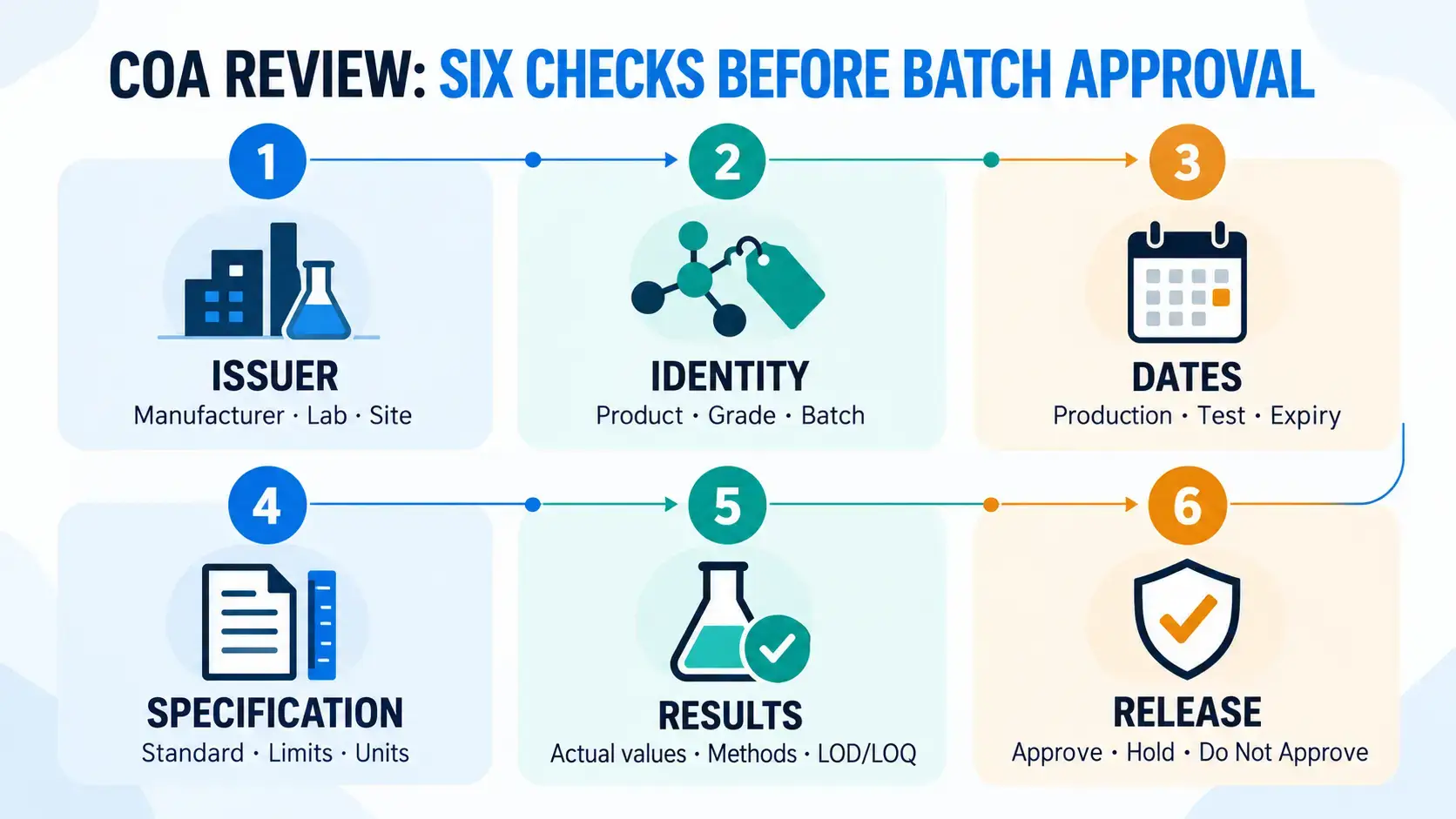
What a COA Can Show
A batch-specific COA records the tests reported for a stated lot or sample. It helps a buyer confirm:
- the identity of the reported product and batch;
- the specification used for release;
- the parameters tested;
- the reported result for each parameter;
- the method used for testing; and
- the manufacturer’s or laboratory’s release decision.
The document covers only the stated sample and reported parameters. It cannot establish that every package is identical or that an untested contaminant is absent. Keep the approved specification, Technical Data Sheet, Safety Data Sheet, relevant certificates, and supplier-qualification records in the same review file.
The U.S. FDA identifies a COA as one possible record of supplier sampling and testing. The receiving facility still needs to review and assess the documentation. FDA guidance also points to the importance of scientifically valid methods, representative sampling, and suitable method sensitivity.
Chinese National Standards and International Specifications
Chinese food emulsifier manufacturers commonly produce and release material against the applicable national food-safety standard. Examples include:
- GB 29221-2012 for polyoxyethylene (20) sorbitan monolaurate;
- GB 25553-2010 for polyoxyethylene (20) sorbitan monostearate;
- GB 25554-2010 for polyoxyethylene (20) sorbitan monooleate; and
- GB 13481-2011 for sorbitan monostearate.
These standards define product scope, quality parameters, limits, and test methods. For example, the official text of GB 29221-2012 specifies acid value, saponification value, hydroxyl value, water, ignition residue, lead, and oxyethylene-group content for polyoxyethylene (20) sorbitan monolaurate. GB 13481-2011 specifies fatty acids, polyols, acid value, saponification value, hydroxyl value, water, arsenic, and lead for sorbitan monostearate.
China’s food-additive standards have developed over several decades alongside international compendia. The official Chinese standards database records that the 1992 predecessor standard for sorbitan monostearate non-equivalently adopted FCC III:1981. Current Chinese standards, JECFA specifications, FCC monographs, and European Union specifications remain separate documents. Similar parameters or limits should not be presented as automatic legal equivalence.
Production equipment, plant hygiene, process control, and laboratory capability in China have advanced considerably over the past three to four decades. Qualified manufacturers can meet demanding international buyer specifications. The useful proof is current and specific: facility information, an agreed specification, suitable test methods, and results from the batch being offered. “International quality” on a brochure cannot replace that evidence.
The 12 Fields to Verify
1. Manufacturer, Testing Entity, and Issuer
Identify the manufacturer, testing laboratory, and COA issuer. They may be the same organisation, but the document should make their roles clear.
Compare the legal entity and manufacturing site with the approved supplier file, quotation, specification, and package label. When an exporter or distributor provides the COA, ask whether the results came from the manufacturer’s laboratory or an independent laboratory.
Hold the batch if the site is missing, the source of the data is unclear, or the entity names conflict.
2. Exact Product Identity and Grade
The material description must separate the ordered product from related emulsifiers and non-food grades. Look for:
- the standard chemical name;
- product or material code;
- food grade or other agreed grade;
- applicable INS, E-number, or CAS identifier when relevant; and
- any buyer-approved internal specification code.
A broad family name or series code may leave too much room for error. Similar emulsifiers can differ in fatty acid composition, degree of ethoxylation, quality limits, and permitted uses.
3. Batch or Lot Number
The batch number connects the paper to the material. Compare it with:
- the label on the drum, bag, or intermediate bulk container;
- the packing list;
- the invoice or shipment record;
- the retained sample record; and
- the receiving inspection record.
If the batch numbers differ, request the correct COA before release.
4. Quantity and Shipment Link
Check the batch quantity or another clear link to the shipment. If one production batch is split across several deliveries, the supplier should be able to trace each package back to the released lot.
An empty quantity field weakens traceability. Resolve it through the packing list, batch-release record, or supplier confirmation.
5. Production Date
Compare the production date with the batch-number format and package label.
Investigate future dates, impossible sequences, and differences between the COA and the package. Copied templates sometimes preserve an old date after the batch number changes.
6. Inspection, Issue, Expiry, and Retest Dates
Keep these dates separate:
- Production date: when the batch was manufactured.
- Inspection date: when the reported sample was tested.
- Issue or approval date: when the COA was released.
- Expiry date: the stated end of shelf life.
- Retest date: the date after which the material requires review or testing under the supplier’s stated programme.
“Shelf life: 12 months” gives a duration. The reviewer should still calculate or obtain the exact end date and confirm that the planned use falls within it.
7. Applicable Specification and Revision
The COA should name the standard or approved specification used for release. This may be a Chinese national standard, a current supplier specification, a customer specification, or an agreed combination.
Record the standard number and revision or approval date. A familiar template may still refer to an obsolete specification.
For export orders, compare the following four references:
- the supplier’s release specification;
- the purchase contract or approved buyer specification;
- the applicable requirements in the country of manufacture; and
- the destination-market or customer-specific requirements.
8. Complete, Product-Specific Test Panel
More rows do not make a better COA. The test panel must fit the emulsifier and the buyer’s approval decision.
Commonly reported parameters for polysorbates may include appearance, acid value, saponification value, hydroxyl value, water, ignition residue, oxyethylene-group content, and specified elemental impurities. Commonly reported parameters for sorbitan fatty acid esters may include appearance, fatty acid content, polyol content, acid value, saponification value, hydroxyl value, water, and specified elemental impurities.
Use the approved product specification to decide which parameters need batch results and which may be verified periodically or in a separate report.
9. Units and Reporting Basis
A result needs a unit and a clear reporting basis. Common examples include:
- mg KOH/g for acid, saponification, and hydroxyl values;
- percent by mass for water, fatty acid, polyol, or oxyethylene-group content; and
- mg/kg for lead, arsenic, residual substances, or other trace analytes.
Results on an anhydrous basis may differ from results reported as received. The COA and specification must use comparable bases.
10. Actual Results Versus Acceptance Limits
Read every row before reading the release conclusion.
For each parameter, confirm that:
- a specification limit or range is stated;
- an actual numeric or qualitative result is reported;
- the result falls within the stated limit;
- the unit matches the specification; and
- the result also meets the buyer’s approved requirement.
In one document reviewed for this article, a result appeared to fall outside the limit printed in the same row. The COA still ended with “Pass.” We could not tell from the page whether the result, the limit, or the data entry was wrong. The batch should remain on hold until the issuer provides a corrected COA or a written technical explanation.
11. Test Method and Reporting Limit
The method reference tells the reviewer how the laboratory obtained the result and whether it can be compared with the required limit. Check for:
- a national, compendial, or recognised method number;
- an identified in-house method where applicable;
- the method version or specification reference;
- suitable sensitivity for the required limit; and
- the reporting limit for “not detected” results.
“Not detected” means the analyte was below the method’s reported detection capability. Ask for the limit of detection or quantification when that threshold affects acceptance.
For ethoxylated emulsifiers, oxyethylene-group content and residual free ethylene oxide are different parameters. The first describes product composition. It cannot establish the residual level of unreacted ethylene oxide. If the destination specification, including the relevant European Union food-additive specification, controls ethylene oxide, 1,4-dioxane, ethylene glycols, or another process-related impurity, request that result and method by name.
12. Review, Approval, and Authenticity
Confirm that the COA is dated, approved, and traceable to the issuer. Review the inspector, reviewer, and authorised approver fields.
Possible verification controls include:
- confirmation through the manufacturer’s document system;
- a supplier verification portal or QR code;
- confirmation from an authorised quality contact;
- comparison with the approved COA template; and
- controlled retention of the original file and any corrected version.
A stamp supports document control. It cannot correct a wrong batch number, missing test, or out-of-limit result.
Five Red Flags That Require Clarification
| Red flag | What to do |
|---|---|
| The COA belongs to another batch | Request the document for the shipped lot. |
| Product identity or grade is unclear | Ask for the agreed chemical identity, grade, and product code. |
| A result falls outside the printed limit | Hold the batch and ask the issuer to correct or explain the inconsistent field. |
| A critical result says only “Complies” | Check whether a conformity statement is allowed; otherwise request the actual result. |
| “Not detected” has no method or reporting limit | Obtain the method and reporting capability before using the result for a safety or regulatory decision. |
Approve, Hold, or Do Not Approve
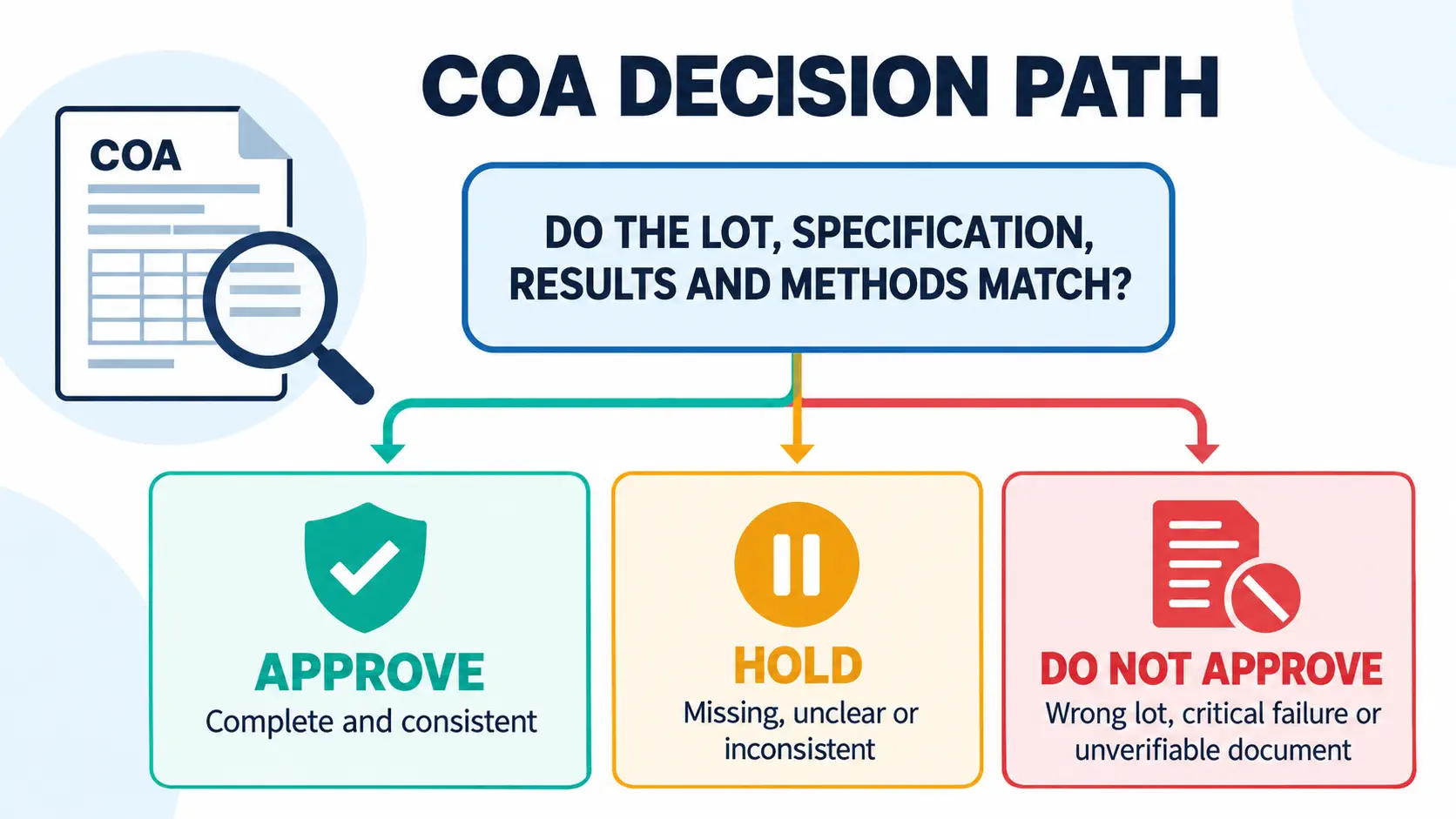
| Decision | Practical rule |
|---|---|
| Approve | Product identity, lot, dates, specification, required test panel, units, methods, results, and authorisation are complete and consistent with the approved purchase requirements. |
| Hold for clarification | The COA contains an empty field, ambiguous identity, unclear method, missing reporting limit, date problem, or internal inconsistency that the issuer may be able to correct. |
| Do not approve | The document belongs to the wrong lot, a critical result is outside the agreed limit, required evidence is missing, or the document cannot be authenticated. Follow the buyer’s nonconformance and supplier-corrective-action procedure. |
Copyable COA Review Checklist
| Review item | Status | Evidence or comment |
|---|---|---|
| Manufacturer, testing entity, and issuer confirmed | ☐ | |
| Exact product identity and grade confirmed | ☐ | |
| Batch number matches labels and shipment documents | ☐ | |
| Quantity or shipment link confirmed | ☐ | |
| Production date verified | ☐ | |
| Inspection, issue, expiry, or retest dates verified | ☐ | |
| Applicable specification and revision confirmed | ☐ | |
| Required product-specific tests are present | ☐ | |
| Units and reporting basis are clear | ☐ | |
| Every result meets the agreed limit | ☐ | |
| Test methods and reporting limits are adequate | ☐ | |
| Approval and document authenticity confirmed | ☐ |
Record the reviewer, review date, decision, open questions, supplier response, and final disposition in the receiving or supplier-approval file.
Frequently Asked Questions
Is a COA the same as a product specification?
No. A specification defines the limits or requirements a product is expected to meet. A batch COA reports the results stated for a specific lot and compares them with the release specification.
Can a historical COA be used before placing an order?
A historical COA can show the supplier’s typical document format and reported test panel. It cannot replace the current COA for the batch that will be shipped.
Does a COA prove compliance with every international market?
No. A COA supports only the parameters, methods, limits, and batch identified in the document. The buyer must compare it with the requirements of the intended market and use.
Should all food emulsifier COAs contain the same tests?
No. Polysorbates, sorbitan fatty acid esters, lecithins, mono- and diglycerides, and other emulsifiers have different identities, production routes, and risk profiles. Use a product-specific approved specification.
Is the supplier’s “Pass” conclusion enough?
No. The reviewer should confirm that each required result falls within the applicable limit and that the document matches the physical batch.
Review the COA Against the Shipment
Put four documents side by side: the current COA, approved specification, package label, and packing list. The product identity, batch number, dates, quantity, and release basis should tell one consistent story. Any difference belongs in the review record, together with the supplier’s correction or explanation.
For a FoodEmul document review, provide the product name, grade, destination market, required standard, and expected order quantity. We can then identify which specifications and batch documents should be requested before quotation, sampling, or shipment.
