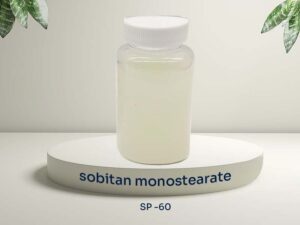

If you’re importing Span and polysorbate emulsifiers into the EU or US, the first question is always the same: do products manufactured under Chinese GB standards meet FCC and EU requirements? The short answer: yes — when manufactured to spec. Below you’ll find the exact parameter comparisons across GB, EU, and FCC standards for every polysorbate and sorbitan ester.
At FoodEmul, our Span and polysorbate series align GB 25553-2010 with EU Regulation No 231/2012 and FDA 21 CFR. Every E-number on our TDS is backed by chemical data.

EU Purity Standards — Polysorbate Series (E431–E436)
These are the EU purity criteria every polysorbate must meet for E-number designation:
| Parameter | E431 (PS40 stearate) | E432 (PS20) | E433 (PS80) | E434 (PS40) | E435 (PS60) | E436 (PS65) |
|---|---|---|---|---|---|---|
| Water content | ≤ 3% | ≤ 3% | ≤ 3% | ≤ 3% | ≤ 3% | ≤ 3% |
| Acid value | ≤ 1 | ≤ 2 | ≤ 2 | ≤ 2 | ≤ 2 | ≤ 2 |
| Saponification value | 25–35 | 40–50 | 45–55 | 41–52 | 45–55 | 88–98 |
| Hydroxyl value | 27–40 | 96–108 | 65–80 | 90–107 | 81–96 | 40–60 |
| 1,4-Dioxane | ≤ 5 mg/kg | ≤ 5 mg/kg | ≤ 5 mg/kg | ≤ 5 mg/kg | ≤ 5 mg/kg | ≤ 5 mg/kg |
| Ethylene oxide | ≤ 0.2 mg/kg | ≤ 0.2 mg/kg | ≤ 0.2 mg/kg | ≤ 0.2 mg/kg | ≤ 0.2 mg/kg | ≤ 0.2 mg/kg |
| Ethylene glycols | ≤ 0.25% | ≤ 0.25% | ≤ 0.25% | ≤ 0.25% | ≤ 0.25% | ≤ 0.25% |
| Arsenic (As) | ≤ 3 mg/kg | ≤ 3 mg/kg | ≤ 3 mg/kg | ≤ 3 mg/kg | ≤ 3 mg/kg | ≤ 3 mg/kg |
| Lead (Pb) | ≤ 2 mg/kg | ≤ 2 mg/kg | ≤ 2 mg/kg | ≤ 2 mg/kg | ≤ 2 mg/kg | ≤ 2 mg/kg |
| Mercury (Hg) | ≤ 1 mg/kg | ≤ 1 mg/kg | ≤ 1 mg/kg | ≤ 1 mg/kg | ≤ 1 mg/kg | ≤ 1 mg/kg |
| Cadmium (Cd) | ≤ 1 mg/kg | ≤ 1 mg/kg | ≤ 1 mg/kg | ≤ 1 mg/kg | ≤ 1 mg/kg | ≤ 1 mg/kg |
EU Purity Standards — Sorbitan Ester Series (E491–E495)
| Parameter | E491 (Monostearate) | E492 (Tristearate) | E493 (Monolaurate) | E494 (Monooleate) | E495 (Monopalmitate) |
|---|---|---|---|---|---|
| Water content | ≤ 2% | ≤ 2% | ≤ 2% | ≤ 2% | ≤ 2% |
| Sulphated ash | ≤ 0.5% | ≤ 0.5% | ≤ 0.5% | ≤ 0.5% | ≤ 0.5% |
| Acid value | ≤ 10 | ≤ 15 | ≤ 7 | ≤ 8 | ≤ 10 |
| Saponification value | 147–157 | 176–188 | 158–170 | 145–160 | 140–155 |
| Hydroxyl value | 235–260 | 66–80 | 330–358 | 193–210 | 270–305 |
| Arsenic (As) | ≤ 3 mg/kg | ≤ 3 mg/kg | ≤ 3 mg/kg | ≤ 3 mg/kg | ≤ 3 mg/kg |
| Lead (Pb) | ≤ 2 mg/kg | ≤ 2 mg/kg | ≤ 2 mg/kg | ≤ 2 mg/kg | ≤ 2 mg/kg |
| Mercury (Hg) | ≤ 1 mg/kg | ≤ 1 mg/kg | ≤ 1 mg/kg | ≤ 1 mg/kg | ≤ 1 mg/kg |
| Cadmium (Cd) | ≤ 1 mg/kg | ≤ 1 mg/kg | ≤ 1 mg/kg | ≤ 1 mg/kg | ≤ 1 mg/kg |
GB vs. FCC vs. EU: Key Parameter Alignment
Chinese GB 25553-2010 (Polysorbates) and GB standards for sorbitan esters specify purity parameters that align with both FCC and EU requirements. The three standards share the same core testing methodology and acceptance criteria for:
- Saponification, acid, and hydroxyl values — confirming correct esterification and ethoxylation
- Heavy metal limits (As, Pb, Hg, Cd) — at or below EU thresholds
- 1,4-Dioxane and ethylene oxide residuals — removed by vacuum stripping to ≤ 5 mg/kg and ≤ 0.2 mg/kg respectively
- Water content — strictly controlled below FCC/EU maxima
For formulators and importers, the key verification point: confirm your supplier’s CoA cites the relevant GB standard and shows values within FCC/EU ranges. Don’t assume — check.
Acceptable Daily Intake (ADI) — Global Consensus
| Regulatory Body | Span ADI | polysorbate ADI | Basis |
|---|---|---|---|
| EFSA (EU) | 10 mg/kg bw/day (as sorbitan esters total) | 10 mg/kg bw/day (as polysorbates total) | Combined group ADI |
| JECFA (WHO/FAO) | 0–25 mg/kg bw/day | 0–25 mg/kg bw/day | Individual ADI |
| FDA (US) | Not specified — GRAS, application limits apply | Not specified — GRAS, application limits apply | 21 CFR 172.840–172.842 |
| FSSAI (India) | Aligns with Codex | Aligns with Codex | INS numbers adopted |
Global Approval Status by Region
- EU: All Span (E491–E495) and polysorbate (E432–E436) approved under Regulation (EC) No 1333/2008. Quantum satis in most categories; specific limits in Annex II.
- USA: GRAS under 21 CFR 172.840–172.842. Application-specific limits for each polysorbate and sorbitan ester.
- Codex Alimentarius: INS 432–436 (polysorbates), INS 491–495 (sorbitan esters). Listed in GSFA with category-specific maximum use levels.
- China: GB 2760-2024 governs use levels. GB 25553-2010 and related standards specify purity. Both series approved for food use.
- Japan: Approved food additives under MHLW specifications.
- MERCOSUR: Approved under harmonized Mercosur food additive regulations.
- Halal / Kosher: Certifiable in all regions — no animal-derived raw materials. FoodEmul products carry Halal (MUI, Indonesia) and Kosher certification.
Our Certification Approach
For individual product limits, see our Span 60 Limits, PS60 Limits, and PS80 Specifications.
FoodEmul’s compliance documentation package for international buyers includes:
- Certificate of Analysis (CoA) — GB-referenced with FCC/EU parameter cross-reference
- Halal Certificate (MUI, Indonesia)
- Kosher Certificate
- Technical Data Sheet (TDS) with E-number designations
- Safety Data Sheet (SDS) per GHS
For import clearance, our CoA format includes the relevant GB standard reference and explicit confirmation that the measured values fall within FCC and EU limits. This format has been accepted by EU and US customs without additional testing requirements.
Key Takeaways
- GB 25553-2010 aligns with FCC and EU (EC) No 231/2012 on all critical purity parameters for polysorbates and sorbitan esters.
- Heavy metal limits (As ≤ 3, Pb ≤ 2, Hg/Cd ≤ 1 mg/kg) are consistent across all three standards.
- ADI is harmonized at 10 mg/kg bw/day (EFSA) to 25 mg/kg bw/day (JECFA) across major regulatory bodies.
- Always verify your supplier’s CoA explicitly references the relevant standard and shows values within target ranges.
This guide references EU Regulation (EC) No 1333/2008, EU Regulation (EU) No 231/2012, FDA 21 CFR 172.840–172.842, GB 25553-2010, GB 2760-2024, Codex GSFA, and JECFA monographs. For your specific regulatory jurisdiction, consult your compliance officer or emulsifier supplier’s regulatory team.