
Estimated reading time: 12 minutes
In this guide:
- Why meat products are fundamentally emulsion systems — and why that emulsion breaks down
- The protein matrix: how myofibrillar proteins, fat, and water form the structure of sausage and processed meat
- Emulsifier selection for meat: E471 (GMS/DMG), SSL, CSL, DATEM, CITREM, lecithin, and GML
- Application-by-application guidance: sausages, deli meats, hot dogs, luncheon meats, canned meat, pâté
- Specialty emulsifiers: GML’s dual emulsifier + antimicrobial function and where it fits
- Process control essentials: temperature, salt levels, protein extraction, mixing sequence
- Troubleshooting: fatting out, cooking loss, texture defects, batch inconsistency
1. Meat Products Are Emulsions — Whether You Think of Them That Way or Not
A sausage, a hot dog, a slice of bologna — these are not simply chopped meat in a casing. They are structured emulsion systems in which fat droplets are dispersed in a continuous phase of water and protein. The myofibrillar proteins (actin and myosin) extracted from lean meat during mixing with salt form a three-dimensional gel network that encapsulates fat particles and immobilizes water.
When this system holds, the result is a firm, juicy, sliceable product with good yield. When it breaks — and it often does — fat pools under the casing, water escapes as cooking loss, texture becomes crumbly or rubbery, and yield drops by 5-15%.
Emulsifiers in meat processing do not replace the protein matrix. They support it — by reducing interfacial tension at the fat-water boundary, promoting finer fat dispersion, strengthening the protein gel network, and improving heat stability during cooking.
If you are new to emulsifier fundamentals, start with our guide to food emulsifier functions.
2. The Meat Emulsion System: How It Works — and Fails
2.1 The Protein Matrix
Meat emulsions depend on myofibrillar proteins extracted from lean meat:
- Salt (1.5-2.5%) solubilizes myosin and actin from muscle tissue during mixing/chopping.
- These proteins unfold and re-associate into a continuous gel network.
- Fat droplets become trapped within this network, with a protein film forming at the fat-water interface.
- During cooking (68-72°C), the protein gel sets irreversibly, locking fat and water in place.
2.2 Why It Breaks Down
| Failure Point | What Goes Wrong | Visible Result |
|---|---|---|
| Insufficient protein extraction | Salt too low, mixing too short, or meat too warm | Weak gel, fat separation during cooking |
| Fat melting before gel sets | Batter temperature exceeds 12-15°C during chopping | Fat smearing, greasy surface, fat caps under casing |
| Over-chopping | Excessive shear breaks the protein network before it can set | Soft, mushy texture even after cooking |
| Thermal shock | Cooking temperature ramps too fast; outer layer sets before interior | Fat pocketing in center, uneven texture |
| Fat-to-lean ratio imbalance | Too much fat for the available protein to encapsulate | Fatting out, poor sliceability |
3. Emulsifier Selection for Meat and Processed Foods
3.1 E471 — Mono- and Diglycerides (GMS/DMG)
The most widely used emulsifier in processed meat. E471 improves fat dispersion by reducing interfacial tension, helping fat droplets break into smaller, more uniformly distributed particles that the protein matrix can encapsulate.
Typical dosage: 0.2-0.5% of total batter weight
Best for: All comminuted meat products — sausages, frankfurters, bologna, luncheon meats
Function: Fat dispersion, reduced fatting out, improved sliceability
3.2 SSL — Sodium Stearoyl Lactylate (E481)
SSL interacts directly with meat proteins through ionic binding, strengthening the gel network. This improves heat stability during cooking, reduces cooking loss, and increases firmness and elasticity of the finished product.
Typical dosage: 0.2-0.5% of total batter weight
Best for: Lower-fat formulations where protein plays a larger structural role; emulsified sausages requiring firm bite; products with extended thermal processing
Function: Protein network strengthening, cooking loss reduction, improved firmness
3.3 CSL — Calcium Stearoyl Lactylate (E482)
CSL provides a milder protein interaction than SSL, making it suitable where a softer texture is desired. The calcium ion contributes additional protein cross-linking potential, supporting water retention.
Typical dosage: 0.2-0.5% of total batter weight
Best for: Coarse-textured sausages, products where excessive firmness is undesirable
Function: Moderate protein reinforcement, water retention, softer gel texture
3.4 DATEM — Diacetyl Tartaric Acid Esters of Mono- and Diglycerides (E472e)
DATEM strengthens the interfacial protein film around individual fat droplets, providing additional heat stability. This is especially valuable in cooked or smoked sausages exposed to prolonged thermal processing where the natural protein film is stressed.
Typical dosage: 0.2-0.4% of total batter weight
Best for: Cooked/smoked sausages, retorted canned meats, frankfurters with extended hold times
Function: Interfacial film strengthening, heat stability, emulsion integrity during extended cooking
3.5 CITREM — Citric Acid Esters of Mono- and Diglycerides (E472c)
CITREM provides both emulsification and a mild pH-lowering effect, useful where emulsion stability and microbial control intersect. In processed meat, CITREM helps disperse fat while the acidity contributes to protein coagulation characteristics.
Typical dosage: 0.2-0.5% of total batter weight
Best for: Emulsified sausages, canned meat products, pH-sensitive formulations
3.6 Lecithin (E322)
Lecithin is valued in meat processing for its clean-label positioning — it is the emulsifier consumers recognize. It stabilizes the fat-water interface and is often combined with E471 to balance functionality and labeling requirements.
Typical dosage: 0.2-0.5% of total batter weight
Best for: Clean-label or natural-positioned meat products, premium sausages
Limitation: Less effective than SSL/DATEM at high cooking temperatures; best in moderate-heat applications
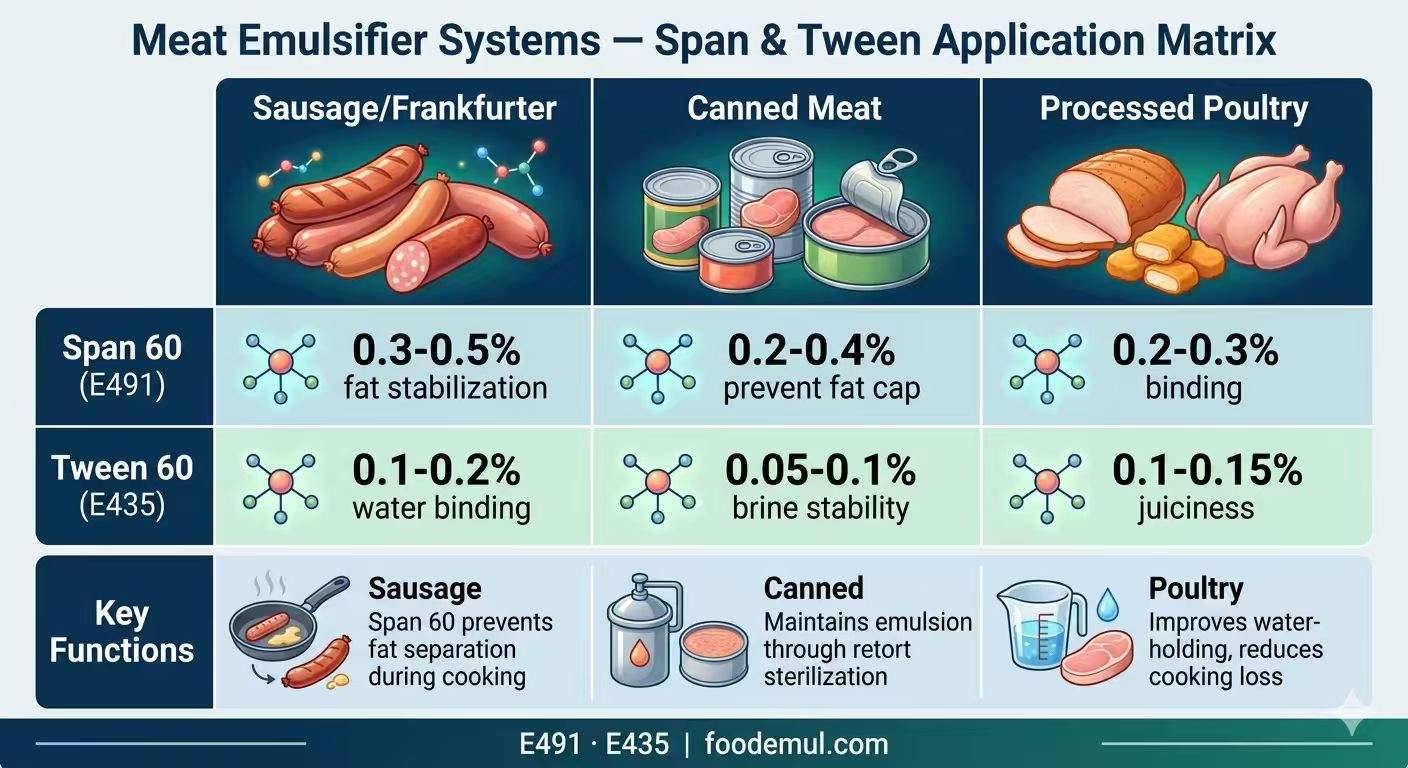
3.7 The Span/Tween Role in Meat
Span and Tween emulsifiers are less commonly used in traditional meat processing than E471, SSL, and DATEM — the ionic emulsifiers interact more directly with meat proteins. However, Span 60 (E491) has a role in specific applications:
- Fat pre-emulsification: Span 60 can pre-stabilize fat before it enters the meat batter, creating a more stable fat phase that the protein matrix can encapsulate more reliably.
- Processed meat spreads and pâtés: Where a W/O or mixed emulsion structure is desired, Span 60 at 0.1-0.3% provides fat structuring.
- Low-fat processed meat: Span 60’s fat-crystal-structuring capability helps build body when fat content is reduced.
For Span/Tween science, see our formulators guide.
4. Specialty Emulsifier: Glyceryl Monolaurate (GML)
Glyceryl Monolaurate (GML, also called monolaurin) is a monoester of glycerol and lauric acid (C12:0), naturally present in coconut oil. It is the only food emulsifier that provides both emulsification and demonstrated antimicrobial activity — a dual function that makes it strategically valuable in processed meat.
4.1 Antimicrobial Mechanism
GML disrupts the cell membrane of Gram-positive bacteria, including key meat safety pathogens:
- Listeria monocytogenes — the pathogen of highest concern in ready-to-eat (RTE) deli meats
- Staphylococcus aureus — salt-tolerant, survives in processed meat
- Bacillus species — spore-formers that survive cooking
By incorporating into bacterial cell membranes, GML increases membrane permeability, causing leakage of cellular contents and cell death. This mechanism is physical rather than metabolic, meaning resistance development is less of a concern than with conventional preservatives.
4.2 Practical Benefits in Meat Processing
| Benefit | How GML Delivers It |
|---|---|
| Shelf life extension | Slows microbial growth in vacuum-packed RTE meats |
| Cleaner label | Reduces or eliminates synthetic preservatives (nitrites cannot be fully replaced for C. botulinum control) |
| Preservative synergy | Works with rosemary extract, cultured celery powder, vinegar — reducing total preservative load |
| Dual functionality | One ingredient provides emulsification + antimicrobial protection — fewer label entries |
| Heat stability | Remains functional through cooking and retorting |
4.3 GML Dosage and Incorporation
Typical dosage: 0.05-0.15% of total product weight (antimicrobial effect); up to 0.3% for combined emulsification + antimicrobial function.
Incorporation method:
– Pre-melt GML (MP ~60-65°C) into the fat phase before adding to the batter
– For dry blending: GML powder can be blended with other dry ingredients
– Ensure even dispersion — GML is effective at very low concentrations, and uneven distribution creates hot spots and cold spots in antimicrobial protection
4.4 GML Limitations
- Gram-negative limited: GML is less effective against Gram-negative bacteria (E. coli, Salmonella) — it does not replace comprehensive food safety systems
- Not a nitrite replacement for C. botulinum: GML does not control Clostridium botulinum spores; nitrites remain essential in cured meats
- Cost: GML is more expensive per kg than E471 or SSL; cost-in-use evaluation is essential
5. Application-by-Application Guidance
5.1 Emulsified Sausages (Frankfurters, Hot Dogs, Bologna)
The most demanding meat emulsion application — fine comminution, high fat content (25-30%), and long cooking cycles.
| Emulsifier System | Dosage | Result |
|---|---|---|
| E471 (0.3%) + SSL (0.2%) | 0.5% total | Good all-around: fat dispersion + protein reinforcement |
| E471 (0.3%) + DATEM (0.2%) | 0.5% total | Maximum heat stability for extended smoking/cooking cycles |
| E471 (0.2%) + SSL (0.2%) + GML (0.1%) | 0.5% total | Emulsion stability + antimicrobial protection for extended shelf life |
Critical process parameters:
– Batt temperature: ≤12°C throughout chopping — use ice or chilled water
– Salt: 1.8-2.5% for adequate protein extraction
– Final batt temperature before stuffing: 12-14°C maximum
5.2 Coarse-Textured Sausages (Fresh Sausage, Breakfast Sausage)
Less demanding than emulsified sausages — visible fat particles are acceptable.
| Emulsifier System | Dosage | Result |
|---|---|---|
| E471 (0.2-0.3%) | 0.2-0.3% | Sufficient for most fresh sausage — reduces cooking loss |
| E471 (0.2%) + CSL (0.2%) | 0.4% | Adds moisture retention without over-firming |
5.3 Deli Meats and Cooked Hams (Whole-Muscle)
Whole-muscle products rely more on brine injection and tumbling than batter emulsification. Emulsifiers are introduced via the brine:
| Emulsifier in Brine | Dosage (% of brine) | Function |
|---|---|---|
| E471 + SSL | 0.3-0.5% each | Improves brine retention, reduces purge during slicing |
| Lecithin (E322) | 0.2-0.4% | Clean-label brine stabilization |
5.4 Canned Meat (Retorted)
Retort processing (115-121°C for 30-60 minutes) places extreme thermal stress on the emulsion. DATEM’s heat-stable interfacial film is particularly valuable here.
| Emulsifier System | Dosage | Result |
|---|---|---|
| E471 (0.3%) + DATEM (0.3%) | 0.6% total | Survives retort with minimal fat separation |
| CITREM (0.3%) + E471 (0.3%) | 0.6% total | Emulsification + pH management for retort stability |
5.5 Pâté and Meat Spreads
These are more complex W/O or mixed emulsions with high fat content (30-50%) and a spreadable texture requirement.
| Emulsifier | Dosage | Function |
|---|---|---|
| E471 | 0.3-0.5% | Primary emulsifier, fat dispersion |
| Span 60 (E491) | 0.1-0.3% | Fat crystal structuring — prevents oil separation during storage |
| Lecithin + E471 blend | 0.3-0.4% | Clean-label spread system |
6. Process Control: Where Emulsifiers Can’t Save You
The best emulsifier system cannot compensate for poor process control in meat manufacturing.
6.1 Temperature — The Non-Negotiable
| Stage | Target Temperature | Why |
|---|---|---|
| Raw meat storage | 0-4°C | Fat must remain solid before chopping begins |
| Chopping/mixing | ≤12°C (ideally 8-10°C) | Protein extraction occurs optimally; fat remains solid and choppable |
| Post-chopping batter | 12-14°C max | Above 15°C, fat begins to smear rather than form discrete droplets |
| Cooking to core | 68-72°C | Protein gel sets irreversibly at this range |
Rule: If you can feel warmth when touching the batter, the emulsion is already degrading. Use ice — typically 20-25% of added water as ice — to maintain temperature.
6.2 Protein Extraction — What Emulsifiers Depend On
Emulsifiers support the protein matrix, but they cannot create it. If protein extraction is inadequate, no amount of emulsifier will produce a stable emulsion:
- Salt level: 1.5-2.5% NaCl (1.8-2.2% is the practical sweet spot)
- Mixing time after salt addition: Minimum 2-4 minutes for myosin extraction; visible change — batter becomes tacky and sticky
- Lean meat quality: High-pH meat (DFD — dark, firm, dry) has better protein functionality than low-pH meat (PSE — pale, soft, exudative)
6.3 Mixing Sequence
The order of ingredient addition matters:
- Lean meat + salt + phosphate (if used) + half the ice — Chop 2-4 minutes until batter is tacky (protein extracted)
- Emulsifier (pre-melted into fat or added as powder) — Distribute 1-2 minutes
- Fat + remaining ice + seasonings — Final chop to target particle size, monitoring temperature continuously
- Stuff immediately — Do not hold batter; protein gel begins to set even at cold temperatures
7. Troubleshooting Common Meat Emulsion Problems
| Problem | Likely Causes | What to Check First | Emulsifier Adjustment |
|---|---|---|---|
| Fatting out / fat caps | Batter too warm (>14°C), insufficient protein extraction, fat-to-lean ratio too high | Check batter temperature before stuffing; verify salt level | Add 0.1% DATEM to strengthen interfacial film; reduce fat or increase lean |
| Excessive cooking loss (>8%) | Weak protein gel, insufficient salt, over-chopping | Check salt level and mixing time; verify chopper blade sharpness | Increase SSL to 0.4% for protein network reinforcement |
| Soft/mushy texture | Over-chopping, too much ice, insufficient protein | Reduce chopping time; verify meat quality (PSE?) | Add CSL (0.2%) for mild structure without over-firming |
| Rubbery/tough texture | Too much SSL, over-extraction of protein, lean meat too high | Reduce SSL if using; check mixing time | Switch from SSL to CSL for softer gel; add 0.1% E471 for fat lubrication |
| Batch inconsistency | Raw material variation (fat hardness, meat pH), inconsistent temperature control | Standardize meat sourcing; install batter temperature monitoring | Standardize emulsifier pre-blend rather than adding individual emulsifiers per batch |
| Purge in sliced deli meat | Weak brine binding, insufficient tumbling, poor emulsifier distribution | Check tumbling time and vacuum; verify brine injection uniformity | Increase SSL in brine to 0.4-0.5%; add E471 to brine via pre-emulsification |
8. Clean-Label and Regulatory Considerations for Meat Emulsifiers
8.1 Clean-Label Options
For meat products positioned as natural, clean-label, or minimally processed:
| Conventional Emulsifier | Clean-Label Alternative | Trade-off |
|---|---|---|
| E471 + SSL | Lecithin (E322) + citrus fiber | Reduced heat stability; higher usage needed |
| SSL for binding | Mustard flour, potato protein | Allergen considerations (mustard); cost |
| E471 for fat dispersion | Rice bran extract, citrus fiber | Not true emulsifiers — stabilizers only |
| GML for antimicrobial | Cultured dextrose, vinegar, rosemary extract | Different antimicrobial spectrum; flavor impact at higher levels |
8.2 Regulatory Status
All emulsifiers discussed in this guide are approved for meat processing in the EU (E-number system), US (FDA GRAS), and Codex Alimentarius. Country-specific maximum permitted levels may apply — verify against your target market’s regulations. Our Regulatory Landscape guide covers regional compliance in detail.
8.3 Certification Considerations
Meat products exported to the Middle East, Southeast Asia, or Israel require Halal or Kosher certification — and this extends to all emulsifiers in the formulation. Vegetable-source E471, SSL, DATEM, and GML can all carry Halal and Kosher certification. Non-GMO documentation is increasingly required for premium retail channels. Our Natural vs Synthetic guide covers raw material sourcing and certification strategy.
9. Key Takeaways
- Meat products are emulsion systems. Sausage, deli meat, and canned meat depend on a protein gel network that encapsulates fat and water — and emulsifiers stabilize that network.
- E471 (GMS/DMG) is the workhorse. At 0.2-0.5%, it improves fat dispersion in every category of comminuted meat product.
- SSL (E481) reinforces the protein network. Use it where cooking loss reduction and firm texture are priorities — frankfurters, bologna, canned meats.
- DATEM (E472e) adds heat stability. Essential for retorted canned meat and extended-cycle smoked sausages where the interfacial film is stressed.
- GML is the dual-function specialist. Emulsifier + antimicrobial — valuable for extended shelf life RTE meats and clean-label positioning, at 0.05-0.15%.
- Temperature control is non-negotiable. Keep batter below 12°C. No emulsifier can save an emulsion where the fat has melted before the protein gel has set.
- Emulsifiers support the protein matrix — they don’t replace it. Salt (1.5-2.5%), proper mixing, and quality lean meat remain the foundation of any stable meat emulsion.
For product-specific emulsifier selection methodology, see our Emulsifier Selection Framework. For temperature and process effects across food systems, see our Temperature & Process Effects guide.