

Polysorbate 80 (E433) is the most widely used synthetic emulsifier in the food industry — and one of the most misunderstood. It stabilizes ice cream, solubilizes flavor oils in clear beverages, and keeps sauces smooth through freeze-thaw cycles. At FoodEmul, it is our highest-volume product for a reason. This guide covers what Polysorbate 80 is, how it works, and where it shows up in everyday products.
What Exactly Is Polysorbate 80?
Polysorbate 80 belongs to the polysorbate (Polysorbate) family of ethoxylated sorbitan esters. It is manufactured by reacting sorbitan monooleate (Span 80) with ethylene oxide under controlled conditions. The resulting molecule has a lipophilic oleic acid tail (C18:1, unsaturated) and a highly hydrophilic polyoxyethylene head — giving it an HLB of 15.0, making it one of the most effective oil-in-water (O/W) emulsifiers available for food production.
Per Food Emulsifiers (Science Press, Chapter 3), food-grade Polysorbate 80 is an amber to orange oily liquid at room temperature with: relative density 1.08–1.13, viscosity 0.425 Pa·s, flash point >149°C, boiling point 321°C. It is freely soluble in water, ethanol, isopropanol, ethyl acetate, and non-volatile oils — forming clear, nearly colorless aqueous solutions.
What Is Polysorbate 80 Derived From?
Polysorbate 80 is derived from three plant-based raw materials:
- Sorbitol — a sugar alcohol obtained from corn, cassava, or wheat starch. Dehydrated to form sorbitan (the cyclic ether core).
- Oleic acid — a monounsaturated fatty acid (C18:1) sourced from vegetable oils (palm, olive, or sunflower). Esterified to the sorbitan ring to form Span 80.
- Ethylene oxide — a petrochemical-derived compound. Approximately 20 moles are polymerized onto the Span 80 molecule to create the hydrophilic polyoxyethylene chain.
The result is fully plant-derived when the oleic acid source is vegetable-based — making Polysorbate 80 suitable for vegan, halal, and kosher certification. The ethylene oxide step is a chemical modification (ethoxylation), not an animal-derived process.
Technical Specifications at a Glance
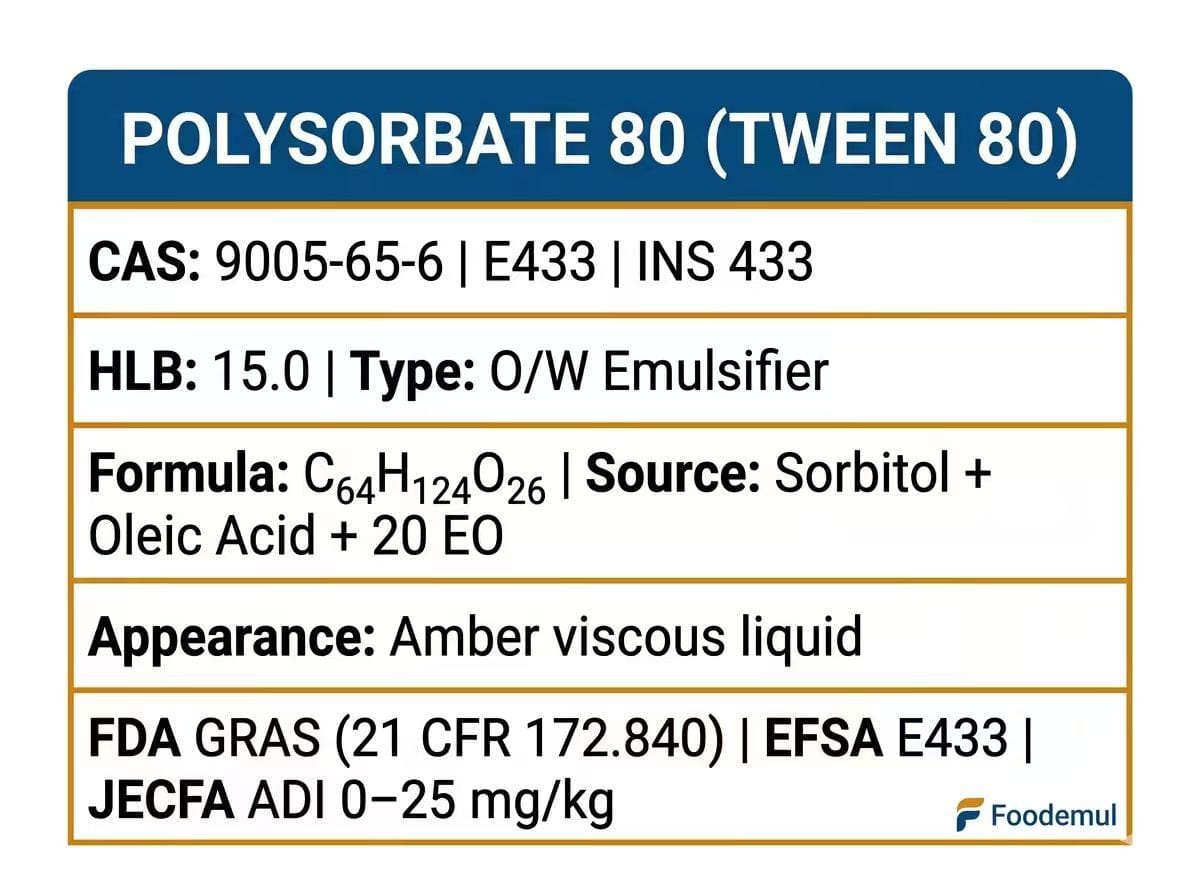
| Property | Value |
|---|---|
| Chemical Name | Polyoxyethylene (20) sorbitan monooleate |
| CAS Number | 9005-65-6 |
| E-Number / INS | E433 / INS 433 |
| HLB Value | 15.0 (highly water-soluble, O/W emulsifier) |
| Appearance | Yellow to amber oily liquid |
| Viscosity | ~400 mPa·s at 25°C |
| Specific Gravity | ~1.08 g/cm³ |
| Saponification Value | 45–55 mg KOH/g |
| Acid Value | ≤ 2.0 mg KOH/g |
| Hydroxyl Value | 65–80 mg KOH/g |
| Regulatory Status | FDA GRAS (21 CFR 172.840), EFSA approved (E433), JECFA |
Source:
How to Identify Polysorbate 80 on Food Labels
Polysorbate 80 appears on ingredient labels under several names depending on the regulatory jurisdiction:
- European Union / UK: E433 or “Polysorbate 80”
- Codex Alimentarius (International): INS 433 — the globally recognized identifier under the International Numbering System for Food Additives
- United States: “Polysorbate 80” (FDA requires the full chemical name or common name on the ingredient statement)
- Trade names: Polysorbate 80, Alkest TW 80, T-Maz 80
When scanning an ingredient list, look for any of these identifiers. They all refer to the same substance. The INS 433 designation is particularly useful when comparing products across countries with different labeling regulations, as it is the globally recognized Codex identifier.
For a complete list of foods that commonly contain Polysorbate 80, see our Foods Containing Polysorbate 80 guide.
What Is Polysorbate 80 Used For?
Polysorbate 80 serves three primary functions across food, cosmetic, and pharmaceutical industries:
- Emulsifier (O/W). At HLB 15.0, it creates stable oil-in-water emulsions in ice cream, salad dressings, sauces, and whipped toppings. It prevents fat separation and improves mouthfeel.
- Solubilizer. It disperses essential oils, fat-soluble vitamins (A, D, E, K), and flavor compounds into clear aqueous systems — critical for beverages, liquid supplements, and flavored waters. See our Polysorbate 80 Dosage Guide for exact ratios.
- Dough conditioner / defoamer. In yeast-leavened baked goods, it controls foam during fermentation and improves dough handling at levels up to 0.5% (FDA 21 CFR 172.840).
Where Is Polysorbate 80 Found?
Polysorbate 80 appears in a remarkably wide range of supermarket products. The most common categories include ice cream and frozen desserts (prevents ice crystals), salad dressings and mayonnaise (emulsion stability), baked goods (crumb softness), dairy alternatives (coffee creamers, whipped toppings), and chewing gum (plasticity). For a complete guide with specific product examples, see our Foods Containing Polysorbate 80 article.
On ingredient labels, look for: “Polysorbate 80,” “E433,” “INS 433,” or “polyoxyethylene (20) sorbitan monooleate.” The INS (International Numbering System) code 433 is consistent worldwide; the EU E-number is E433.
Food Grade vs Cosmetic Grade — Why Purity Matters
Not all Polysorbate 80 is created equal. Food-grade Polysorbate 80 must meet strict specifications under GB 25554-2010 (China), FCC (US), and JECFA (FAO/WHO): oxyethylene content 65.0–69.5%, acid value ≤ 2.0 mg KOH/g, saponification value 40–55 mg KOH/g, hydroxyl value 65–80 mg KOH/g, moisture ≤ 3.0%, arsenic ≤ 3 mg/kg, lead ≤ 2 mg/kg. Cosmetic-grade Polysorbate 80 may have looser heavy metal limits and is not suitable for ingestion. Always specify the grade when sourcing.
Is Polysorbate 80 Safe?
Yes — Polysorbate 80 is approved as a food additive by every major regulatory body worldwide. The FDA classifies it as GRAS under 21 CFR 172.840. The EFSA re-evaluated it in 2015 and confirmed an Acceptable Daily Intake (ADI) of 25 mg/kg body weight per day. JECFA (FAO/WHO) established the same ADI in 1984 and reaffirmed it in 2014. GB 2760-2011 (China) permits its use as an emulsifier, stabilizer, and defoamer across multiple food categories. For a comprehensive regulatory deep dive, see our Polysorbate 80 Safety & Global Compliance Guide.
The European Food Safety Authority (EFSA) re-evaluated polysorbates in 2015 (EFSA Journal 2015;13(7):4152) and established a group Acceptable Daily Intake (ADI) of 25 mg/kg body weight per day for polysorbates E432–E436. To put this in perspective, a 70 kg adult would need to consume over 1.75 grams of pure Polysorbate 80 daily — far more than what appears in any typical diet — to reach the ADI limit.
The Joint FAO/WHO Expert Committee on Food Additives (JECFA) has similarly reviewed Polysorbate 80 and assigned an ADI of 0–25 mg/kg bw. Both EFSA and JECFA concluded that dietary exposure to Polysorbate 80 from approved food uses does not pose a health concern for the general population.
The Polysorbate Family — How Polysorbate 80 Compares
Polysorbate 80 is one of five food-grade polysorbates. Each differs by its fatty acid chain, which determines its HLB value and optimal use:
- Polysorbate 20 (E432) — Lauric acid, HLB 16.7 — solubilizer for flavors and cosmetics
- Polysorbate 60 (E435) — Stearic acid, HLB 14.9 — bakery, whipped toppings
- Polysorbate 65 (E436) — Tristearate, HLB 10.5 — frozen desserts, coffee creamers
- Polysorbate 80 (E433) — Oleic acid, HLB 15.0 — general-purpose food emulsifier
For a detailed comparison, see our PS20 vs Polysorbate 80 Guide and PS60 vs Polysorbate 80 Guide.
Frequently Asked Questions
What does INS 433 mean?
INS 433 is the International Numbering System code for Polysorbate 80, assigned by the Codex Alimentarius Commission. It is the global identifier for this emulsifier and appears on food labels in many countries. In the EU, the same substance is labeled E433.
Is Polysorbate 80 natural?
Polysorbate 80 is a semi-synthetic compound. Its raw materials — sorbitol (from corn or wheat starch) and oleic acid (from vegetable oils) — are plant-derived. However, the manufacturing process involves ethoxylation, a chemical reaction with ethylene oxide, which means the final product is not considered “natural” under clean-label definitions. For natural alternatives, see our Natural Substitutes Guide.
What is the difference between food grade and cosmetic grade Polysorbate 80?
Food-grade Polysorbate 80 must meet stricter purity specifications (FCC, JECFA, or GB 25554-2010) with tighter limits on impurities, heavy metals, and residual ethylene oxide. Cosmetic-grade Polysorbate 80 may have different specifications optimized for skin feel and formulation stability rather than ingestion safety. Always verify the grade against your intended application — they are not interchangeable.
Further Reading
- Dosage & formulation: Polysorbate 80 Dosage Guide — Ratios & Regulatory Limits
- Safety deep dive: Polysorbate 80 Safety, Uses & Global Compliance
- What foods contain it: Foods Containing Polysorbate 80
- Natural alternatives: Natural Substitutes for Polysorbate 80
- Full Polysorbate family guide: Polysorbate Emulsifiers: Polysorbate 20, 40, 60 & 80 Compared
- Product & ordering: Food-Grade Polysorbate 80 (E433)
Need Polysorbate 80? We manufacture it with Kosher and MUI Halal certification — reach out for specifications or samples.
