

Sorbitan esters do more than emulsify — in cosmetics, they modify texture, control viscosity, and stabilize formulations through temperature swings that would break most systems. Span 60 thickens creams, Span 80 softens emulsions, and the Span/Polysorbate pairing creates textures no single emulsifier can match. At FoodEmul, we supply sorbitan esters to cosmetic formulators worldwide. This guide covers the full cosmetic application spectrum for the Span series.
Understanding the Role of Sorbitan Esters in Cosmetics
At their core, sorbitan esters—commonly known by the trade name “Span” (Chinese GB standard: 司盘)—function as powerful non-ionic surfactants. In cosmetic chemistry, their primary role is to bridge the gap between oil and water, specifically favoring water-in-oil (W/O) emulsions. Their molecular structure consists of a sorbitan (dehydrated sorbitol) head as the hydrophilic group, esterified with fatty acids that serve as the lipophilic tail. By varying the fatty acid type and esterification degree, manufacturers produce a range of Span products with distinct HLB values and performance characteristics.
Because they are oil-soluble, they are exceptionally effective at stabilizing high-internal-phase emulsions. Whether you are working with a rich night cream or a complex pigment dispersion, these esters provide the structural integrity needed to prevent phase separation.
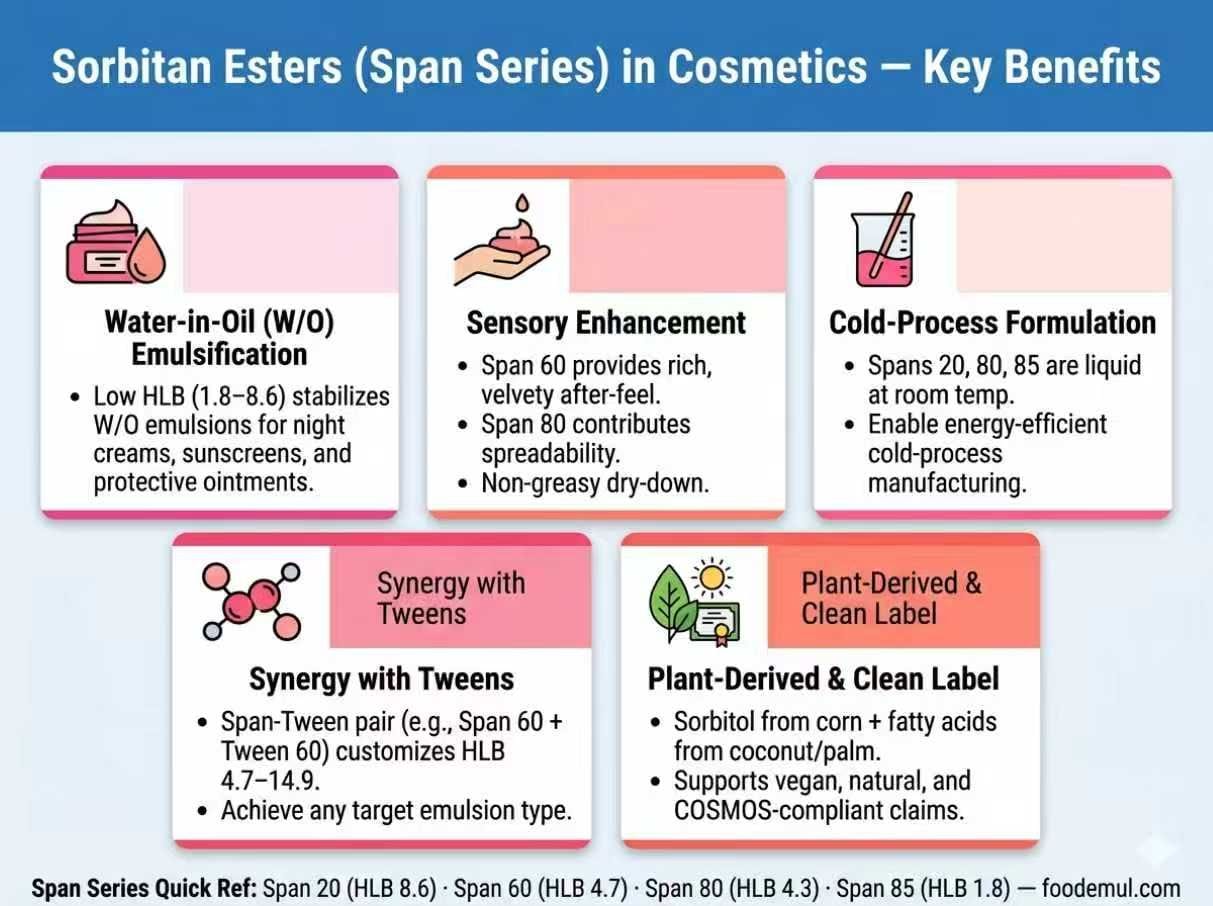
For the full Span and Polysorbate series comparison table (chemical names, fatty acids, HLB values, and functions), see our Span & Polysorbate Formulators Master Guide . In cosmetics, the key players are Span 60 (HLB 4.7, creamy texture for body butters and thick creams) and Span 80 (HLB 4.3, better low-temperature fluidity for lotions and serums). For lighter emulsions, Span 20 (HLB 8.6) is occasionally used as a co-emulsifier in micellar waters and toners. For ultra-gentle cleansing formulations, Sorbitan Sesquioleate (Span 83) — a partial oleate ester — provides exceptionally mild surfactant properties suitable for sensitive-skin and baby-care products.
The Versatility of the Span Series for Skin Care
When formulating dermatological products, safety and sensory appeal are paramount. Utilizing span for skin care applications offers several advantages:
- Skin Compatibility: They are generally recognized as mild and non-irritating, making them suitable for sensitive skin formulations.
- Moisture Retention: By forming a cohesive film on the skin’s surface, they help reduce trans-epidermal water loss (TEWL).
- Compatibility: They work harmoniously with a wide range of botanical oils and active ingredients.
Key Benefits of Sorbitan Esters in Formulations
Achieving the Perfect Creamy Texture
Consumers often judge a product by its “rub-out” and initial feel. Using a creamy texture emulsifier like Sorbitan Stearate or Sorbitan Oleate ensures a smooth, luxurious application without the waxiness often associated with high-viscosity products. These esters help refine the droplet size within the emulsion, leading to a more homogenous and visually appealing finish.
Non-Ionic Stability
As a non-ionic emulsifier cosmetic ingredient, sorbitan esters do not carry an electrical charge — they won’t react with electrolytes, preservatives, or active botanical extracts. This pH-independent stability is critical for cosmetic formulations that must remain intact across months of shelf life and varying usage conditions. For the full chemistry and HLB blending methodology, see the Span & Polysorbate Formulators Master Guide .
📚 Need the Big Picture?
You are reading a detailed chapter on a specific topic. To understand the complete chemistry, manufacturing process, and full application range of the Span Series, check out our central guide.
Read the Ultimate Guide to Sorbitan Esters →
Practical Applications: From Lotions to Makeup
The utility of these esters extends across the entire spectrum of beauty products:
- Lotions: Selecting the right emulsifier in lotion recipes allows for a product that is pourable yet stable. Sorbitan esters are often paired with polysorbates (Polysorbate series) to reach the ideal HLB (Hydrophilic-Lipophilic Balance) value for light, daily-use lotions.
- Makeup: Achieving a uniform color is the biggest challenge in color cosmetics. Incorporating a sorbitan ester in makeup, such as in liquid foundations or creamy lipsticks, helps to wet and disperse pigments evenly, preventing clumping and ensuring consistent color payoff.
Formulation Efficiency: Cold Process and Beyond
In an era focusing on sustainability and cost-reduction, the manufacturing process is just as important as the ingredients. Many modern sorbitan derivatives are designed to act as a cold process emulsifier. By eliminating the need to heat large vats of water and oil phases, manufacturers can significantly reduce energy consumption and shorten production cycles—all while protecting heat-sensitive active ingredients from degradation.
Conclusion: Elevating Your Personal Care Formulations
From stabilizing the complex pigment loads in foundations to ensuring a silky-smooth application in body butters, sorbitan esters are indispensable. Their ability to provide non-ionic stability and support cold-process manufacturing makes them a future-proof choice for any cosmetic chemist.
Looking for industrial or household applications? See our Sorbitan Esters Industrial Formulation Guide and Technical Manufacturing & Safety Guide.
Need sorbitan esters for cosmetic formulations? We manufacture Span 60, Span 80, and the full range — reach out for specifications or samples.
