

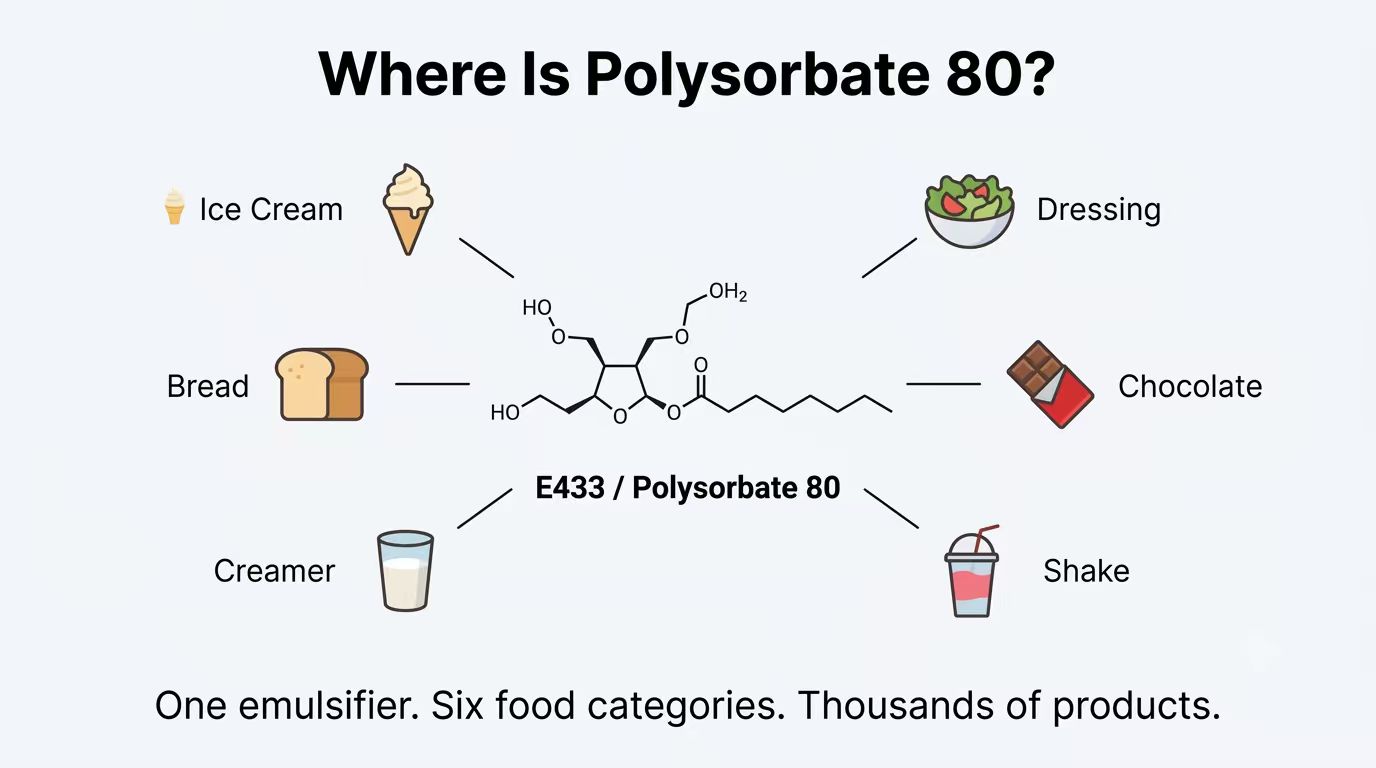
Polysorbate 80 is in more foods than most consumers realize — ice cream, pickles, chewing gum, cake mix, whipped topping, vitamin drops. It is the most widely used synthetic emulsifier in processed foods. At FoodEmul, we supply it to manufacturers across categories. This guide is a complete list of what foods contain Polysorbate 80, why it is there, and what it does in each product.
What Is Polysorbate 80 in Food?
How Is Polysorbate 80 Made?
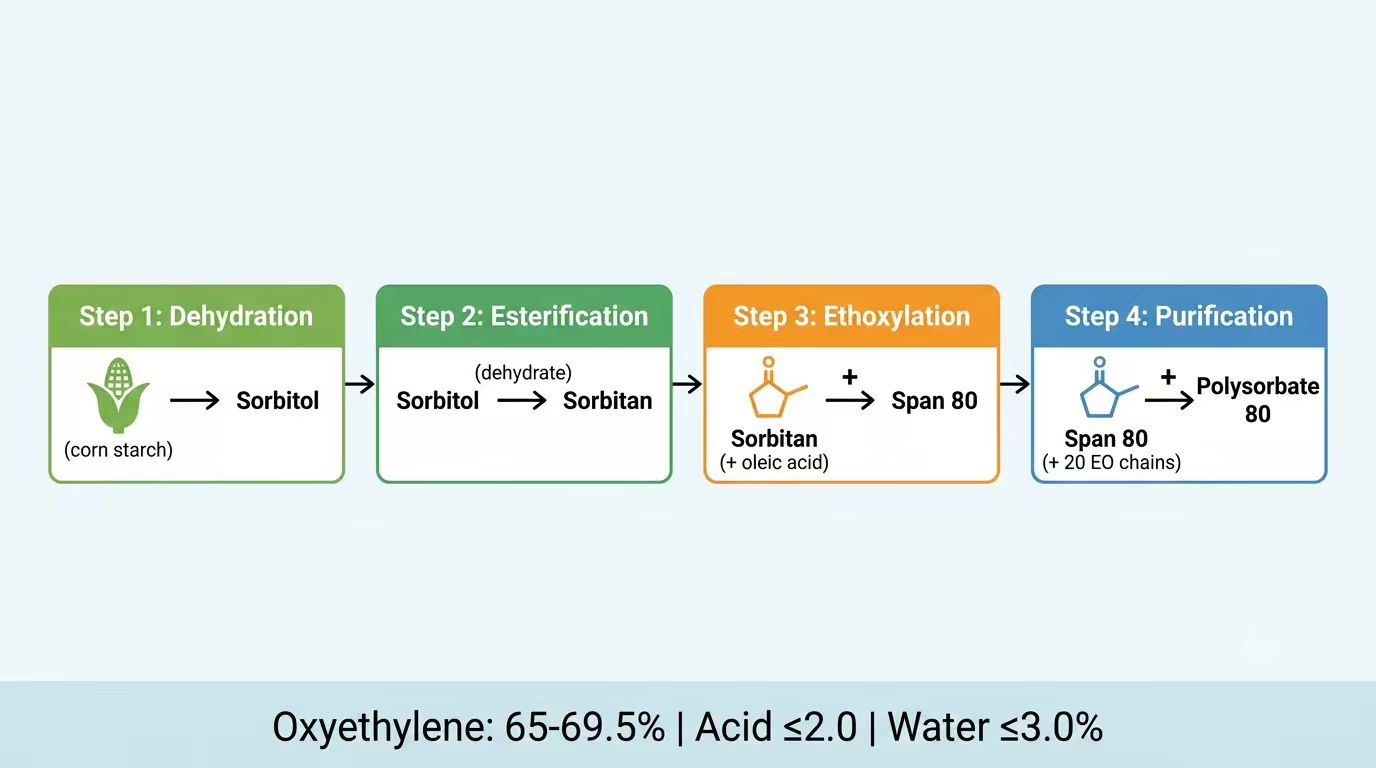
Source materials: Polysorbate 80 is derived from sorbitol (from corn, tapioca, or wheat starch), oleic acid (from palm, coconut, or olive oil), and ethylene oxide (petroleum-derived). The sorbitol is first dehydrated to sorbitan, esterified with oleic acid to form Sorbitan Monooleate (Span 80), then ethoxylated with approximately 20 moles of ethylene oxide to produce the final Polysorbate 80 molecule. The vegetable origin of the fatty acid and sorbitol means Polysorbate 80 can be certified Kosher and Halal when manufactured under appropriate protocols.
Polysorbate 80 is a synthetic, non-ionic surfactant produced through a multi-step chemical process. Understanding its origin helps explain why it functions so effectively as a food emulsifier.
The Production Process
- Step 1 — Sorbitol dehydration: Sorbitol, a sugar alcohol typically derived from corn or cassava starch, is heated to remove water molecules, forming sorbitan (a cyclic anhydride).
- Step 2 — Esterification: The sorbitan is reacted with oleic acid (a fatty acid sourced from vegetable oils such as olive, sunflower, or palm oil) to produce sorbitan monooleate — also known as Span 80.
- Step 3 — Ethoxylation: The Span 80 molecule is then reacted with approximately 20 moles of ethylene oxide. This attaches polyoxyethylene (POE) chains to the sorbitan ring, transforming the lipophilic Span 80 into the hydrophilic Polysorbate 80 (Polysorbate 80).
- Step 4 — Purification: The crude product is neutralized, bleached, and vacuum-stripped to remove residual ethylene oxide and other impurities, bringing it to food-grade purity.
Quality Standards
Food-grade Polysorbate 80 must meet strict specifications. According to the Food Chemicals Codex (FCC) and China’s GB 25554-2010 standard, key parameters include:
- Oxyethylene content: 65.0–69.5%
- Acid value: ≤2.0 mg KOH/g
- Saponification value: 45–55 mg KOH/g
- Hydroxyl value: 65–80 mg KOH/g
- Water content: ≤3.0%
- Residue on ignition: ≤0.25%
The ethoxylation step is what gives Polysorbate 80 its characteristic HLB value of approximately 15.0, making it a powerful oil-in-water (O/W) emulsifier. The raw materials — sorbitol, oleic acid, and ethylene oxide — are commodity chemicals, making Polysorbate 80 one of the most cost-effective food-grade synthetic emulsifiers available at industrial scale.
Polysorbate 80 (Polyoxyethylene (20) sorbitan monooleate) is a non-ionic surfactant and emulsifier. It is derived from polyethoxylated sorbitan and oleic acid. In the European Union, it is identified by the food additive code E433.
Chemically, Polysorbate 80 is characterized by a high Hydrophile-Lipophile Balance (HLB) value of approximately 15. This high HLB indicates that it is highly water-soluble and is particularly effective at creating oil-in-water (O/W) emulsions. This unique chemical structure allows it to interact with both water and fats, preventing them from separating. For a deeper dive into the chemistry and technical specifications, see the Polysorbate 80 Technical Guide.
Expert Insight: While Polysorbate 80 is the hydrophilic (water-loving) component, it is often used in conjunction with Sorbitan Monooleate (Span 80), its lipophilic (oil-loving) counterpart. Using these two together allows formulators to fine-tune the emulsion stability of complex food matrices.
Foods That Contain Polysorbate 80 — by Category
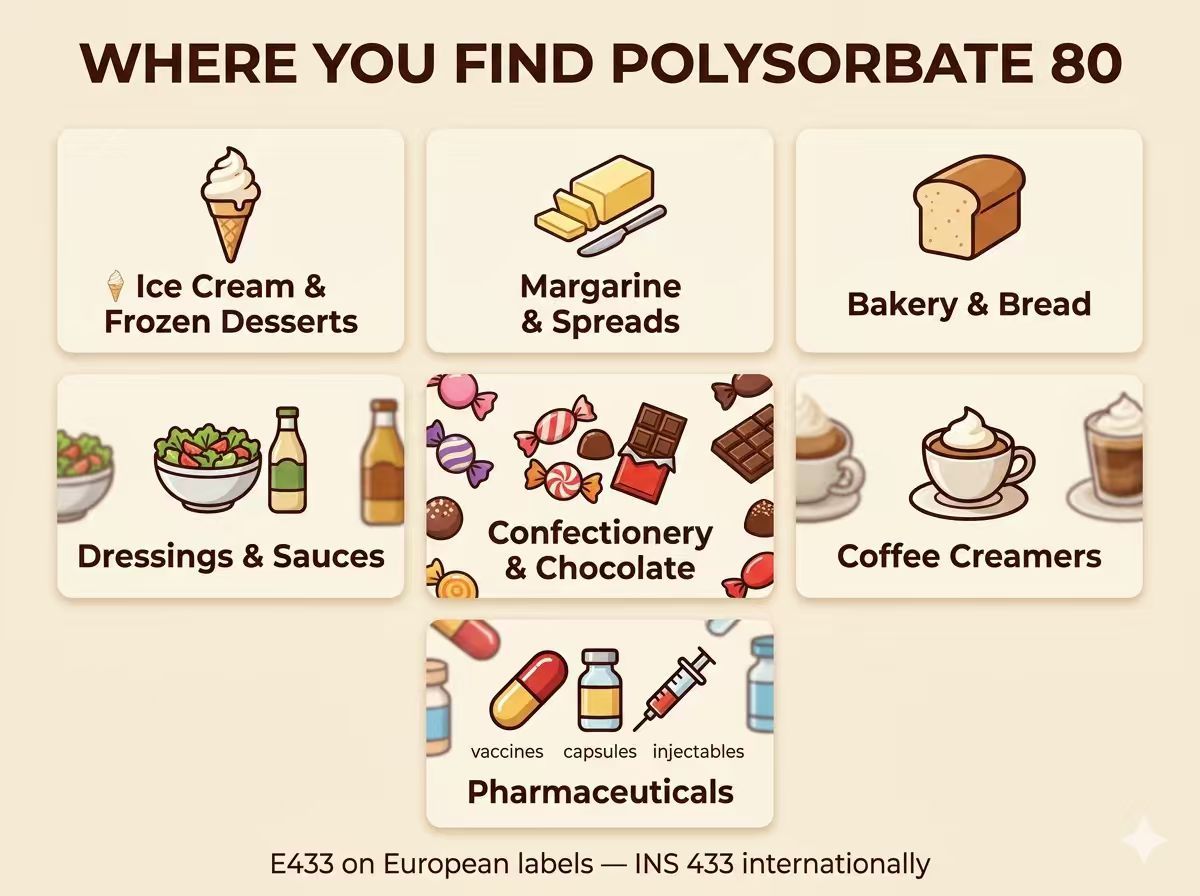
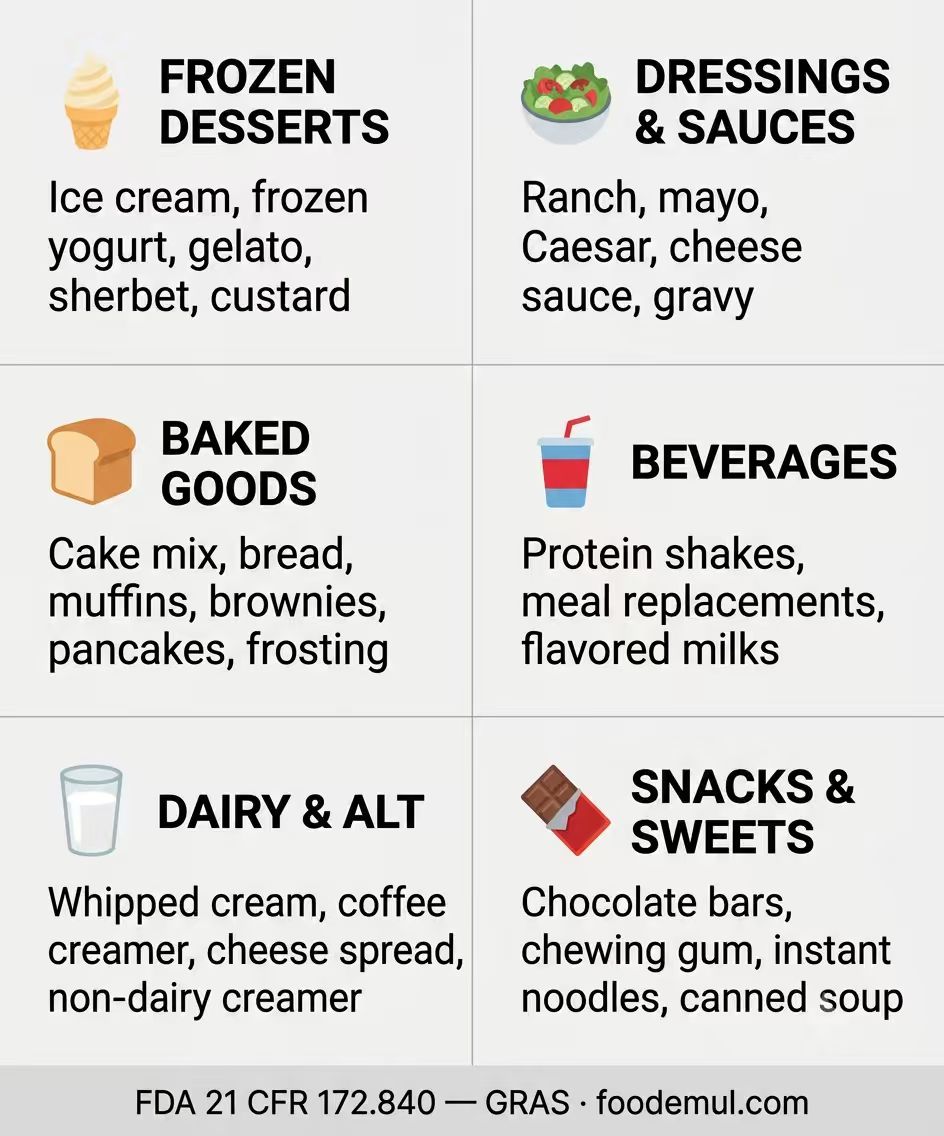
Polysorbate 80 appears in a remarkably wide range of processed foods. Below is a comprehensive breakdown organized by food category, with specific product examples and the functional reason Polysorbate 80 is added to each.
Frozen Desserts & Ice Cream
This is the most well-known application. Polysorbate 80 prevents ice crystal formation during freezing and storage, ensuring a smooth, creamy texture rather than a grainy one. Common products: ice cream, frozen yogurt, gelato, sherbet, frozen custard, and novelty bars. In ice cream specifically, the emulsifier helps disperse fat globules evenly, contributing to slower melting and better mouthfeel — a principle confirmed in Chinese food emulsifier textbooks.
Salad Dressings & Sauces
Oil-and-vinegar dressings naturally separate. Polysorbate 80 keeps the oil phase suspended in the water phase, creating a stable, pourable emulsion. Common products: ranch, Italian, Caesar, and vinaigrette dressings; mayonnaise; creamy pasta sauces; gravy mixes; and cheese sauces.
Baked Goods & Baking Mixes
Polysorbate 80 improves dough handling, increases loaf volume, and extends shelf life by retaining moisture. Common products: cake mixes, bread, muffins, brownie mixes, pancake mixes, biscuits, and frosting/icing. In commercial baking, Polysorbate 80 is often paired with mono- and diglycerides for synergistic crumb softening.
Beverages
Flavored drinks often contain oil-based flavors or vitamins that need to stay evenly dispersed. Polysorbate 80 solubilizes these into clear or opaque beverages. Common products: protein shakes, meal replacement drinks, flavored milks, cream-based liqueurs, sports drinks, and vitamin-enhanced waters.
Dairy & Dairy Alternatives
In processed dairy, Polysorbate 80 stabilizes fat emulsions and prevents whey separation. Common products: whipped cream, coffee creamers (liquid and powdered), processed cheese spreads, sour cream, yogurt drinks, and non-dairy creamers. In plant-based milk alternatives (almond, oat, soy), Polysorbate 80 prevents the separation of added oils and proteins.
Snacks, Confectionery & Prepared Foods
Common products: chocolate bars and coatings (improves flow during enrobing), chewing gum (softens texture), instant noodles (prevents starch clumping), canned soups, and processed meat products. In chocolate, Polysorbate 80 reduces the viscosity of molten chocolate, allowing thinner, more even coatings.
Regulatory note: Under FDA 21 CFR 172.840, polysorbate 80 is GRAS (Generally Recognized as Safe) for use in food. The EFSA re-evaluation confirmed its safety as food additive E433, and China’s GB 2760 standard permits its use across these food categories with specified limits.
Why Is Polysorbate 80 Used in Food Processing?
Food engineers choose Polysorbate 80 not just for habit, but for its high-performance characteristics. It is a cost-effective solution for solving complex formulation challenges.
| Function | Description | Typical Application |
|---|---|---|
| Emulsification | Reduces surface tension between oil and water, creating stable mixtures. | Salad dressings, sauces, soups. |
| Solubilization | Helps dissolve ingredients that usually do not dissolve in water (like essential oils or vitamins). | Pickle jars (dispersing dill oil), vitamin supplements. |
| Aeration / Foaming | Stabilizes air cells within a liquid matrix. | Whipped toppings, ice cream, mousse. |
| Wetting Agent | Helps powders disperse quickly in liquid without clumping. | Instant drink powders, gelatin mixes. |
Polysorbate 80 Safety: What the Science Says
As one of the most widely used food additives globally, Polysorbate 80 has been extensively studied for safety. Here is what the major regulatory bodies and scientific literature conclude.
Regulatory Approvals
- FDA (United States): Polysorbate 80 is designated as GRAS under 21 CFR 172.840, permitted at levels not exceeding good manufacturing practices.
- EFSA (European Union): Authorized as E433 with an Acceptable Daily Intake (ADI) of 25 mg/kg body weight per day.
- GB 2760 (China): Permitted across specified food categories. Quality standards under GB 25554-2010.
- JECFA (Joint FAO/WHO): Established ADI of 0–25 mg/kg body weight, consistent with EFSA.
Common Concerns Addressed
“Is Polysorbate 80 linked to gut inflammation?” Some animal studies suggested high-dose emulsifiers may alter gut microbiota, but these used doses far exceeding typical human intake. EFSA’s 2015 re-evaluation concluded that at approved usage levels, Polysorbate 80 “is not of safety concern.” No regulatory body has revised its status.
“Is food-grade Polysorbate 80 the same as the one in vaccines?” The base molecule is identical, but pharmaceutical-grade Polysorbate 80 requires additional purification to meet USP/EP standards. The trace amount in a vaccine dose is far lower than daily food intake. Both FDA and WHO consider each application safe within its context.
“Should I avoid foods containing Polysorbate 80?” For the vast majority of consumers, there is no scientific basis for avoiding Polysorbate 80. It has been safely used for over 60 years. Individuals on medically supervised elimination diets may choose to avoid it, but for general consumption, Polysorbate 80 is one of the most thoroughly vetted emulsifiers available.
Bottom line: At approved food-use levels, Polysorbate 80 is safe. The consensus across FDA, EFSA, JECFA, and GB 2760 is consistent and long-standing.
Polysorbate 80 in Pharmaceuticals & Medications
Beyond food, Polysorbate 80 is widely used as an excipient in pharmaceutical products. The FDA’s Inactive Ingredient Database lists Polysorbate 80 in over 2,000 approved drug products.
Common medications containing Polysorbate 80:
- Vaccines: Used as a stabilizer in certain vaccines (including some influenza, HPV, and COVID-19 vaccines) to prevent protein aggregation during storage and shipment. Typical concentration: 0.05–0.1 mg per dose.
- Oral capsules and tablets: Acts as a solubilizer for poorly water-soluble APIs (active pharmaceutical ingredients). Examples include certain vitamin D supplements, amiodarone (antiarrhythmic), and some NSAIDs.
- Injectable formulations: Used in intravenous products like docetaxel (chemotherapy) and certain propofol formulations as a solubilizer at concentrations of 0.5–5%.
- Topical creams and ointments: Emulsifier in prescription dermatological products, including corticosteroid creams and antifungal preparations.
- Ophthalmic solutions: Used in eye drops to solubilize active ingredients at very low concentrations (<0.1%).
Note: The pharmaceutical-grade Polysorbate 80 (meeting USP-NF, Ph. Eur., and JP monographs) has tighter specifications than food-grade, particularly for peroxide value and endotoxin levels.
Dietary Questions and Label Reading
For procurement officers sourcing ingredients or consumers avoiding additives, reading labels accurately is essential.
How to Identify Polysorbates on Labels
Polysorbate 80 may not always be listed under that exact name. Look for these synonyms on ingredient lists:
- Polysorbate 80
- Polyoxyethylene (20) sorbitan monooleate
- E433 (in Europe)
- Alkest TW 80
Is Polysorbate 80 and Polysorbate 20 Vegan?
This is a critical question for modern food manufacturers targeting the plant-based market. Polysorbates are derived from Sorbitol (sugar alcohol) and fatty acids (specifically oleic acid for Polysorbate 80).
The crucial factor is the source of the Oleic Acid. While it can be derived from animal fats, the vast majority of industrial Polysorbate 80—including the high-purity grades supplied by foodemul.com—is derived from vegetable sources such as olive, palm, or sunflower oil. For a complete verification guide, see Is Polysorbate 80 Kosher? A Buyer’s Verification Guide.
Pro-Tip for Buyers: When sourcing Polysorbate 80 for vegan-certified products, always request a “Vegetable Origin Statement” or Kosher/Halal certification from your supplier to ensure no animal by-products were used in the esterification process.
Need High-Quality Emulsifiers?
Whether you are formulating a new line of dairy-free ice creams or stabilizing industrial food processes, purity and consistency matter. Visit the Polysorbate 80 product page for sourcing and the Polysorbate 80 in Ice Cream guide for frozen dessert-specific formulation insights.
Need Polysorbate 80 for your product? We manufacture it alongside Span 60 and the full range — Kosher and MUI Halal certified — reach out for specifications or samples.
