
Polysorbate 80 (E433 / polysorbate 80) is approved for 15 distinct food processing applications under FDA 21 CFR 172.840. Each one has its own usage limit. Below you’ll find every application, the exact permitted level, and what PS80 is actually doing in that product.
For technical specs (CAS, viscosity, density, grade parameters), see our PS80 Technical Specifications & Properties Guide. For a general overview, see What Is Polysorbate 80?. For safety, see the PS80 Safety & Compliance Guide.
Manufacturing Standards
Food-grade PS80 must meet the purity specs set by the Food Chemicals Codex (FCC) and FDA 21 CFR 172.840. These are the parameters you’ll see on every Certificate of Analysis:
| Parameter | Food Grade Limit | What It Indicates |
|---|---|---|
| Saponification Number | 45–55 mg KOH/g | Total ester content — confirms correct degree of oleic acid esterification |
| Acid Number | ≤ 2.0 mg KOH/g | Free fatty acid level — high values signal hydrolysis during storage or manufacturing |
| Hydroxyl Number | 65–80 mg KOH/g | Residual hydroxyl groups — confirms correct ethoxylation extent (~20 EO units) |
| Oxyethylene Content | 65.0–69.5% | Ethylene oxide incorporation — the defining parameter for surfactant function |
| Water Content | ≤ 0.5% | Karl Fischer titration — moisture above 0.5% accelerates ester hydrolysis and microbial risk |
| Heavy Metals (as Pb) | ≤ 10 ppm | General purity — ensures no contamination from equipment or raw materials |
| 1,4-Dioxane | ≤ 10 ppm | Ethoxylation byproduct — removed by vacuum stripping during manufacturing |
Procurement tip: The Acid Number is your best quick-check parameter. If it’s elevated, the ester bonds are partially broken down — the surfactant may still work, but free oleic acid can add off-flavors you’ll taste in delicate products like vanilla ice cream or clear beverages. For grade-by-grade specs (food vs. pharma vs. industrial), see our Technical Specifications Guide.
Food Processing Applications & FDA Limits
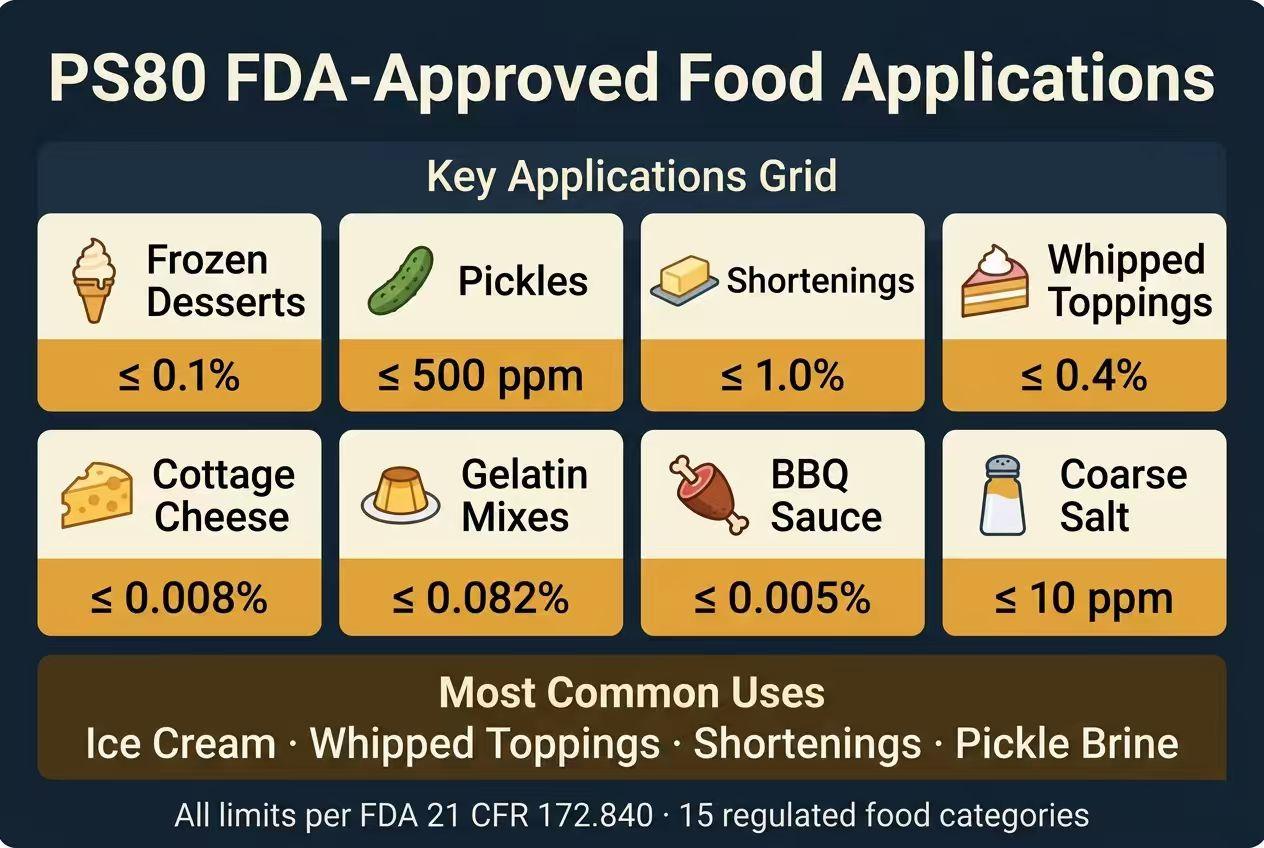
All limits below are per FDA 21 CFR 172.840. PS80 is the most broadly permitted polysorbate in food processing, covering 15 distinct applications.
Frozen Desserts
Ice cream, frozen custard, ice milk, fruit sherbet. PS80 partially displaces milk proteins from the fat globule surface during freezing, enabling controlled fat destabilization. This partial coalescence creates a 3D fat network that traps air cells for smooth mouthfeel and slows melt-down.
| Application | Limit |
|---|---|
| Frozen desserts (alone or with PS65) | ≤ 0.1% of finished product weight |
Pickles & Pickle Products
PS80 disperses spice oils (dill, turmeric, celery) in brine systems. Without it, hydrophobic oils float to the surface — uneven flavor and an oil slick. PS80 keeps them evenly spread through the water phase.
| Application | Limit |
|---|---|
| Pickles and pickle products | ≤ 500 ppm (0.05%) |
Shortenings & Edible Oils
In fat-based systems, PS80 provides emulsification stability and improves creaming performance in batter preparation. Often blended with PS60 — PS80’s liquid oleic acid complements PS60’s solid stearic acid for balanced crystallization.
| Application | Limit |
|---|---|
| Shortenings and edible oils | ≤ 1.0% by weight (alone or with PS60) |
Whipped Edible Oil Toppings
PS80 stabilizes the air-cell interface in whipped vegetable-oil toppings, giving high overrun with firm, non-weeping peaks. The 0.4% limit covers total polysorbate load (PS80 + PS60 + PS65 combined).
| Application | PS80 Limit | Total |
|---|---|---|
| Whipped edible oil toppings | ≤ 0.77% | ≤ 0.4% combined with other polysorbates |
Coffee Whiteners
PS80 prevents feathering — the visible oil separation when liquid creamer hits hot, acidic coffee. Its polyoxyethylene chains extend into the water phase, building a steric barrier that survives the 60°C temperature shock.
| Application | PS80 Limit |
|---|---|
| Coffee whiteners / dairy substitutes | ≤ 0.4% of finished emulsion |
Beverage Flavor and Cloud Emulsions
PS80 is the standard emulsifier for beverage flavor oils and cloud systems. At 10–100 ppm in the finished drink, it produces sub-micron droplets that stay dispersed for 6–18 months.
| Application | PS80 Limit |
|---|---|
| Flavor emulsions / beverage bases | Per GMP — minimum needed for emulsification |
Confectionery Coatings
In chocolate and compound coatings, PS80 reduces viscosity for uniform enrobing. Often paired with Span 60 for the fat-crystal stabilization side.
| Application | PS80 Limit | Total |
|---|---|---|
| Confectionery coatings | ≤ 0.5% | ≤ 1.0% combined with Span 60 |
Chewing Gum Base
PS80 improves the dispersion of elastomers in the gum base resin phase, contributing to smoother chew and longer flavor release.
| Application | PS80 Limit |
|---|---|
| Chewing gum base | ≤ 0.5% of gum base |
Poultry Processing
PS80 is approved as a scald agent in poultry processing — it reduces surface tension of scald water for better feather removal. This is a processing aid, not an ingredient — it’s rinsed off and doesn’t appear in the finished product.
| Application | PS80 Limit |
|---|---|
| Poultry scald water | ≤ 0.1% of scald water |
Complete FDA Application Table
| # | Application | PS80 Limit | Key Function |
|---|---|---|---|
| 1 | Frozen desserts | ≤ 0.1% | Fat destabilization for body and melt resistance |
| 2 | Pickles / pickle products | ≤ 500 ppm | Spice oil dispersion in brine |
| 3 | Shortenings / edible oils | ≤ 1.0% | Creaming improvement; crystallization balance |
| 4 | Whipped toppings | ≤ 0.77% | Air-cell interface stabilization |
| 5 | Coffee whiteners | ≤ 0.4% | Thermal shock / pH feathering prevention |
| 6 | Beverage flavor emulsions | Per GMP | Sub-micron oil droplet stabilization |
| 7 | Confectionery coatings | ≤ 0.5% | Viscosity control; fat crystal stabilization |
| 8 | Chewing gum base | ≤ 0.5% | Elastomer dispersion in resin phase |
| 9 | Poultry scald water | ≤ 0.1% | Surface tension reduction (processing aid) |
| 10 | Gelatins / puddings / fillings | ≤ 0.4% | Emulsion stability; texture uniformity |
| 11 | Dairy product analogs | ≤ 0.4% | Fat phase stabilization in non-dairy alternatives |
| 12 | Sugar-based confectionery | Per GMP | Mold release; surface finish |
| 13 | Yeast-leavened bakery | ≤ 0.5% flour weight | Dough conditioning; anti-staling |
| 14 | Vitamin / nutrient emulsions | Per GMP | Fat-soluble vitamin dispersion in aqueous systems |
| 15 | Nonstandardized foods | Per GMP | Minimum needed for intended effect |
Global Regulatory Status
| Region | Code | Key References |
|---|---|---|
| USA | — | FDA 21 CFR 172.840; GRAS |
| EU | E433 | Regulation (EC) No 1333/2008; ADI 10 mg/kg bw/day |
| Codex Alimentarius | INS 433 | GSFA category-specific limits |
| Japan | — | MHLW approved food additive |
Key Takeaways
- PS80 (E433) is approved across 15 FDA food categories — the broadest polysorbate approval.
- The highest limit is 1.0% (shortenings/edible oils). The lowest is 0.05% (pickles). The strictest application is 0.1% (frozen desserts).
- Food-grade PS80 must meet FCC purity specs — Acid Number ≤ 2.0, Water ≤ 0.5%, 1,4-Dioxane ≤ 10 ppm.
- FoodEmul’s PS80 carries Halal (MUI, Indonesia) and Kosher certification.
This guide references FDA 21 CFR 172.840, FCC monographs, EU Regulation (EC) No 1333/2008, Codex GSFA, and published research (Hu et al., 2011). For application-specific advice, consult your emulsifier supplier’s technical service team.