

Estimated reading time: 10 minutes
Hi, I’m Joe. Here at FoodEmul, we’ve been supplying Span and polysorbate emulsifiers to food manufacturers for years, and margarine is one of those categories where the chemistry lines up almost perfectly. It’s a water-in-oil system — and Span 60 was built for water-in-oil systems.
This guide came from a question I hear a lot: “If Span 60 makes margarine firm, how do I soften it?” The answer is the Span-to-polysorbate ratio — and once you understand that knob, you can tune anything from a bakery block to a soft tub spread with the same two emulsifiers.
I’ll walk you through the ratios, the dosages, and exactly where Span 60 and polysorbates fit in your margarine line.
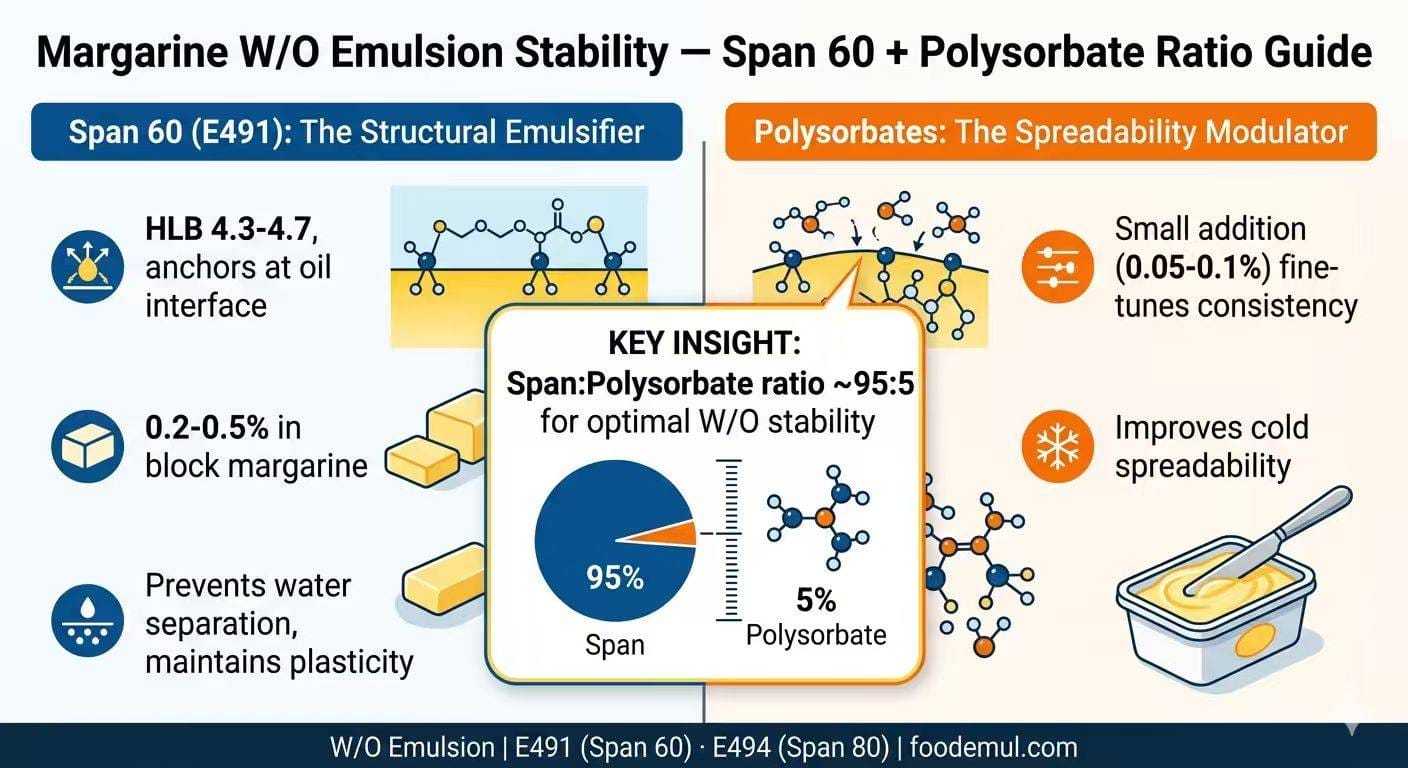
Why Margarine Needs Emulsifiers — and Why Span 60 Is the Natural Fit
Margarine is a water-in-oil (W/O) emulsion: 80% fat continuous phase with 16–20% water spread through it as fine droplets. This is the opposite of most food emulsions — beverages, cake batters, ice cream mix — which are oil-in-water. Here, the fat is the continuous phase.
That W/O structure demands low-HLB emulsifiers. And the most effective low-HLB emulsifiers in the standard food toolkit are sorbitan esters — Span 60 (Sorbitan Monostearate, E491, HLB 4.7) and Span 80 (Sorbitan Monooleate, E494, HLB 4.3). Their HLB values sit right in the W/O stabilization range (3–6).
Two different margarine types need different emulsifier approaches:
| Margarine Type | Fat Content | Key Requirement | Span/polysorbate Role |
|---|---|---|---|
| Block margarine (bakery) | 80–82% | Firmness, structure, dough lamination | Span 60 dominant — body and shape retention |
| Soft tub margarine (table spread) | 40–60% | Spreadability, creaminess, reduced fat | Balanced Span/polysorbate — structure plus spread |
Span 60 — The Structural Emulsifier for Block Margarine
How Span 60 Works in Margarine
Span 60 (Sorbitan Monostearate, E491, HLB 4.7) is the primary structural emulsifier for block and bakery margarine. It works through three connected functions:
W/O emulsion stabilization. Span 60’s low HLB positions it at the water-oil interface — sorbitan head toward the water droplet, stearic acid tail buried in the surrounding fat phase. This stops water droplets from merging into larger pools. Without it, you get phase separation and uneven water distribution during baking.
Fat crystal templating. Span 60’s stearic acid chain (C18:0) co-crystallizes with the saturated triglycerides in the margarine fat phase. These mixed crystals build a structured fat crystal network — the thing that gives block margarine its firm, plastic texture. This matters most for laminated doughs, where the margarine must stay as a distinct layer between dough sheets.
Firmness and body. Sorbitan esters directly contribute to the solid-like feel of block margarine. The competitor literature says it plainly: sorbitan esters “provide firmness and body, which is important in block margarines and bakery margarines” — and they “work in synergy with other emulsifiers” including polysorbates for complex formulas.
Span 60 vs Span 80 in Margarine
| Property | Span 60 (E491) | Span 80 (E494) |
|---|---|---|
| Fatty acid | Stearic (C18:0) | Oleic (C18:1) |
| HLB | 4.7 | 4.3 |
| Melting point | ~56°C | Liquid at room temp |
| Crystal contribution | Strong — co-crystallizes with saturates | Minimal — unsaturated chain |
| Best application | Block margarine, bakery shortening | Soft margarine, fluid shortenings |
Span 60 wins for block margarine because its saturated stearic acid chain matches the crystal-forming triglycerides (palmitic C16:0, stearic C18:0) in hydrogenated vegetable oils. Span 80’s unsaturated oleic chain brings more flexibility — better for softer, more spreadable systems.
For full specs, see our Sorbitan Monostearate (E491) Technical Guide and Span 80 Guide.
Polysorbates — The Spreadability Modulator
Why Add a High-HLB Emulsifier to a W/O System?
Polysorbates (polysorbate 60, HLB 14.9; PS80, HLB 15.0) are high-HLB emulsifiers built for O/W systems. Adding them to a W/O margarine sounds backwards — but it’s standard practice, and here’s why:
Pure Span 60 at 0.5% makes a very firm, almost brittle margarine. Perfect for bakery blocks, but way too stiff for a consumer table spread. Adding a small amount of polysorbate broadens the HLB coverage, softening the fat crystal network just enough for spreadability — without breaking the W/O emulsion.
The mechanism: polysorbate molecules slide between Span 60 molecules at the fat crystal interface. Their larger polyoxyethylene head groups and unsaturated (PS80) or longer (polysorbate 60) tails disrupt the tight crystal packing — like adding a small amount of co-monomer to a polymer. Span 60 still runs the W/O emulsion, but the fat network becomes more flexible.
When to Use Which Polysorbate
| Polysorbate | HLB | Best For |
|---|---|---|
| polysorbate 60 (E435) | 14.9 | Margarine with palm/palm kernel base — stearic chain matches |
| PS80 (E433) | 15.0 | Margarine with soybean/canola base — oleic chain matches |
Same fatty acid matching principle as always: polysorbate 60’s stearic acid chain pairs with palm-based fat systems; PS80’s oleic acid chain pairs with soybean and canola-based systems.
For full polysorbate data, see our Polysorbate 60 Comprehensive Guide.
The Span/Polysorbate Ratio — Your Primary Tuning Knob
The Span 60 : Polysorbate ratio is how you dial in margarine texture:
| Span 60 : polysorbate 60 Ratio | Effective HLB | Texture Result | Application |
|---|---|---|---|
| Span 60 alone | 4.7 | Very firm, plastic, brittle | Laminated dough block margarine |
| 3 : 1 | ~7.3 | Firm, good spreadability above 15°C | General bakery margarine |
| 2 : 1 | ~8.1 | Semi-soft, refrigerator-spreadable | Premium table margarine |
| 1 : 1 | ~9.8 | Soft, immediate spreadability | Low-fat spreads (40–50% fat) |
| 1 : 2 | ~11.5 | Very soft, whipped consistency | Whipped margarine |
Practical starting ratios:
- Block bakery margarine (80% fat): Span 60 at 0.3–0.5% alone, or Span 60 : polysorbate 60 = 3:1 at 0.3–0.5%
- Soft tub margarine (60% fat): Span 60 : polysorbate 60 = 2:1 at 0.3–0.5%
- Low-fat spread (40% fat): Span 60 : polysorbate 60 = 1:1 to 1:2 at 0.4–0.6%
For the full methodology, see our Span & polysorbate Formulators Guide.
Supporting Emulsifiers in Compound Margarine Systems
Span 60 and polysorbates form the structural core, but other emulsifiers handle specific jobs in commercial formulas:
| Emulsifier | Role in Margarine | Span/polysorbate Relationship |
|---|---|---|
| Mono- and diglycerides (E471) | Primary fat crystal modifier; bulk emulsion stabilization | Works alongside Span 60; Span provides W/O specificity that GMS alone lacks |
| Lecithin (E322) | Anti-spattering agent; phospholipid emulsifier | Complements Span in the aqueous phase |
| PGE (E475) | Soft margarine texture; water-binding | Competes with sorbitan esters for softness; Span preferred for firmness |
A common compound margarine emulsifier blend: GMS 60% : Span 60 25% : polysorbate 60 15% at 0.3–0.5% total. GMS handles bulk fat structuring, Span 60 locks down the W/O interface, and polysorbate 60 dials in spreadability.
Bakery Shortening — Where Span 60 Adds Unique Value
Bakery shortening is different from margarine — it has no water phase. It’s 100% fat. So why use an emulsifier?
Crystal modification. Shortening needs the right ratio of β’ (beta-prime) to β (beta) crystals for the best creaming performance in cakes and pastries. Span 60 at 0.1–0.3% pushes the β’ crystal form — the one that traps air during creaming and gives you finer-textured baked goods.
Fat dispersion in dough. When shortening mixes into dough, it needs to spread as thin films around flour particles — not as fat lumps. Span 60’s interfacial activity at the fat-dough boundary keeps distribution even, which means more uniform crumb in the final product.
Laminated dough performance. In puff pastry and Danish doughs, the shortening or block margarine has to stay as a continuous, plastic layer through repeated folding and rolling. Span 60’s crystal-templating keeps it plastic through the mechanical stress of lamination — giving you those distinct, even layers.
Dosage Quick Reference
| Product | Span 60 (% of fat) | Polysorbate (% of fat) | Total Emulsifier |
|---|---|---|---|
| Block margarine (80% fat) | 0.3–0.5% | 0–0.1% | 0.3–0.5% |
| Soft tub margarine (60% fat) | 0.2–0.3% | 0.1–0.2% | 0.3–0.5% |
| Low-fat spread (40% fat) | 0.2–0.3% | 0.2–0.3% | 0.4–0.6% |
| Bakery shortening (100% fat) | 0.1–0.3% | — | 0.1–0.3% |
| Laminated dough margarine | 0.4–0.6% (alone) | — | 0.4–0.6% |
Key principle: Span 60 dosage tracks water content — more water means more W/O interface to stabilize, so you need more Span 60. For low-fat spreads, total emulsifier goes up because water is a larger share of the product.
Process Integration
- Fat phase preparation: Melt the fat blend at 60–65°C. Add Span 60 and any other oil-soluble emulsifiers (GMS, lecithin) — Span 60 melts fully at ~56°C and disperses evenly in the fat melt.
- Water phase preparation: Dissolve salt, preservatives, and water-soluble ingredients in water at matching temperature (55–60°C). If using polysorbates, add them to the water phase — they disperse better in water than in hot fat.
- Pre-emulsion: Add the water phase to the fat phase under high-shear mixing. The W/O emulsion starts forming here. Span 60, already dissolved in the fat phase, moves to the forming water droplet surfaces.
- Votator/scraped-surface cooling: The margarine emulsion goes through scraped-surface heat exchangers where it’s rapidly cooled from ~55°C to 10–15°C. This is the critical step: fast cooling forces the fat to crystallize in the desirable β’ form, and Span 60 co-crystallizes with the fat network.
- Working and resting: The cooled margarine is mechanically worked (kneaded) to develop plasticity, then rested at 5–10°C for 24–48 hours to let the crystal network fully set. Final product should be firm but spreadable at fridge temperature.
Troubleshooting
| Problem | Likely Cause | Span/polysorbate Solution |
|---|---|---|
| Oil separation (oiling-off) | Weak W/O emulsion; insufficient Span 60 | Increase Span 60 to 0.4–0.5%; check homogenization |
| Too firm / brittle | Excess Span 60; over-developed crystal network | Add polysorbate 60 at 1:3 ratio to Span 60; reduce total dosage |
| Too soft / collapses | Insufficient Span 60; weak crystal structure | Increase Span 60 proportion; check cooling rate |
| Water droplet pooling | Coarse emulsion; poor Span 60 dispersion | Make sure Span 60 fully melted before water addition; increase shear |
| Grainy texture | Slow cooling; β crystal formation (undesirable) | Increase cooling rate; check scraped-surface freezer function |
| Poor lamination performance | Margarine too soft; breaks through dough layers | Increase Span 60 to 0.5–0.6%; reduce or remove polysorbate |
The Bottom Line
Sorbitan esters — especially Span 60 — are the most structurally important emulsifiers for W/O margarine systems. Their low HLB, fat-crystal templating, and synergy with polysorbates give you independent control over firmness and spreadability that no other emulsifier family can match:
- Span 60 (E491) is the structural workhorse for block and bakery margarine — it co-crystallizes with the fat phase, builds firmness, and stabilizes the W/O interface against water droplet coalescence
- Polysorbates (polysorbate 60 / PS80) are the spreadability control — added at low proportions, they soften the fat crystal network without breaking the W/O emulsion
- The Span/Polysorbate ratio is your primary tuning knob — from firm block (Span 60 alone) to soft spreadable (Span:polysorbate = 1:1 to 1:2)
For Span 60 specs, see the Sorbitan Monostearate Technical Guide. For Span 80 liquid data, see the Span 80 Guide. For HLB ratio methodology, refer to our Span & polysorbate Formulators Guide. For raw material sourcing, see Food-Grade Span & polysorbate Raw Materials.
This guide draws on published industry research, formulation practice, and the food emulsifier science reference work by Hu et al. (2011). For specific margarine formulation advice for your fat system and process, consult your emulsifier supplier’s technical service team.