
Estimated reading time: 13 minutes
In this guide:
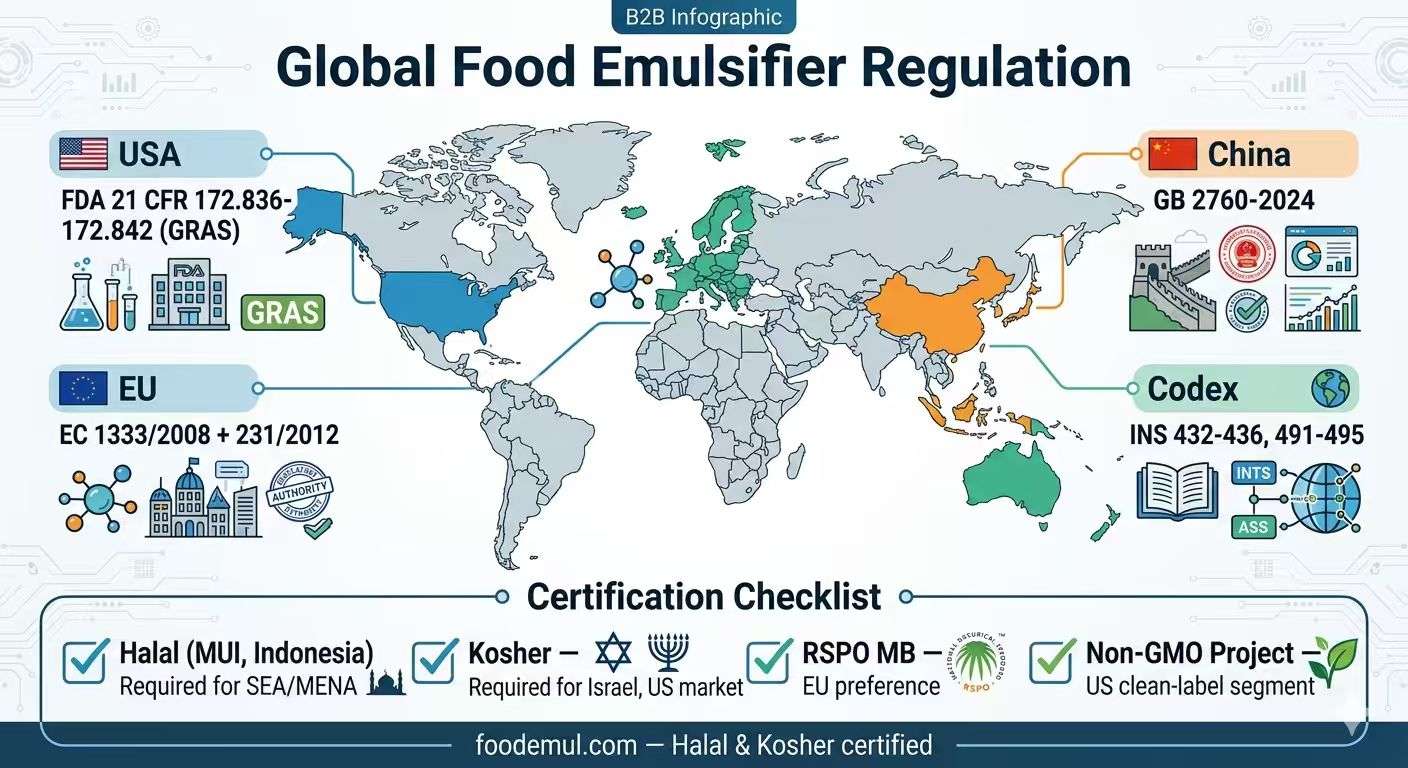
- How the EU E-number system, US FDA GRAS, and Codex Alimentarius each regulate food emulsifiers — and how they differ
- Complete E-number reference for Span, Tween, GMS, DATEM, SSL, lecithin, and other common emulsifiers
- Regulatory status of Span and Tween across 6 major markets (EU, US, China, Japan, Brazil, GCC)
- Religious and ethical certifications: Halal, Kosher, Non-GMO, RSPO — what’s required and why
- Clean-label considerations and how they interact with regulatory compliance
- A compliance verification framework for multi-market food manufacturers
- REACH, microplastics, and emerging regulatory risks for emulsifier users
1. Why Emulsifier Regulation Matters
Food emulsifiers are among the most thoroughly regulated ingredients in the global food supply. A product formulation that is compliant in one market may be rejected at the border of another — not because the emulsifier is unsafe, but because regulatory frameworks differ in how they classify, name, and limit the same molecule.
For manufacturers exporting to multiple regions, understanding these differences is not optional. A shipment held at customs for labeling non-compliance costs more than any savings from switching to a cheaper, undocumented emulsifier supplier.
If you are new to food emulsifier functionality, start with our guide to food emulsifier functions and applications. For the full Span/Tween product specification and regulatory framework, see our global food additive compliance guide.
2. The Three Pillars of Global Emulsifier Regulation
2.1 EU: The E-Number System
The European Union operates the most structured food additive regulatory framework globally, governed by Regulation (EC) No 1333/2008. Every approved food additive receives an E-number — a code that confirms the substance has been evaluated by the European Food Safety Authority (EFSA) and approved for specific food categories with defined maximum usage limits.
What an E-number means:
– The substance has passed EFSA safety evaluation (acute, chronic, reproductive, and genotoxicity studies)
– It is assigned to specific food categories with maximum permitted levels (MPLs)
– Purity specifications are defined in Commission Regulation (EU) No 231/2012
– It is subject to ongoing re-evaluation — EFSA completed re-evaluations of all food additives authorized before 2009, with emulsifiers among them
Key emulsifier E-numbers for food manufacturers:
| E-Number | Emulsifier | Function | Typical EU MPL | Notes |
|---|---|---|---|---|
| E322 | Lecithin | O/W emulsifier, natural origin | QS (quantum satis — no numerical limit) | Clean-label friendly |
| E432 | Polysorbate 20 (Tween 20) | O/W emulsifier, solubilizer | 1-10 g/kg (varies by food category) | Highest HLB (16.7) |
| E433 | Polysorbate 80 (Tween 80) | O/W emulsifier, fat destabilizer | 1-10 g/kg (varies by food category) | Most widely used food polysorbate |
| E434 | Polysorbate 40 (Tween 40) | O/W emulsifier | 1-10 g/kg | Less common; similar to Tween 60 |
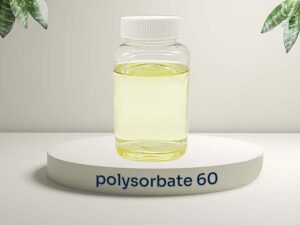
| E435 | Polysorbate 60 (Tween 60) | O/W emulsifier, aeration aid | 1-10 g/kg | Key cake gel component |
| E471 | Mono- and Diglycerides (GMS/DMG) | Multi-functional: anti-staling, aeration, fat structuring | QS | Most widely used food emulsifier globally |
| E472e | DATEM | Dough strengthener | QS | Essential for high-speed bread lines |
| E475 | Polyglycerol Esters of Fatty Acids (PGE) | Emulsifier, stabilizer | QS | Versatile across bakery, dairy, confectionery |
| E476 | PGPR | W/O emulsifier, viscosity reducer | 10 g/kg (chocolate) | Chocolate and compound coatings |
| E477 | Propylene Glycol Esters (PGMS) | Aeration, foam stabilizer | QS | Alpha-tending — excellent for whipped products |
| E481 | Sodium Stearoyl Lactylate (SSL) | Dough strengthener, crumb softener | QS | Bread and bakery |
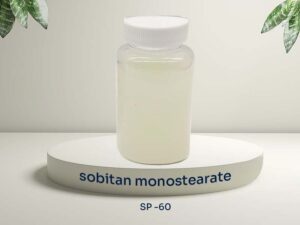
| E491 | Sorbitan Monostearate (Span 60) | W/O emulsifier, fat crystal stabilizer | 1-10 g/kg | Cake gel, margarine, chocolate |
| E492 | Sorbitan Tristearate (Span 65) | W/O emulsifier | 1-10 g/kg | High-fat systems, chocolate |
| E493 | Sorbitan Monolaurate (Span 20) | O/W co-emulsifier | 1-10 g/kg | Dressings, sauces, flavor emulsions |
| E494 | Sorbitan Monooleate (Span 80) | W/O emulsifier | 1-10 g/kg | Ice cream, spreads, confectionery |
| E495 | Sorbitan Monopalmitate (Span 40) | W/O emulsifier | 1-10 g/kg | Less common; intermediate Span |
For the complete specifications, see our Sorbitan Esters formulation guide and Polysorbate 80 formulation guide.
2.2 United States: FDA GRAS and Food Additive Petition
The US system operates differently from the EU E-number framework. Rather than a single standard list with food-category usage limits, the FDA classifies food ingredients through two pathways:
GRAS (Generally Recognized As Safe): The dominant pathway for emulsifiers. A substance is GRAS when qualified experts agree it is safe under conditions of intended use. GRAS can be “self-determined” (manufacturer’s own expert panel) or “FDA-notified” (manufacturer submits GRAS notice, FDA issues “no questions” letter).
Food Additive Petition: A formal pre-market approval process requiring FDA review of safety data. Rarely used for emulsifiers — most are already covered by GRAS.
| Emulsifier | US Regulatory Status | CFR Reference | Notes |
|---|---|---|---|
| Lecithin | GRAS | 21 CFR 184.1400 | Widely accepted |
| GMS/DMG (mono- and diglycerides) | GRAS | 21 CFR 184.1505 | Most widely used |
| Polysorbate 60 (Tween 60) | GRAS | 21 CFR 172.836 | Multipurpose additive |
| Polysorbate 80 (Tween 80) | GRAS | 21 CFR 172.840 | Multipurpose additive |
| Polysorbate 20 (Tween 20) | GRAS | 21 CFR 172.838 | Multipurpose additive |
| Span 60 (Sorbitan Monostearate) | GRAS | 21 CFR 172.842 | Multipurpose additive |
| Span 80 (Sorbitan Monooleate) | GRAS | — | Covered under 172.842 as sorbitan ester |
| SSL (Sodium Stearoyl Lactylate) | GRAS | 21 CFR 172.846 | Multipurpose additive |
| DATEM | GRAS | 21 CFR 184.1101 | Multipurpose additive |
| PGPR | GRAS | 21 CFR 172.854 | Approved for chocolate |
Key difference from EU: The US does not use E-numbers. Emulsifiers are listed on ingredient labels by their common or usual name: “mono- and diglycerides,” “polysorbate 80,” “sorbitan monostearate,” etc.
2.3 Codex Alimentarius — The International Standard
The Codex Alimentarius, jointly administered by FAO and WHO, provides the General Standard for Food Additives (GSFA, Codex STAN 192-1995). Codex standards are not directly enforceable law, but they serve as the reference for WTO trade disputes and are adopted directly by many developing countries.
Codex uses the INS (International Numbering System) — functionally identical to EU E-numbers but without the “E” prefix:
– EU E471 = INS 471
– EU E491 = INS 491
– EU E433 = INS 433
For most practical purposes, an EU-approved emulsifier with an E-number is also Codex-recognized under the corresponding INS number. However, permitted food categories and maximum levels may differ between the two systems.
3. Key Regional Market Snapshots
| Market | Regulatory Framework | Emulsifier Classification | Key Considerations |
|---|---|---|---|
| EU | EC 1333/2008, EFSA evaluation | E-numbers (E4xx for emulsifiers) | Strict food-category-specific MPLs; Span/Tween generally limited to 1-10 g/kg depending on category |
| US | FDA GRAS + Food Additive Petition | Common name on label | GRAS pathway is more flexible than EU; no E-number system |
| China | GB 2760 (National Food Safety Standard for Uses of Food Additives) | GB-listed additives with Chinese names and INS numbers | Must be explicitly listed; emulsifier use expanding as food processing grows |
| Japan | Food Sanitation Act, MHLW | List of Designated Additives + Existing Food Additives | Japan has its own approved list — some EU/US emulsifiers may not be listed |
| Brazil | ANVISA (Resolution RDC 27/2010) | Aligns closely with Codex/Mercosur | Mercosur harmonization makes Brazil the gateway for South American compliance |
| GCC (Gulf States) | GSO (Gulf Standardization Organization) | Broadly aligned with Codex + EU | Halal certification is effectively mandatory for most product categories |
| India | FSSAI (Food Safety and Standards Authority) | Follows Codex with some country-specific modifications | Growing market; regulatory modernization ongoing |
Our global food additive compliance guide covers regional limits in detail.
4. Religious & Ethical Certification: Halal, Kosher, Non-GMO, RSPO
Regulatory approval answers the question “can I use this emulsifier legally?” Certifications answer the questions that regulations do not: “Is this acceptable to my target consumers’ dietary requirements, ethical standards, and religious practices?”
4.1 Halal Certification
Halal certification confirms compliance with Islamic dietary law. For emulsifiers, the primary concern is the source of fatty acids — animal-derived stearic acid (typically from tallow) is not Halal, while vegetable-derived (palm, coconut, rapeseed) is acceptable.
Key requirements:
– Raw materials must be from Halal sources (vegetable oils are preferred; animal-derived materials require Halal slaughter documentation)
– Processing aids and catalysts must not introduce non-Halal contaminants
– Alcohol use in processing must be controlled or eliminated
– Production lines must be dedicated or validated for Halal production
All major Span and Tween emulsifiers can be Halal-certified when manufactured from vegetable fatty acid sources. Our Halal & Kosher compliance guide covers certification requirements in full.
4.2 Kosher Certification
Kosher certification ensures compliance with Jewish dietary law (kashrut). Similar to Halal, the key factor is raw material origin and production line management.
Kosher status types relevant to emulsifiers:
– Pareve: Neither dairy nor meat — the preferred classification for most emulsifiers
– Dairy: Must be clearly labeled; acceptable in dairy products
– Kosher for Passover: Additional restrictions on grain-derived ingredients during Passover
For verification procedures, see our Kosher PS80 verification guide.
4.3 Non-GMO Certification
Non-GMO certification verifies that emulsifiers are produced without genetically modified organisms. This covers both the raw materials (vegetable oils) and any processing aids derived from GMO sources.
Practical sourcing fact: Palm oil, coconut oil, and sunflower oil are inherently non-GMO — commercial GMO varieties of these crops do not exist. Soybean oil-derived emulsifiers may require IP (Identity Preserved) documentation if non-GMO status is required.
Our Span/Tween raw materials guide covers Non-GMO documentation.
4.4 RSPO (Sustainable Palm Oil)
RSPO certification addresses the environmental and social impacts of palm oil production — the source of the majority of fatty acids used in food emulsifiers. RSPO is not a food safety certification (it does not affect the functionality of the emulsifier), but it is increasingly required by European and North American retailers as a condition of listing.
RSPO supply chain models:
| Model | Traceability | Cost | Retailer Acceptance |
|——-|————-|——|———————|
| Identity Preserved (IP) | Full traceability to single certified plantation | Highest | Maximum |
| Segregated (SG) | Certified material kept separate; can blend from multiple certified sources | Moderate | Widely accepted in Europe |
| Mass Balance (MB) | Certified + non-certified mixed; volumes tracked administratively | Lower | Accepted for most applications |
| Book & Claim | Credits only; no physical traceability | Lowest | Generally not accepted for product claims |
For EU-market products, SG is increasingly the minimum expectation. For premium brands, IP is preferred.
4.5 The Value of Multi-Certification
A single emulsifier can carry Halal + Kosher + Non-GMO + RSPO certifications simultaneously, provided the raw materials and production processes support all four. Multi-certified emulsifiers simplify procurement by covering multiple markets with a single SKU — reducing inventory complexity, documentation burden, and the risk of using a non-compliant batch in the wrong market.
5. Emerging Regulatory Risks
5.1 REACH and Microplastics Concerns
The EU REACH regulation (Registration, Evaluation, Authorisation and Restriction of Chemicals) has drawn attention to polymers and, by extension, ethoxylated emulsifiers. Polysorbates (Tween series) contain polyoxyethylene chains — technically a polymer component — leading to questions about their REACH status and potential microplastics classification.
Our analysis in Are Polysorbates Microplastics? covers this topic in depth. The short answer: Polysorbates are not classified as microplastics under current EU definitions, but the regulatory landscape is evolving, and formulators should monitor ECHA (European Chemicals Agency) developments.
5.2 EU Deforestation Regulation (EUDR)
Effective from 2026, the EUDR requires companies placing palm-derived products on the EU market to prove they are deforestation-free, supported by geolocation data tracing to the plantation of origin. This directly affects palm-based emulsifiers including Span 60, Tween 80, GMS, DATEM, SSL, and PGPR.
RSPO certification supports EUDR compliance but does not automatically satisfy it. IP and SG supply chain models are better aligned with EUDR requirements than MB or Book & Claim.
5.3 Titanium Dioxide and the Precautionary Principle
The EU’s 2022 ban on titanium dioxide (E171) as a food additive signaled a shift toward stricter application of the precautionary principle. While no emulsifier has been similarly targeted, the regulatory environment is becoming less predictable. Formulators should maintain awareness of EFSA re-evaluation schedules and have backup options identified for key emulsifiers.
6. Compliance Verification Framework
When sourcing emulsifiers for multi-market products, verify these five items for each emulsifier in your formulation:
| Verification Point | What to Check | Why It Matters |
|---|---|---|
| 1. Regulatory status in target market | Is the emulsifier approved (E-number, GRAS, GB listing)? | Non-approved emulsifier = rejected at customs |
| 2. Maximum permitted level | Does your usage level comply with food-category-specific limits? | EU MPLs for Span/Tween are food-category-specific — exceeding them is a violation |
| 3. Raw material origin documentation | Certificate of origin for fatty acid source | Required for Halal, Kosher, Non-GMO, vegan claims |
| 4. Certificate validity and scope | Are Halal/Kosher/RSPO certs current and do they cover the specific product? | Expired or incorrect-scope certificates are not valid |
| 5. Batch-level documentation | TDS, COA, MSDS for each shipment | Enables traceability if quality or compliance questions arise |
For a complete emulsifier selection methodology that integrates regulatory constraints, see our Emulsifier Selection Framework.
7. Practical Strategies for Multi-Market Manufacturers
7.1 Design Once, Comply Everywhere
Formulate with emulsifiers that are approved in all your target markets. This typically means:
– Vegetable-source E471 (GMS/DMG) — nearly universally approved, largest permitted-use scope
– Vegetable-source lecithin (E322) — universally approved, clean-label
– Vegetable-source Span/Tween — approved in EU, US, Codex, China, and most major markets; verify category-specific MPLs
7.2 Document Before You Need It
The most common compliance failure is not an unapproved emulsifier — it is an approved emulsifier without documentation. Maintain current certificates (Halal, Kosher, Non-GMO, RSPO, ISO 22000) for every emulsifier in your formulation before a customer or regulator asks.
7.3 E-number vs Chemical Name — Know Your Market
| Market | Label Requirement | Example |
|---|---|---|
| EU | E-number OR chemical name | E491 or “Sorbitan monostearate” |
| US | Common or usual name | “Sorbitan monostearate” |
| China | Chinese name + INS number | 山梨醇酐单硬脂酸酯 (INS 491) |
| Codex countries | INS number or chemical name | INS 491 |
7.4 Build a Regulatory Review into Every Formulation Gate
Before finalizing any new formulation, run a regulatory check:
1. Is every emulsifier approved in the target market?
2. Is every usage level within the market’s permitted maximum?
3. Do you hold current certifications (Halal, Kosher, etc.) for the intended market?
4. Is the emulsifier’s raw material origin consistent with your label claims (vegan, plant-based, Non-GMO)?
8. Key Takeaways
- The EU E-number system, US FDA GRAS, and Codex Alimentarius form the three pillars of global emulsifier regulation. An emulsifier approved under all three is effectively global-market ready.
- Span (E491-E495) and Tween (E432-E435) are approved in all major food markets — including EU, US, China, Japan, and Codex countries — with food-category-specific usage limits in the EU.
- E471 (GMS/DMG) is the most universally accepted emulsifier — QS (no numerical limit) in the EU, GRAS in the US, and widely approved globally.
- Certifications (Halal, Kosher, Non-GMO, RSPO) are not regulatory requirements but commercial necessities for global market access. Vegetable-source Span/Tween/GMS can carry all four simultaneously.
- The regulatory landscape is not static. Monitor EUDR for palm-based emulsifiers, REACH developments for polysorbates, and EFSA re-evaluation schedules.
- Documentation is as important as the emulsifier itself. A compliant emulsifier without current certificates is a compliance risk.
For the full technical and regulatory specifications of Span and Tween emulsifiers, see our formulators guide. For certification verification procedures, see our Halal & Kosher compliance guide. For raw material sourcing documentation, see our Span/Tween raw materials guide.