
Estimated reading time: 11 minutes
In this guide:
- Why the “natural vs synthetic” debate misrepresents how food emulsifiers are actually made
- What “natural” really means — and doesn’t mean — in the context of emulsifier regulation
- The raw material reality: most Span, Tween, GMS, and lecithin are plant-derived, regardless of how they sound
- Functional trade-offs: when naturally positioned emulsifiers work, and when they fall short
- How Span and Tween fit: plant-derived raw materials, precise manufacturing, unmatched functionality
- A practical decision framework that prioritizes function first, consumer perception second
- Regulatory labeling considerations for EU, US, and export markets
1. The Question Most Formulators Get Wrong
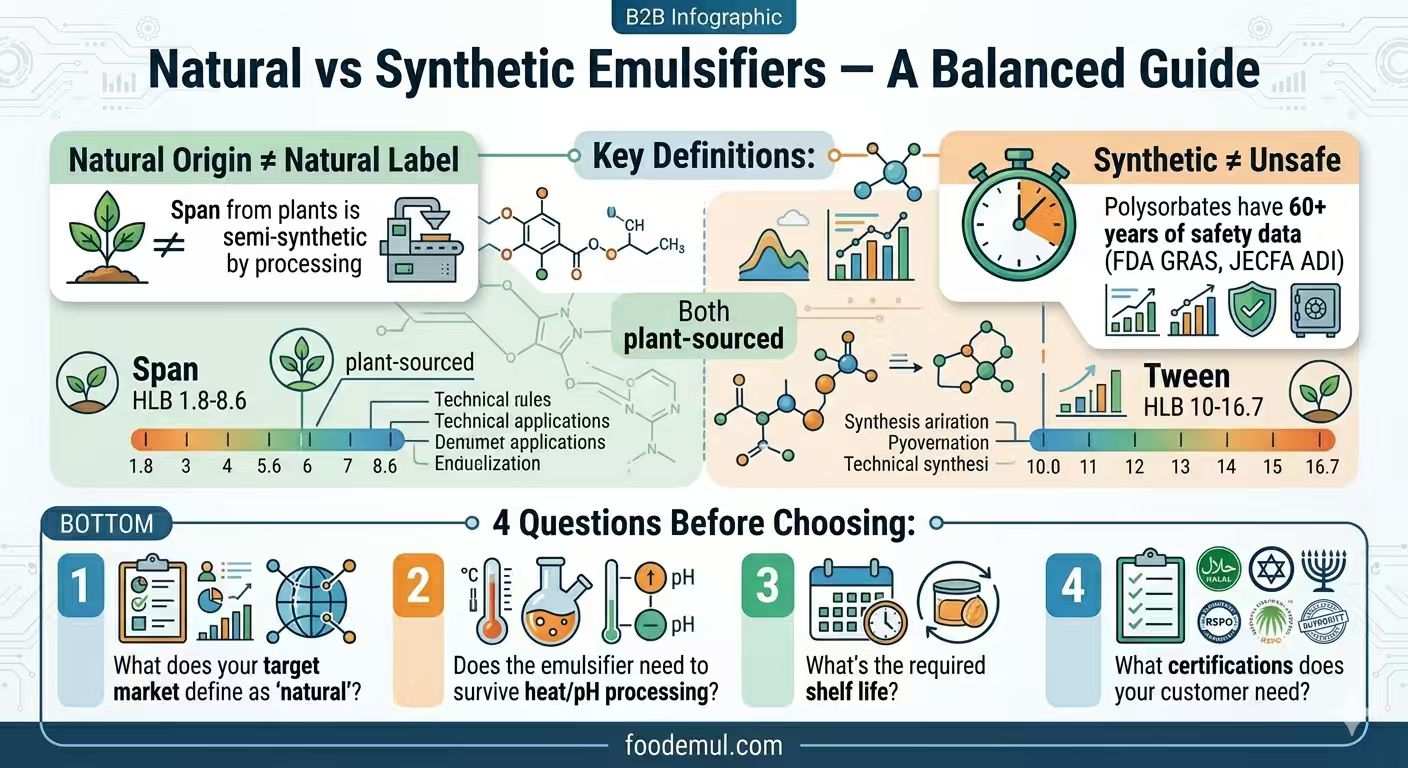
The most common question food manufacturers ask about emulsifiers is: “Is it natural or synthetic?” This question assumes a clean dividing line that does not exist. Most “synthetic-sounding” food emulsifiers — including Span 60 (E491), Tween 80 (E433), and GMS (E471) — are manufactured from vegetable oils using chemical processes that are no more “synthetic” than making soap from fat and lye.
The better question is: “What is this emulsifier made from, how is it processed, and does it perform the function my product needs?”
If you are new to food emulsifiers, start with our guide to food emulsifier functions and applications.
2. What “Natural” Actually Means in Food Regulation
2.1 There Is No Universal Definition
Neither the FDA, EU Commission, nor Codex Alimentarius provides a legally binding definition of “natural” for food additives, including emulsifiers. This absence creates a commercial reality where “natural” means whatever a retailer, certifier, or brand marketing team decides it means.
| Jurisdiction | “Natural” Regulation for Emulsifiers | Practical Effect |
|---|---|---|
| FDA (US) | No formal definition for “natural” | Any emulsifier can be described as natural if it contains nothing artificial or synthetic “that would not normally be expected” — this is guidance, not law |
| EU | No legal definition for “natural” additives | “Natural” on label refers to flavorings (Regulation 1334/2008), not emulsifiers |
| Codex Alimentarius | Guidelines for “natural” flavors exist, but not for emulsifiers | No international standard |
| Private certifications (Organic, Non-GMO Project, etc.) | Each defines its own scope | The practical gatekeepers of “natural” in the marketplace |
Our global food additive compliance guide covers regional regulatory frameworks in depth.
2.2 The Supply Chain Reality
A Span 60 molecule produced from RSPO-certified palm stearic acid (fatty acid) and corn-derived sorbitol (sugar alcohol) is, by its raw material origin, entirely plant-based. The esterification reaction that joins these two molecules uses heat, a catalyst, and vacuum — the same fundamental chemistry as making biodiesel or soap. Whether this qualifies as “natural” depends entirely on who is asking.
| Emulsifier | Raw Material Source | Processing | E-number |
|---|---|---|---|
| Span 60 (Sorbitan Monostearate) | Palm/coconut stearic acid + corn sorbitol | Esterification under vacuum | E491 |
| Tween 80 (Polysorbate 80) | Palm/coconut oleic acid + corn sorbitol + ethylene oxide | Span ethoxylation (~20 moles EO) | E433 |
| GMS/DMG (Mono-diglycerides) | Palm/rapeseed/soybean oil | Glycerolysis or direct esterification | E471 |
| Lecithin | Soybean/sunflower/rapeseed oil | Water degumming, physical separation | E322 |
| SSL (Sodium Stearoyl Lactylate) | Palm stearic acid + lactic acid | Esterification, neutralization with sodium | E481 |
Key point: Every major food emulsifier except egg lecithin can be produced from entirely plant-derived raw materials. The perception that Span and Tween are “synthetic” while lecithin is “natural” reflects consumer familiarity with starting materials — not the degree of processing. Lecithin undergoes physical separation; Span and Tween undergo controlled chemical reactions. Both start from vegetable oils.
Our guide to Span/Tween raw materials covers sourcing documentation in detail.
3. The Real Distinction: Processing Pathways, Not Origins
Rather than “natural vs synthetic,” the technically meaningful distinction is between three categories:
3.1 Physically Extracted Emulsifiers
Lecithin (E322) is the primary example. It is extracted from soybean, sunflower, or rapeseed oil by water degumming — a physical process that separates the phospholipid-rich gum from the triglyceride oil. No chemical modification occurs.
Advantages: Recognizable to consumers, clean-label friendly, available organic.
Limitations: Lower and less predictable HLB (~4-7), limited to O/W stabilization in most systems, batch-to-batch variability in phospholipid composition, can impart off-flavors at higher dosage, moderate heat sensitivity.
3.2 Chemically Modified Plant-Derived Emulsifiers
This category includes Span (E491-E495), Tween (E432-E435), GMS/DMG (E471), DATEM (E472e), SSL (E481), and PGPR (E476). All start from vegetable fatty acids; the modification is a controlled chemical reaction — esterification, ethoxylation, glycerolysis, or lactylation.
Advantages: Precise HLB targeting (2.1–16.7 across the Span/Tween range), predictable batch-to-batch performance, tailored functionality (dough strengthening, aeration, anti-staling, fat crystallization control), heat and pH stability.
Limitations: Consumer perception (E-numbers “sound” synthetic), not accepted by all clean-label certification schemes, ethoxylated Tween grades face additional scrutiny in some EU markets.
3.3 Biosynthetic / Fermentation-Derived Emulsifiers
Emerging category: sophorolipids, rhamnolipids, and glycolipids produced by microbial fermentation of sugars and vegetable oils. Currently used in cosmetics and cleaning products; food applications remain limited and expensive. Not yet competitive with Span/Tween/GMS for industrial food production.
4. The Clean-Label Realities
4.1 What Clean-Label Buyers Actually Want
Clean-label is not a regulation — it is a retailer and consumer preference. Research consistently shows that consumers evaluate ingredients by:
- Recognizability: “I know what lecithin is.”
- Perceived origin: “Plant-based sounds better.”
- Processing perception: “Physical extraction is better than chemical reaction.”
- E-number count: Fewer E-numbers = cleaner label.
These preferences do not always align with technical reality. Lecithin (E322) and GMS (E471) are both plant-derived, but GMS requires a chemical reaction step — making lecithin the preferred clean-label choice despite GMS often being functionally superior in baked goods.
4.2 Where Span and Tween Fit in Clean-Label Strategy
Span and Tween are plant-derived but not clean-label positioned for most consumer-facing brands. They are best deployed in:
| Market Position | Recommended Emulsifier Strategy |
|---|---|
| Mass-market packaged foods | Span/Tween compounds — maximum functionality, lowest cost-in-use |
| Premium “plant-based” positioning | Span/Tween + documented vegetable sourcing — “plant-derived emulsifier” on secondary packaging |
| Clean-label / fewest ingredients | Lecithin + GMS (E471) — recognizable, fewer E-number concerns |
| Organic certified | Organic lecithin only — essentially the only certified organic emulsifier available at scale |
| Vegan certified | Any vegetable-source Span/Tween/GMS with vegan documentation |
For natural substitutes for polysorbate 80, see our guide to PS80 alternatives.
5. Functional Reality: Where “Natural” Emulsifiers Fall Short
5.1 HLB Range Limitation
Lecithin has a natural HLB of 4-7 — suitable for W/O emulsions and some O/W systems, but unable to produce the fine, stable O/W emulsions required for beverages (HLB 12-16), cake batters (HLB 9-12), and ice cream (HLB 9-12) without blending with higher-HLB emulsifiers.
The Span/Tween family covers HLB 2.1 to 16.7 — the full practical range. Our HLB System guide explains how to use this range.
5.2 Batch Consistency
Physically extracted lecithin varies in phospholipid composition depending on the soybean/sunflower harvest, extraction conditions, and storage. This variability matters in high-speed production lines. Chemically manufactured Span, Tween, and GMS have tightly controlled specifications — same HLB, same melting point, same interfacial behavior, every batch.
5.3 Process Tolerance
Lecithin degrades at low pH (<4.0) and high temperatures (>150°C), limiting its use in acidified beverages and high-heat baking. Span 60 (stable to ~200°C) and Tween 80 (pH-independent, heat-stable to ~200°C) tolerate processing conditions that degrade physically extracted emulsifiers. Our Temperature & Process Effects guide covers thermal stability in detail.
5.4 Functional Specificity
No single “natural” emulsifier provides all the functions that a tailored Span/Tween compound system can deliver:
| Function | Best “Natural” Option | Best Performing Option |
|---|---|---|
| Cake aeration + foam stability | Lecithin + GMS | Span 60 + Tween 60 (1:2) |
| Ice cream fat destabilization | GMS | Span 80 + Tween 80 (1:2) |
| Beverage flavor emulsion (fine droplets) | Quillaja extract (limited) | Tween 80 + weighting agent |
| Bread anti-staling | GMS (DMG) | GMS + SSL |
| Margarine W/O stability | Lecithin (partial) | Span 60 + GMS |
6. A Practical Decision Framework
6.1 Start with Function, Not Philosophy
The sequence for choosing an emulsifier should be:
1. Required function — What must this emulsifier do? (aerate, stabilize, soften, structure fat)
2. Process conditions — Heat, pH, shear, freeze-thaw? (See Selection Framework)
3. Fat system — What oil/fat phase? Match the fatty acid chain. (See Span & Tween guide)
4. Regulatory — Which E-numbers are allowed in the target market?
5. Label positioning — Clean-label requirement? Vegan? Organic?
6. Cost — Cost-in-use comparison of functional alternatives.
Label positioning should constrain your choices, not drive them. Start with what works, then narrow to what your label allows.
6.2 When to Choose Each Emulsifier Type
| If Your Priority Is… | Choose… | Accept That… |
|---|---|---|
| Maximum functionality, lowest cost | Span/Tween compound system | Label will show E491/E433, not clean-label |
| Clean-label positioning | Lecithin (E322) + GMS (E471) | Functionality may be reduced; test extensively |
| Plant-based / vegan positioning | Vegetable-source Span/Tween + vegan documentation | E-numbers remain on label |
| Organic certification | Organic lecithin | Limited to O/W stabilization; higher cost; supply constraints |
| Global market access, multi-certification | Vegetable Span/Tween/GMS with Halal, Kosher, Non-GMO, RSPO | Documentation burden is higher, but product is universally compliant |
6.3 The Compound Strategy: Fewer E-numbers, Equal Performance
A strategically designed compound emulsifier system can deliver multiple functions with fewer E-numbers on the label. For example, a Span 60 (E491) + GMS (E471) compound — both vegetable-derived — provides dough strengthening, anti-staling, and fat structuring in bread at 0.3-0.5% total dosage, replacing a three-emulsifier system (DATEM + SSL + GMS) that lists two additional E-numbers.
Our Compound Emulsifiers guide covers blend design strategy.
7. The Regulatory Context: E-numbers Are Not a Warning Label
A widespread misconception is that E-numbers signal “chemical = bad.” In reality, an E-number means an ingredient has been evaluated by the European Food Safety Authority (EFSA) and found safe for its intended use — it represents the most rigorously evaluated category of food ingredients.
| Consumer Perception | Regulatory Reality |
|---|---|
| “E491 sounds chemical” | E491 = sorbitan monostearate, produced from vegetable fatty acids and sorbitol |
| “E-numbers are synthetic” | E322 = lecithin (physically extracted), E471 = mono-diglycerides (from vegetable oil) |
| “No E-numbers = natural” | “No E-numbers” on the label still means emulsifiers are present — they are simply listed by chemical name instead of E-number |
| “Clean-label is safer” | EFSA safety evaluations for E491-E495 and E432-E435 are more rigorous than for most unregulated “natural” alternatives |
For a full regulatory breakdown, see our guide on the Food Emulsifier Regulatory Landscape.
8. The Future: Biosynthetic Emulsifiers and Green Chemistry
Two trends are closing the gap between consumer perception and emulsifier chemistry:
Biosynthetic Span analogs: Research into enzymatic esterification of sorbitol with fatty acids promises Span-grade emulsifiers produced without traditional chemical catalysts — functionally identical but manufactured by a “biological” pathway. These are in development, not yet commercially competitive.
Fermentation-derived glycolipids: Sophorolipids and rhamnolipids produced by yeast and bacteria from sugar and vegetable oil feedstocks offer genuinely new emulsifier chemistries — not just “natural” versions of existing molecules. Current cost is 10-50× that of Span/Tween, limiting food applications. Our bio-based sorbitan esters guide covers the emerging green chemistry landscape.
9. Key Takeaways
- “Natural vs synthetic” is the wrong question. Ask instead: what are the raw materials, what is the processing, and does it perform?
- Span, Tween, and GMS are plant-derived. Their starting materials (vegetable fatty acids and sorbitol) come from palm, coconut, corn, or rapeseed — the same agricultural feedstocks as “natural” lecithin.
- E-numbers represent evaluated safety, not synthetic origin. Lecithin (E322) and Span 60 (E491) are both plant-derived; one is physically extracted, the other chemically esterified.
- Lecithin is the only widely available clean-label emulsifier — and it has functional limitations. Its HLB range (4-7), pH sensitivity, and batch variability restrict where it can replace Span/Tween systems.
- Choose by function first, then filter by label requirements. Starting with label constraints narrows your options before you know what works.
- Compound systems reduce E-number count. A strategically designed Span/Tween/GMS blend can deliver 3+ functions with 2 E-numbers.
For the full emulsifier selection methodology, see our Emulsifier Selection Framework. For raw material sourcing documentation and non-GMO verification, see our guide to Span/Tween raw materials.