
The right emulsifier performs differently at 4°C than at 180°C. Temperature changes everything: solubility, interfacial tension, crystallization kinetics, and phase behavior. A blend that works perfectly at ambient mixing temperature can fail during baking, retorting, or freeze-thaw cycling. At FoodEmul, we test emulsifier performance across the full temperature range because that is where formulations succeed or fail. This guide covers how heat, cold, and processing conditions affect Span and Polysorbate emulsifier performance — and how to design for it.
Temperature: The Most Underestimated Process Variable
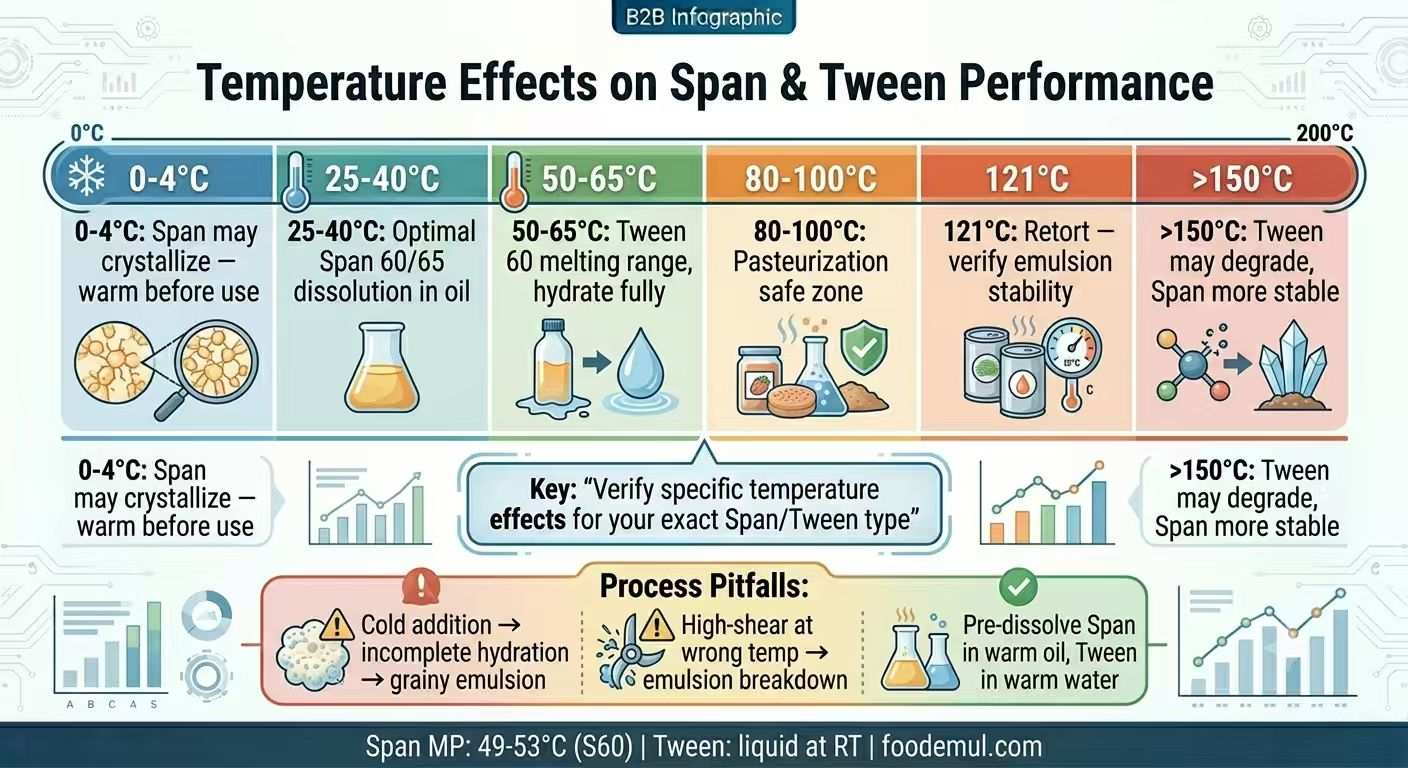
Emulsifier performance is not a fixed property — it changes with temperature. An emulsifier that produces a stable O/W emulsion at 25°C may crystallize and desorb from the interface at 4°C, or degrade and lose functionality at 200°C. Most production problems attributed to “emulsifier quality” are actually temperature problems.
| Temperature Range | What Happens to Emulsifiers | Products Affected |
|---|---|---|
| -25 to -10°C (frozen) | Solid emulsifiers crystallize at interface → potentially desorb; liquid emulsifiers increase in viscosity | Ice cream, frozen dough, frozen desserts |
| 0 to 8°C (refrigerated) | Some emulsifiers lose solubility; O/W emulsions may cream faster | Dairy beverages, dressings, spreads |
| 15 to 30°C (ambient) | Optimal performance range for most food emulsifiers | Shelf-stable products, ambient distribution |
| 60 to 100°C (pasteurization) | Fat melts, emulsifiers redistribute; interfacial film may weaken if emulsifier MP is too low | Pasteurized sauces, UHT dairy |
| 100 to 180°C (baking) | Water evaporates, fat melts completely; emulsifier must survive heat to function in finished product | Bread, cakes, biscuits |
| 180 to 220°C (frying/roasting) | Most emulsifiers degrade or polymerize; only high-MP emulsifiers survive | Deep-fried products, roasted snacks |
If you are new to emulsifier fundamentals, start with our guide to food emulsifier functions.
The Span/Polysorbate Thermal Profile
Melting Points and Heat Behavior
| Emulsifier | Physical Form at 25°C | Melting Point | Behavior Above MP |
|---|---|---|---|
| Span 65 (E492) | Solid powder | ~55-60°C | Becomes mobile, contributes to W/O stabilization at baking temp |
| Span 60 (E491) | Solid powder/flake | ~53-57°C | Co-crystallizes with fat; heat-stable film resists baking |
| Span 80 (E494) | Liquid/paste | ~10-15°C | Doesn’t require pre-melting; always mobile |
| Polysorbate 60 (E435) | Paste | ~25-30°C | Heat-stable to ~200°C; maintains O/W HLB through baking |
| Polysorbate 80 (E433) | Liquid | <-20°C | Most cold-tolerant food Polysorbate; remains pumpable at 0°C |
| Polysorbate 20 (E432) | Liquid | <-20°C | Highest HLB + best cold solubility |
| GMS / DMG (E471) | Powder/flake/bead | ~55-65°C | Must be pre-melted for even dispersion in most systems |
Key insight for Span: Span 60’s melting point (~55°C) is ideally positioned for baking applications. It remains solid and functional during batter mixing (20-25°C), then melts and mobilizes as the batter heats in the oven, positioning itself at the expanding air-bubble interface precisely when foam stability is needed most. This thermal timing — solid during mixing, mobile during baking — is a fundamental reason Span 60 outperforms lower-MP alternatives in cake gel systems.
For detailed Span specifications, see our Sorbitan Esters formulation guide. For Polysorbate, see our Polysorbate 80 formulation guide.
Cold Behavior: The Span Limitation
At refrigeration temperatures (0-8°C), Span 60 can crystallize at the oil-water interface. In some cases, this is beneficial — it provides additional mechanical stabilization to W/O margarine emulsions during cold storage. In O/W systems, however, Span crystallization at the droplet surface can create surface defects that promote droplet coalescence.
Rule of thumb: For products distributed and consumed cold (dressings, dairy alternatives, beverages), use Span 80 or Polysorbate 80 rather than Span 60 — their lower melting points prevent cold-temperature crystallization problems.
Process Effects Beyond Temperature
Shear — The Double-Edged Sword
Shear is necessary to create fine droplets — higher shear produces smaller, more stable droplets. But excessive shear can damage an emulsion:
| Shear Level | Droplet Size | Emulsion Stability | Risk |
|---|---|---|---|
| Low (gentle stirring) | Large (>50 µm) | Poor — droplets coalesce quickly | Visible oil separation |
| Medium (rotor-stator, colloid mill) | Medium (5-20 µm) | Good — standard for most food emulsions | Adequate for most products |
| High (high-pressure homogenizer) | Fine (0.5-5 µm) | Excellent — long-term stability | Over-processing can break stabilizer networks |
| Very high (ultrasonication) | Ultra-fine (<1 µm) | Excellent immediate stability | May desorb emulsifier from interface |
Polysorbate 80 advantage: Among food emulsifiers, Polysorbate 80 has one of the fastest interfacial adsorption rates. This means it stabilizes newly formed droplets almost instantly during homogenization — a significant advantage in high-speed beverage and dairy processing lines.
pH Effects
Nonionic emulsifiers (Span and Polysorbate) are largely pH-independent — a major advantage over ionic emulsifiers and proteins. Their stabilization mechanism (steric hindrance from polyoxyethylene chains) does not depend on surface charge, so they function equally well from pH 3 (fruit beverages) to pH 8 (baked goods).
| Emulsifier Type | pH Sensitivity | Best pH Range |
|---|---|---|
| Span / Polysorbate (nonionic) | Minimal | Full food range (2-10) |
| SSL / DATEM (anionic) | Moderate — lose charge at low pH | 4-8 |
| Lecithin (amphoteric) | Moderate to high — isoelectric point ~3.5 | 5-9 |
| Proteins (casein, whey) | High — denature at isoelectric point | Near neutral |
Ionic Strength (Salt Content)
Salt can destabilize emulsions stabilized by ionic emulsifiers (SSL, DATEM) through charge screening — salt ions shield the electrostatic repulsion between droplets, allowing them to approach and coalesce. Nonionic Span/Polysorbate emulsions are salt-insensitive, making them the preferred choice for high-salt products like processed meats, savory sauces, and cheese applications.
Freeze-Thaw Stability
Freeze-thaw cycling is more damaging than steady freezing. Each cycle causes:
1. Ice crystal growth → physical rupture of the interfacial film
2. Fat crystal transitions → emulsifier desorption from the interface
3. Concentration effects → as water freezes, the unfrozen phase becomes concentrated, shifting pH and ionic strength
| Freeze-Thaw Challenge | Span/Polysorbate Solution |
|---|---|
| Ice crystal puncture of O/W droplets | Polysorbate 80 provides steric stabilization that resists ice compression |
| Fat desorption at low temperature | Span 80 (liquid at -18°C) remains mobile vs Span 60 (solid at -18°C) |
| Serum phase concentration effects | Nonionic Span/Polysorbate are salt-insensitive — no charge screening |
For frozen products, use Span 80/Polysorbate 80 rather than Span 60/Polysorbate 60. The unsaturated (oleic) fatty acid chains remain liquid and functional at freezer temperatures.
Application-Specific Temperature Guidance
Baking (Ambient → 220°C)
The critical transition is from batter/dough temperature (~20°C) to oven temperature (180-220°C) in the first 5 minutes:
- Span 60 (MP 53°C): Solid during mixing → melts as batter heats → reorients at expanding air-bubble interface → forms heat-stable film that resists collapse until starch gelatinization sets the structure at ~85°C.
- DATEM / SSL: Remain functional throughout baking through ionic binding to gluten.
Process tip: Pre-melt Span 60 and GMS into the fat phase before adding to batter. Cold-powder addition results in undispersed particles that never fully activate during the short baking window.
UHT & Retort Processing (135-145°C)
Ultra-high temperature processing imposes the most severe thermal stress on emulsifiers:
– Use Polysorbate 80 or Polysorbate 60 — their polyoxyethylene chains are heat-stable to ~200°C.
– DMG/GMS (E471) survives retort but may redistribute — test full formulation under process conditions.
– Avoid low-MP emulsifiers that can degrade or produce off-flavors at retort temperatures.
Frozen Storage (-18°C to -25°C)
- Use Span 80/Polysorbate 80 (unsaturated, remain liquid at -18°C), not Span 60/Polysorbate 60.
- Important: emulsifiers prevent ice crystal growth indirectly — by stabilizing fat networks that physically obstruct ice crystal propagation — not by direct ice crystal modification. See our Ice Cream guide for ice crystal control mechanisms.
Cold-Filled Products (4-8°C)
- Use Polysorbate 20 or Polysorbate 80 — highest cold solubility.
- Ensure emulsifier is hydrated/dispersed in the warm phase before chilling. Adding cold emulsifier to cold liquid results in lumps.
Raw Material Storage & Handling
| Emulsifier | Storage Condition | Avoid | Shelf Life (unopened) |
|---|---|---|---|
| Span 60 powder | <25°C, dry, ventilated | Humidity (causes caking), >30°C (softening) | 18-24 months |
| Span 80 liquid | 15-25°C | Freezing (phase separation), >30°C (oxidation) | 12-18 months |
| Polysorbate 60 paste | 15-25°C | Freezing, prolonged >35°C | 12-24 months |
| Polysorbate 80 liquid | 15-25°C | Freezing (viscosity increase), direct sunlight | 18-24 months |
| GMS/DMG powder | <25°C, dry | Humidity, >30°C (clumping from surface melting) | 18-24 months |
Temperature cycling during transport is the most common cause of performance problems that are misattributed to “quality.” An emulsifier that has been through multiple heat-cool cycles during international shipping may show normal appearance but reduced functionality. Check supplier cold-chain protocols before attributing formulation issues to the wrong cause.
Key Takeaways
- Temperature determines whether your emulsifier works, not just how well. The same Span 60 that performs flawlessly at baking temperature can crystallize and fail at refrigeration temperature.
- Span 60’s 53°C melting point is not a limitation — it’s engineered timing. Solid during mixing, mobile during baking, functional when foam stability is needed.
- For cold products, use unsaturated fatty acid chains. Span 80/Polysorbate 80 (oleic) remain liquid and functional at -18°C; Span 60/Polysorbate 60 (stearic) crystallize.
- Nonionic Span/Polysorbate are pH and salt insensitive. Use them in high-acid and high-salt products where ionic emulsifiers fail.
- Freeze-thaw cycling is more damaging than steady freezing. Each cycle mechanically ruptures interfacial films.
- Pre-melt high-MP emulsifiers into the fat phase. Cold powder addition wastes emulsifier performance.
For full emulsifier selection by process condition, see our Emulsifier Selection Framework. For the science behind Span/Polysorbate interfacial behavior, see our Span & Polysorbate formulators guide.
Need emulsifiers that survive your process conditions? We manufacture Span 60, Polysorbate 80, and the full range — reach out for technical data or samples.