

Polysorbate 20 at HLB 16.7 and Polysorbate 80 at HLB 15.0 look close on paper — but the lauric acid (C12:0) chain on Polysorbate 20 behaves nothing like the oleic acid (C18:1) chain on Polysorbate 80. The fatty acid difference changes everything: solubility, foam behavior, taste profile, and which food systems each one works in. At FoodEmul, we manufacture both. This guide compares them on every metric that matters for formulation.
Introduction to Polysorbates
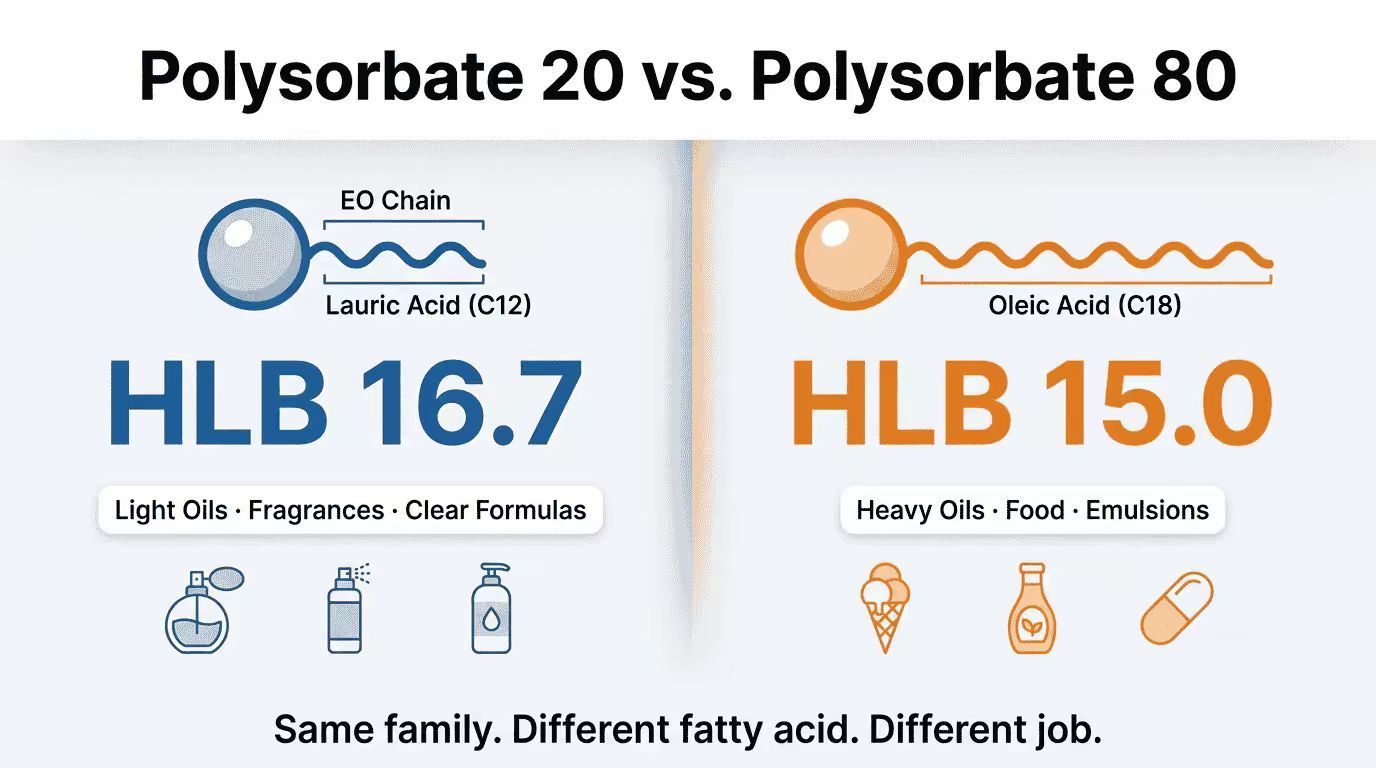
In the world of industrial chemistry and formulation, polysorbates represent a critical class of emulsifiers used extensively across the food, pharmaceutical, and cosmetic industries. While they share a common lineage as ethoxylated sorbitan esters, the distinction between Polysorbate 20 and Polysorbate 80 is significant, dictating their specific performance in solubilizing oils and stabilizing emulsions. For a detailed introduction, see What Is Polysorbate 80 (E433)?
TL;DR — Polysorbate 20 vs. 80 at a Glance
Choose PS20 (E432, HLB 16.7) when working with short-chain fatty acids (C12 lauric acid) — lighter oils, fragrances, solubilization in personal care and beverages.
Choose Polysorbate 80 (E433, HLB 15.0) when working with long-chain unsaturated fatty acids (C18:1 oleic acid) — heavier oils, food emulsions, ice cream, dressings, and general-purpose emulsification.
Both are FDA GRAS, EFSA-approved, Kosher & Halal certified from Foodemul.
For B2B buyers and formulators, selecting the correct surfactant is not merely a matter of preference but of chemical compatibility. This guide breaks down the technical differences, HLB values, and optimal applications for both variants. For a complete overview of all Polysorbate types, see our comprehensive Polysorbate emulsifiers guide. For applications requiring reduced water solubility, Polysorbate 21 (Polysorbate 21) — a low-EO monolaurate — offers controlled wetting and emulsification in agricultural and industrial formulations.
Chemical Composition and Structure
Both Polysorbate 20 and Polysorbate 80 are non-ionic surfactants belonging to the polysorbate family. They are formed by the ethoxylation of sorbitan before the addition of fatty acids. The primary difference lies in the fatty acid tail attached to the polyoxyethylene sorbitan portion of the molecule.
Polysorbate 20 (Polyoxyethylene (20) Sorbitan Monolaurate)
Polysorbate 20 is esterified with Lauric Acid, a medium-chain fatty acid typically derived from coconut or palm kernel oil. Because lauric acid has a shorter carbon chain (C12), the resulting molecule is relatively more hydrophilic (water-loving). This structural characteristic makes it an exceptional solubilizer for lighter oils.
Polysorbate 80 (Polyoxyethylene (20) Sorbitan Monooleate)
Polysorbate 80 is esterified with Oleic Acid, a long-chain unsaturated fatty acid (C18) found in olive oil and other vegetable sources. The longer, unsaturated hydrocarbon chain gives Polysorbate 80 a higher affinity for heavier, more complex lipids. It creates a robust interface between water and thicker oils.
The HLB Factor: Hydrophilic-Lipophilic Balance
The Hydrophilic-Lipophilic Balance (HLB) system is the standard metric for predicting surfactant behavior. Both polysorbates are high-HLB emulsifiers, meaning they are water-soluble and favor Oil-in-Water (O/W) emulsions.
- Polysorbate 20 HLB: ~16.7. Its higher value indicates a strong affinity for water. It acts as a wetting agent and is highly effective at solubilizing essential oils and fragrances into water-based systems without cloudiness.
- Polysorbate 80 HLB: ~15.0. While still hydrophilic, the lower HLB compared to Polysorbate 20 reflects its stronger lipophilic (oil-loving) tendency due to the oleate tail. This makes it superior for emulsifying vegetable oils, waxes, and heavier fats.
Key Applications and Use Cases
When to Use Polysorbate 20
Due to its lauric acid base, Polysorbate 20 is the industry standard for solubilizing rather than heavy-duty emulsification. It is gentle and non-irritating, making it a staple in personal care.
- Cosmetics & Personal Care: Used to disperse fragrance oils and essential oils in body sprays, toners, and shampoos where clear formulations are desired.
- Pharmaceuticals: Acts as an excipient to stabilize aqueous formulations of medications.
When to Use Polysorbate 80
Polysorbate 80 is the heavy lifter of the two. Its ability to handle complex lipids makes it indispensable in food science and parenteral drug delivery.
- Food Industry: Widely used in ice cream (to prevent fat globule coalescence and improve texture), salad dressings, and baked goods.
- Pharmaceuticals: Essential for solubilizing active pharmaceutical ingredients (APIs) that are poorly soluble in water, including biologics and vaccines.
- Skincare: Used in creams, lotions, and balms where thicker vegetable oils (like almond or olive oil) need to be emulsified into water.
Technical Comparison Table: Polysorbate 20 vs. 80
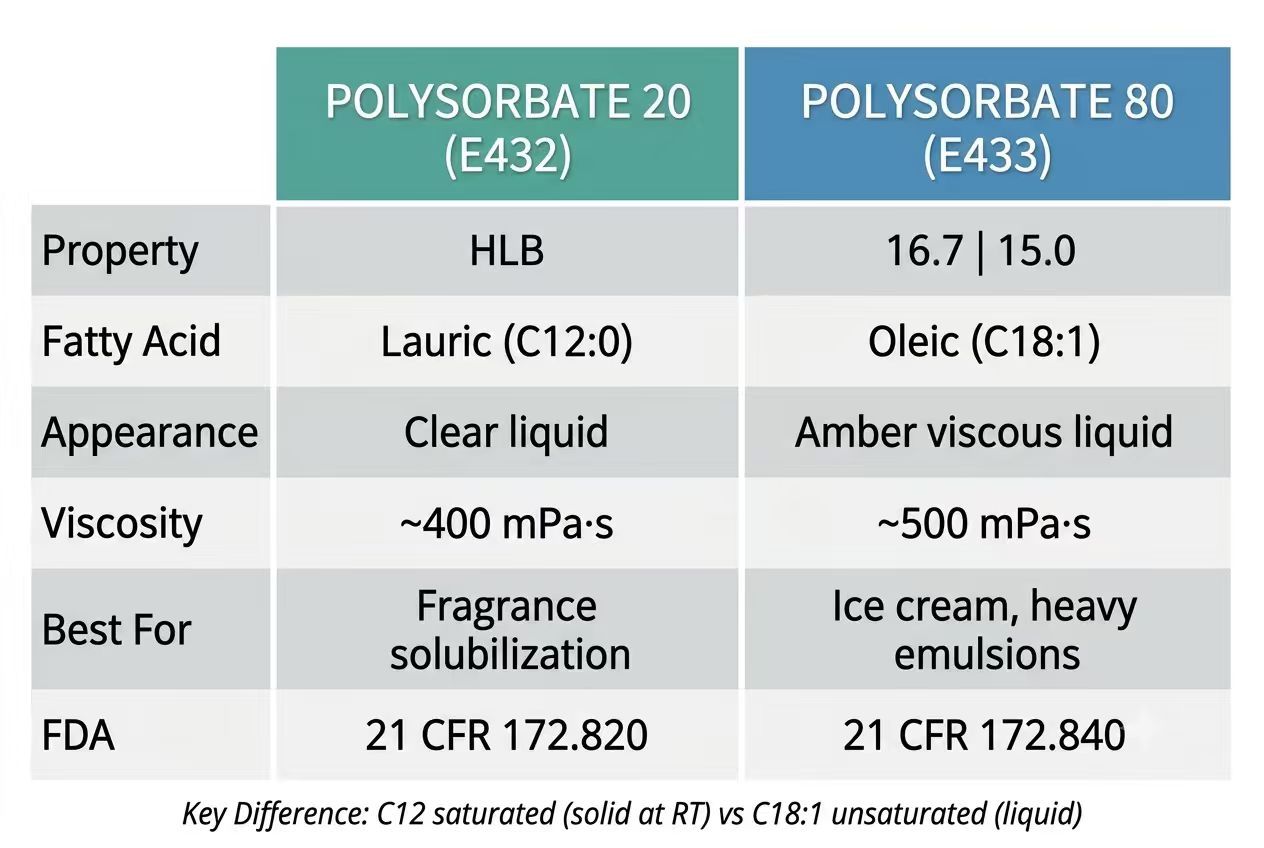
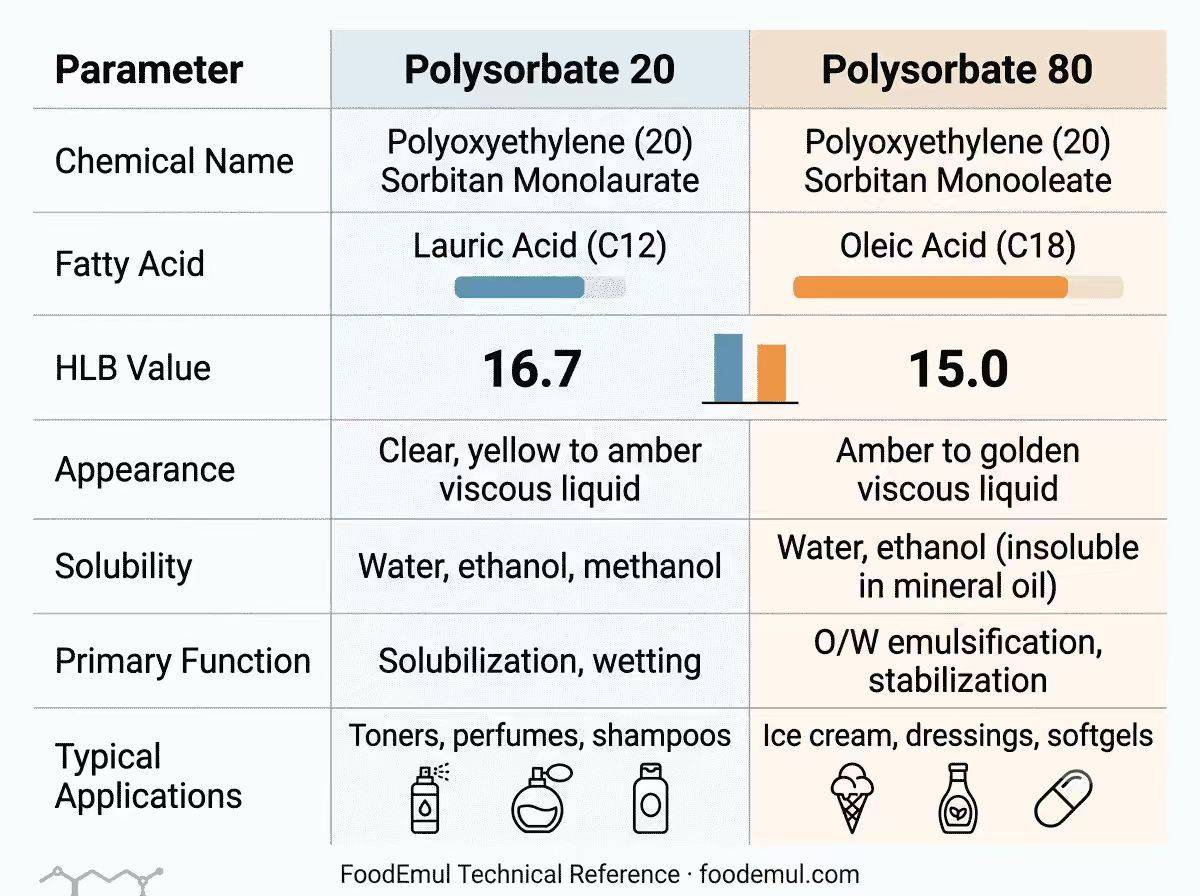
| Feature | Polysorbate 20 | Polysorbate 80 |
|---|---|---|
| Chemical Name | Polyoxyethylene (20) Sorbitan Monolaurate | Polyoxyethylene (20) Sorbitan Monooleate |
| Primary Fatty Acid | Lauric Acid (C12) | Oleic Acid (C18) |
| HLB Value | ~16.7 | ~15.0 |
| Appearance | Clear, yellow to amber viscous liquid | Amber to golden viscous liquid |
| Solubility | Soluble in water, ethanol, methanol | Soluble in water, ethanol; Insoluble in mineral oil |
| Primary Function | Solubilizer (Fragrances/Essential Oils) | Emulsifier (Vegetable Oils/Fats) |
| Common CAS Number | 9005-64-5 | 9005-65-6 |
Safety and Regulatory Status
Both surfactants are generally recognized as safe (GRAS) by the FDA and are approved for use in food and cosmetics within specific concentration limits. However, due to the difference in their chemical precursors, they are not always interchangeable in regulated formulations. For example, in ophthalmic or injectable pharmaceutical applications, the specific grade and purity (often requiring low peroxide levels) of Polysorbate 80 are strictly mandated to ensure stability and patient safety.
The FDA classifies both under their respective GRAS regulations — Polysorbate 20 under 21 CFR 172.820 and Polysorbate 80 under 21 CFR 172.840. Both are permitted at levels up to 1% of the finished food product in over 30 food categories.
The European Food Safety Authority (EFSA) groups polysorbates E432–E436 under a common Acceptable Daily Intake (ADI) of 25 mg/kg body weight per day (EFSA Journal 2015;13(7):4152). For a 70 kg adult, this equates to 1.75 grams of pure polysorbate daily — far exceeding typical dietary exposure.
Both polysorbates are also approved by the Joint FAO/WHO Expert Committee on Food Additives (JECFA) and comply with Codex Alimentarius General Standard for Food Additives (GSFA).
The FDA recognizes both as GRAS (Generally Recognized as Safe) under 21 CFR 172.840 (Polysorbate 80) and 21 CFR 172.835 (Polysorbate 20), while EFSA has reaffirmed their safety as food additives (E432–E436) in its 2015 re-evaluation (EFSA Journal 2015;13(7):4152). For cosmetic applications, the Cosmetic Ingredient Review (CIR) Expert Panel has concluded both are safe as used in cosmetic formulations (CIR Final Report, 2015).
When to Choose Polysorbate 20 vs. 80 — A Practical Decision Guide
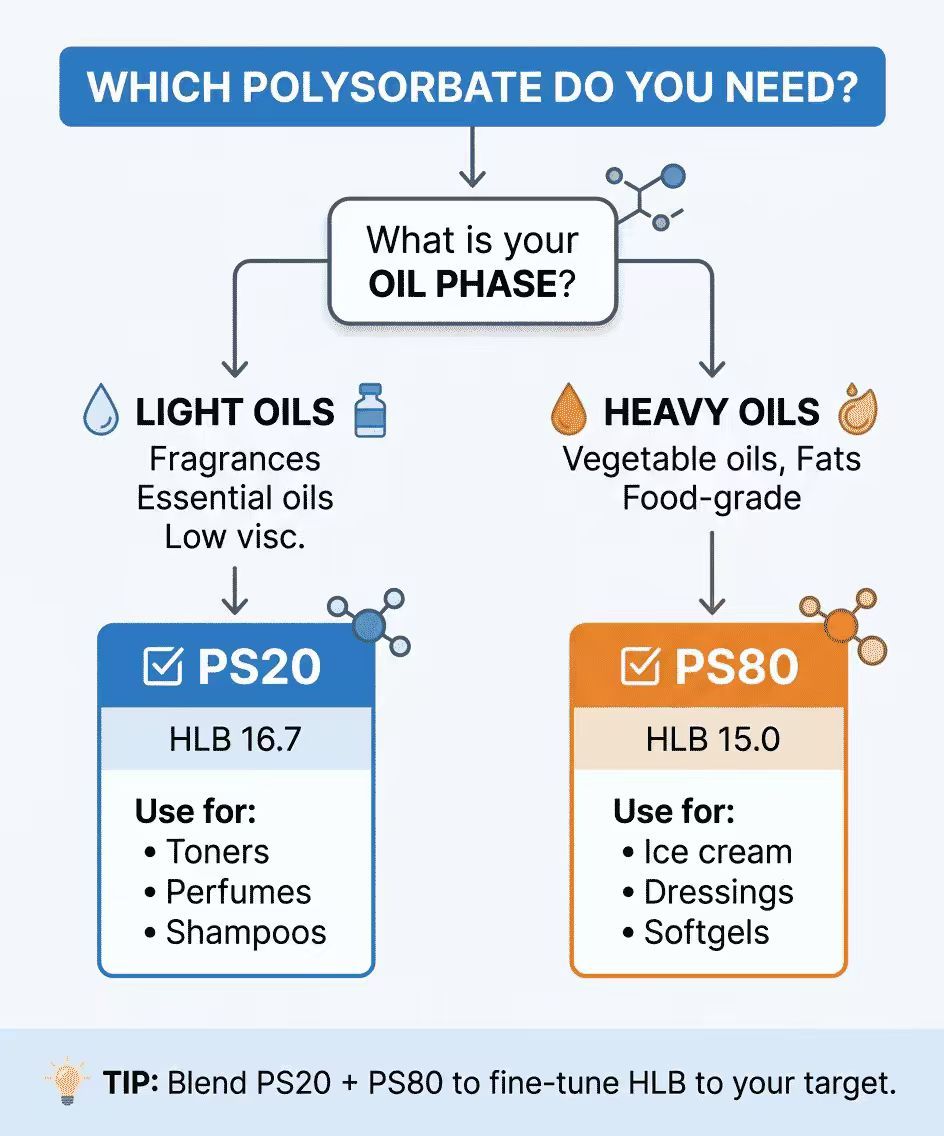
The choice between Polysorbate 20 and 80 comes down to your oil phase. Here is a straightforward decision framework based on formulation chemistry and practical experience in emulsifier manufacturing:
Choose Polysorbate 20 When:
- Your formula uses light essential oils, fragrances, or low-viscosity carriers (isopropyl myristate, caprylic/capric triglyceride, mineral oil light grade).
- You need a water-soluble surfactant for aqueous systems — beverages, toners, room sprays, and micellar waters.
- Your target HLB requirement is 15.0–17.0, where Polysorbate 20 (HLB 16.7) provides the strongest O/W emulsification in the series.
- You are formulating personal care products with light emollients: face mists, cleansing waters, water-based serums.
- The final product must remain low-viscosity and transparent — Polysorbate 20 produces thinner, clearer emulsions than Polysorbate 80.
Choose Polysorbate 80 When:
- Your formula contains heavier oils: castor oil, mineral oil (heavy), jojoba oil, avocado oil, shea butter olein, or rich botanical carriers with high unsaponifiable content.
- You need stronger emulsification for viscous O/W systems: creams, body lotions, sauces, mayonnaise-type dressings, and dairy emulsions.
- Your target HLB requirement is 14.0–15.5 — Polysorbate 80 (HLB 15.0) sits in the sweet spot for medium-to-heavy oil phases.
- You are formulating bakery emulsifiers (cake gels, bread improvers), dairy emulsions (ice cream, coffee creamers), or rich cosmetic creams requiring both emulsification and a smooth sensory profile.
- Thermal processing is involved: Polysorbate 80 demonstrates superior stability in baked goods and heat-processed foods, where Polysorbate 20 degrades faster at elevated temperatures.
Quick rule of thumb: If you can see through your oil phase at room temperature, start with Polysorbate 20. If your oil is thick, opaque, or high-viscosity, reach for Polysorbate 80. For industrial formulators working with systems containing both light and heavy oils: a blend of Polysorbate 20 and 80 (or a Span co-emulsifier) often yields better stability than either alone. Refer to the emulsifier ratio table in the Technical Comparison section above for starting-point HLB calculations.
Disclaimer: This guide serves as a formulation reference. Always verify your finished product against the applicable regulatory framework (FDA 21 CFR, EU Regulation (EC) No 1333/2008 on food additives, or national cosmetic regulations) before commercial production.
Can Polysorbate 20 Replace Polysorbate 80? Substitution Guidelines
The short answer: sometimes, but not always. Whether substitution works depends on the specific formulation and the role the emulsifier plays. Having evaluated hundreds of formulation inquiries at Foodemul, here is what the chemistry and practical experience tell us:
When Substitution Works
- High-HLB systems (15+): Both Polysorbate 20 (HLB 16.7) and Polysorbate 80 (HLB 15.0) can function as primary O/W emulsifiers above HLB 15. If your formula already targets this range, Polysorbate 20 can often replace Polysorbate 80 with minimal adjustment — the HLB shift is just 1.7 units, which most systems tolerate.
- Water-dominant formulations: Solutions, toners, and aqueous sprays where the oil phase is minimal (<5%) tolerate substitution well. The surfactant is acting more as a solubilizer than a true emulsifier in these cases.
- When lower final-product viscosity is desired: Polysorbate 20 produces thinner, more flowable emulsions than Polysorbate 80. If your current Polysorbate 80 formulation is thicker than intended, switching to Polysorbate 20 can be a deliberate viscosity-tuning strategy.
When Substitution Fails
- Heavy oil systems: Polysorbate 20 cannot adequately emulsify castor oil, mineral oil (heavy grade), or rich botanical carriers. The lauric acid tail (C12) is simply too short and too saturated to penetrate and stabilize the oil-water interface of long-chain, unsaturated triglycerides. Expect phase separation within hours to days.
- High-temperature processing: Polysorbate 80’s oleic acid tail (C18:1) provides significantly better thermal stability than Polysorbate 20’s lauric tail (C12). In baked goods, sauce processing, and any application above 60°C for extended periods, Polysorbate 80 holds its emulsifying capacity while Polysorbate 20 can degrade. The 2015 EFSA re-evaluation notes peroxide formation as a key stability parameter — Polysorbate 80 generates fewer peroxides under thermal stress than Polysorbate 20 (EFSA Journal 2015;13(7):4152).
- Low-HLB co-emulsifier systems: If your formula relies on Span 80 (HLB 4.3) or Span 85 (HLB 1.8) as a co-emulsifier, substituting Polysorbate 80 → Polysorbate 20 shifts the overall system HLB significantly upward. Polysorbate 80 (HLB 15.0) + Span 80 (HLB 4.3) = HLB range 4.3–15.0 covering nearly the entire emulsification spectrum. Polysorbate 20 (HLB 16.7) + Span 80 (HLB 4.3) leaves a gap in the 5–12 range where W/O and intermediate emulsions live, effectively breaking the blend’s flexibility.
Practical Testing Protocol
Before committing to any substitution in a commercial formula, run a small-batch stability test:
- Prepare 50g test batch with the substituted emulsifier at the same concentration.
- Split into two aliquots: one at 25°C (ambient), one at 45°C (accelerated).
- Observe at 24 and 48 hours for phase separation, viscosity change, color shift, and odor development.
- Verify HLB: Use the standard HLB calculation method (Griffin, 1949) to confirm the adjusted system falls within your oil phase’s required HLB range. An off-by-2 HLB error can mean the difference between a stable 12-month shelf life and separation within a week.
Note: For regulated food products, any formulation change affecting the emulsifier system constitutes a material change. Review the updated ingredient declaration against your market’s labeling requirements (FDA 21 CFR 101.4, EU FIC Regulation (EU) No 1169/2011) before launch.
How Polysorbate 60 and the Span Series Compare
While the Polysorbate 20 vs. 80 comparison is the most common, Polysorbate 60 (E435, HLB 14.9) offers a higher melting point for heat-processed foods like bakery and confectionery, and the Span series (E491–E495, HLB 2–9) provides low-HLB W/O emulsifiers for fat-based systems.
For these comparisons, see our dedicated guides: PS60 vs Polysorbate 80 and Span Series E491–E495.
Conclusion: Making the Right Selection
Choosing between Polysorbate 20 and Polysorbate 80 depends entirely on the nature of the oil phase in your formulation:
- Choose Polysorbate 20 if you are working with light essential oils, fragrances, or require a clear solubilizate in a water-based product.
- Choose Polysorbate 80 if you are emulsifying heavier vegetable oils, fatty acids, or formulating food products like ice cream that require structural stability.
By aligning the surfactant’s lipid tail (Laurate vs. Oleate) with your oil phase, you ensure thermodynamic stability and optimal performance in your final product.
For technical specifications and sourcing, visit the Polysorbate 20 product page or the Polysorbate 80 product page. For formulation guidance, see the Polysorbate 80 Formulation & HLB Synergy Guide.
Family overview: For the full four-way polysorbate comparison (20 vs 40 vs 60 vs 80) with decision framework, see our Polysorbate Emulsifiers Complete Guide.
Technical specifications: For the complete PS20 TDS with HLB, CMC, solubility, and quality specifications, see our Polysorbate 20 TDS & Specifications.
Further reading: PS20 Usage Guide · PS20 Technical Data Sheet · What Is Polysorbate 80? · Polysorbate 80 Comprehensive Guide
Not sure which Polysorbate fits your system? We manufacture Polysorbate 20 and Polysorbate 80 alongside the full sorbitan ester range — reach out for technical guidance or samples.
