
So you need to swap out polysorbate 60 or 80. Maybe your supply chain is a mess right now. Maybe a customer wants the E-numbers off the label. Maybe you just want options.
I’ve been sourcing and formulating with polysorbates for years, and I’ve seen what works in real production environments — not just on a spec sheet. The five substitutes below are ones I’d actually recommend to a formulator, ranked by what you’re trying to accomplish.
For this article, I compared performance data, talked to our technical team, and pulled from actual customer formulations where someone successfully made the switch. The goal is to save you the trial-and-error.
Here’s the short version before we go deep:
If you’re replacing polysorbate 80 (the oleate one, HLB 15.0), your best starting points are lecithin, Span 80 with a gum, or cetearyl glucoside.
If you’re replacing polysorbate 60 (the stearate one, HLB 14.9), try lecithin, Span 60 with a gum, or DATEM.
Most of these substitutes work for both, just with slightly different HLB tuning. Let’s walk through each one.
Polysorbate 60 is defined by GB 25553—2010 (harmonized with FCC-IV):
oxyethylene content 65.0–69.5%,
acid value ≤2.0 mg KOH/g,
saponification value 45–55 mg KOH/g,
moisture ≤3%.
Polysorbate 80 follows GB 25554—2010 with oleic acid as the fatty acid backbone. Both are nonionic O/W emulsifiers with well-characterized quality parameters that directly affect emulsion performance.
1. For clean-label food: lecithin
If you’re trying to strip E433 or E435 off your ingredient list, lecithin is where most formulators start. It comes from soy, sunflower, or egg yolk, and consumers recognize it as food, not a chemical.
It handles oil-in-water emulsions across a wide range, which is why it covers both PS60 and PS80 applications.
Lecithin works well in chocolate, baked goods, instant drink powders, and sauces.
The catch: lecithin’s HLB sits around 4 to 7, way below either polysorbate. You’ll probably need a fluid lecithin or a mix with guar gum or xanthan to match the stability you’re used to. Test small batches first. There’s no way around that.
2. For whipped toppings and aeration: Span 60 or Span 80 plus hydrocolloids
Polysorbates are really good at holding air in whipped creams and dessert toppings. One ingredient alone won’t replace that. You need a two-part system.
If you’re replacing PS60, pair Span 60 (Sorbitan Monostearate) with xanthan gum or methylcellulose.
If you’re replacing PS80, use Span 80 (Sorbitan Monooleate) with the same hydrocolloids.
The sorbitan ester grabs the fat. The hydrocolloid builds the viscosity that traps the air bubbles. Both Span 60 and Span 80 are in the same chemical family as the polysorbates, so your Kosher and Halal certifications usually carry right over.
Unlike lecithin, this combo won’t work for clean label. But if you just need performance, it’s the closest match.
3. For bakery and dough conditioning: DATEM or CITREM
In industrial baking, polysorbates soften the crumb and keep things fresh longer. Two established bakery emulsifiers can step in.
DATEM (Diacetyl Tartaric Acid Esters of Mono- and Diglycerides) is a strong dough strengthener that gives you good bread volume. It works for both PS60 and PS80 bakery applications.
CITREM (Citric Acid Esters of Mono- and Diglycerides) is often seen as the more natural-friendly choice for fat-based systems.
Both have been in commercial bakeries for decades, and the supply chain is stable. That alone makes them worth a look.
4. For cosmetics and lotions: cetearyl glucoside
Skincare brands have been dropping PEG-based emulsifiers for a while now, and cetearyl glucoside has become the standard swap.
It’s used in natural face creams, body lotions, and gentle cleansers.
Unlike polysorbates, which form micellar emulsions, cetearyl glucoside gives you a lamellar structure. That lamellar arrangement actually helps with skin hydration, so you’re getting a functional benefit on top of the cleaner INCI profile. Works for both PS60 and PS80 in personal care.
5. For heavy-duty industrial use: PEG-100 stearate
Not chasing a clean label. Just need a synthetic workhorse that performs.
PEG-100 stearate shares the same stearic acid backbone as PS60 and has an HLB in the same neighborhood, around 15 to 16. For industrial emulsions, pharmaceutical ointments, or anywhere the label story doesn’t matter, it’s practically a drop-in.
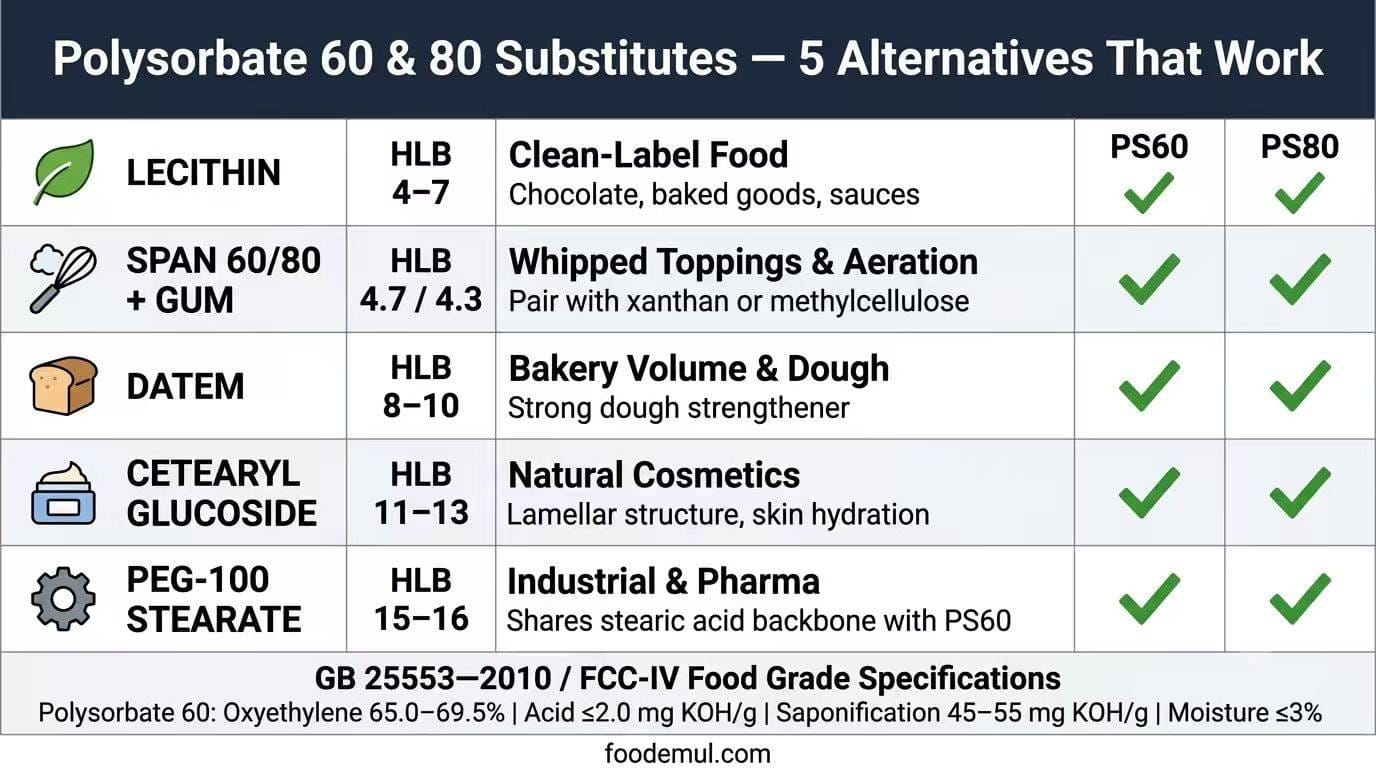
All five at a glance
| Substitute | HLB Range | Best Application | PS60 | PS80 |
|---|---|---|---|---|
| Lecithin | 4–7 | Clean-label food | Yes | Yes |
| Span 60 or 80 + gum | 4.7 / 4.3 | Whipped toppings | Yes | Yes |
| DATEM | 8–10 | Bakery volume | Yes | Yes |
| Cetearyl glucoside | 11–13 | Natural cosmetics | Yes | Yes |
| PEG-100 stearate | 15–16 | Industrial & pharma | Yes | Yes |

Three things to check before you switch
For a deeper comparison, see our Polysorbate 60 vs 80 formulation guide.
HLB isn’t everything. Temperature, mixing speed, and which phase goes in first all change when you swap emulsifiers. Budget for bench trials.
Different emulsifiers, different rules. PS60 and PS80 both have GRAS status with well-established safety data. Your substitute might have a different regulatory profile. Check what your target market requires before you commit.
Start small. Every substitute changes something: mouthfeel, shelf stability, viscosity. Run a small batch, let it sit a week, then decide.
Here at Foodemul, we’ve been supplying food-grade emulsifiers for over a decade, and we carry the full Span and polysorbate range. Tell us what you’re formulating — we’ll recommend the right substitute and send a sample to test.