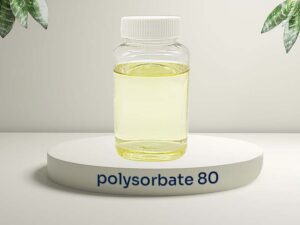

Polysorbate 80 at HLB 15.0 looks like a straightforward O/W emulsifier on paper. In practice, its real power shows up in blends — paired with Span 60, Span 80, or other emulsifiers, it produces interfacial films that outperform any single emulsifier. At FoodEmul, we see this synergy in formulations every day. This guide covers the HLB strategy, dosage ranges, and practical pairings that make Polysorbate 80 the most versatile emulsifier in the food-grade Polysorbate family. For a detailed technical guide on polysorbate solubilization — CMC, micelles, and essential oil loading data — see our Polysorbate Solubilizers Guide.
Technical Basics: Grade Selection & HLB Targeting
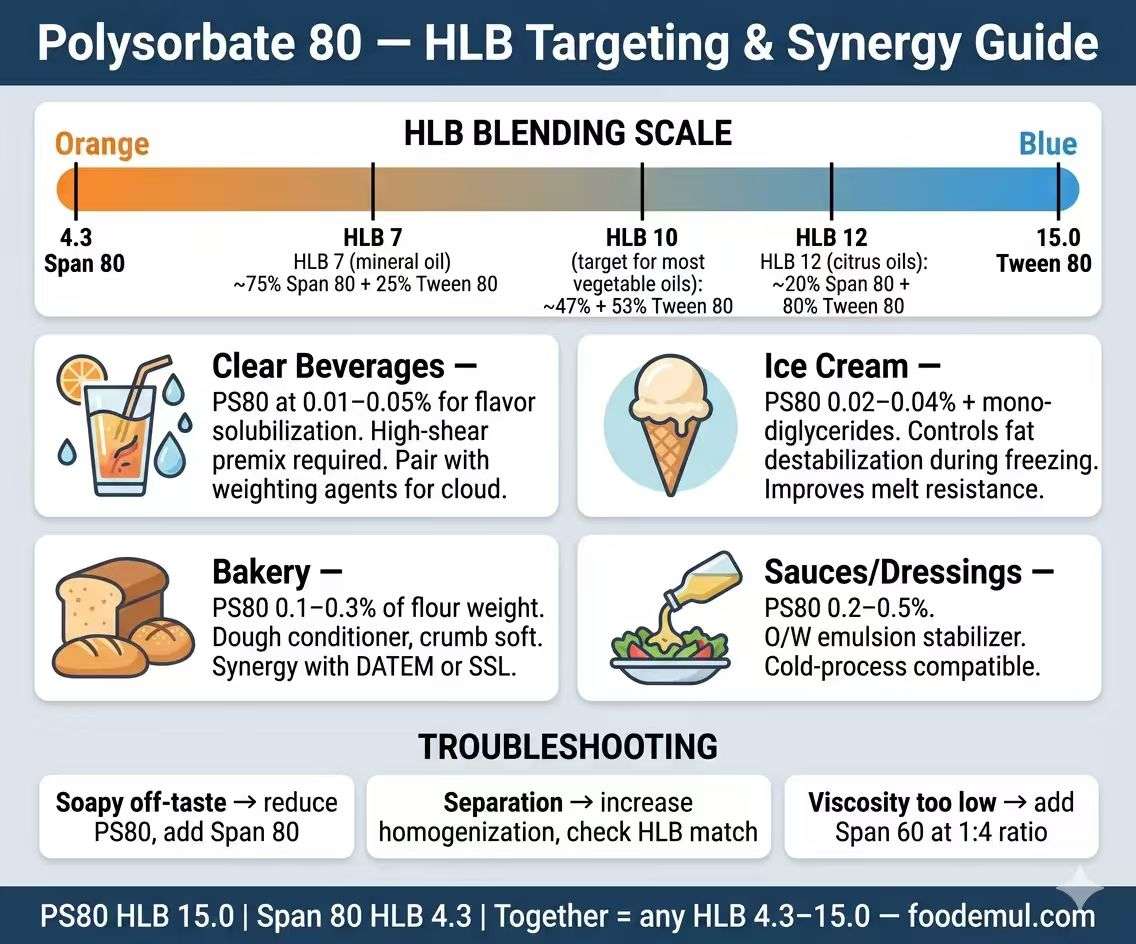
Before starting benchtop trials, it is crucial to understand the chemical parameters of your surfactant.
Key Technical Data: Polysorbate 80
The HLB 15.0 Strategy
Since Polysorbate 80 has an HLB of 15.0, it is highly hydrophilic (water-loving). This makes it excellent for:
- Solubilizing flavors into water (e.g., clear beverages).
- Creating O/W emulsions where fine droplet size is needed.
Matching the “Required HLB”:
Most vegetable oils require an HLB of 10–12 for optimal stability. Using Polysorbate 80 alone (HLB 15.0) might be too hydrophilic.
- The Solution: Blend Polysorbate 80 with a lipophilic (oil-loving) surfactant like Span 80 (Sorbitan Monooleate) (HLB 4.3).
- The Calculation: By adjusting the ratio of Polysorbate 80 to Span 80, you can precisely hit any HLB target between 4.3 and 15.0.
Synergistic Systems: Optimizing Surfactant Blends
Polysorbate 80 performs best when part of a system. Using a single surfactant often requires higher dosages, which can lead to off-flavors. Blending creates synergy.
| Co-Emulsifier | Synergy Goal | Mechanism & Application |
|---|---|---|
| Span 80 (Sorbitan Monooleate) | Targeted HLB Control | General Emulsions: The “Golden Pair.” Span 80 packs into the oil side of the interface, while Polysorbate 80 extends into the water side, creating a stronger, more rigid film than either surfactant alone. |
| Mono-/Diglycerides | Robustness & Softness | Bakery: Mono-diglycerides interact with starch (softness), while Polysorbate 80 strengthens the dough and stabilizes the air-water interface. Reduces total required Polysorbate 80 usage. |
| Lecithin | Sensory Balance | Dressings/Fillings: Lecithin sits at the oil interface while Polysorbate 80 sits in the water phase. This blend helps mask “chemical” tastes and improves mouthfeel. |
| OSA Starches | Cloud Stability | Beverages: Starch provides steric stabilization (prevents “ringing” or oil separation at the neck) while Polysorbate 80 reduces surface tension for fine droplets. |
Process Design: Temperature & Shear
Even the perfect formula will fail with the wrong process.
Pre-dissolution & Addition Order
- Hydration: Although water-soluble, pre-blending Polysorbate 80 with the oil phase or a warm aqueous phase ensures rapid dispersion.
- Proteins: Always hydrate proteins first. Adding Polysorbate 80 too early can displace proteins from the interface due to competitive adsorption, potentially destabilizing the system.
Temperature & Shear Profile
- Temperature Window: 40–60°C is ideal. This lowers viscosity and accelerates dissolution without degrading sensitive flavor oils.
- Shear Strategy:
Low Shear: For initial wet-out.
High Shear/Homogenization: Required to reach target droplet size.
D90 < 1–2 µm: For standard physical stability (milky appearance).
D90 < 200 nm: For clarity (nano-emulsions).
Application Mini-Guides (Dosage & Tips)
Clear Flavored Beverages: Clarity & Solubilization
- Goal: Crystal clear appearance with stable flavor solubilization.
- Approach: Use Polysorbate 80 at low ppm levels with a high-shear premix. Often paired with Propylene Glycol as a co-solvent.
- Target: Droplet size must be smaller than the wavelength of light (< 100-200 nm).
Ice Cream: Overrun & Meltdown Control
- Goal: Controlled fat agglomeration for dryness and overrun (air incorporation).
- Approach: 0.1% – 0.2% Polysorbate 80 in the mix.
- Mechanism: Polysorbate 80 displaces protein from the fat globule surface, allowing partial coalescence. This structure traps air, creating a creamy texture and slow meltdown.
- Sensory Check: Monitor for “waxy” mouthfeel if dosage exceeds 0.25%.
Plant-Based Milk: Calcium Fortification
- Goal: Emulsion stability in the presence of Calcium ions and heat.
- Approach: Polysorbate 80 (0.05–0.15%) + Gellan Gum or Pectin.
- Process: Use two-stage homogenization (e.g., 200/50 bar) to prevent flocculation.
Formulation Troubleshooting (Decision Tree)
When hitting regulatory or sensory limits, use this logic to adjust your formula rather than abandoning Polysorbate 80 entirely.
- Problem: “Soapy” or Bitter Off-Notes?
Solution: Do not replace entirely. Blend with Lecithin or Span 60 (Sorbitan Monostearate) to dampen the sensory impact, or reduce Polysorbate 80 dosage to <0.1%.
- Problem: Fat Separation in Chocolate (Fat-Continuous)?
Solution: Polysorbate 80 is hydrophilic (water-loving). For oil-based systems, it is the wrong tool. Switch to PGPR (E476) or Span 60/65.
- Problem: Label requires “Clean Label”?
Solution: Evaluate Quillaia Extract or Gum Acacia. Note: These require significantly higher usage rates and may result in larger droplet sizes.
Stability Testing & Compliance
Quick-Start Stability Checklist:
- Thermal: Pasteurization/UHT simulation and heat-hold at 40°C.
- pH Sweep: Test intended pH range ±0.5 units to ensure the emulsion doesn’t break in acidic environments.
- Freeze–Thaw: 3–5 cycles for frozen desserts.
- Centrifuge: Accelerated creaming check (e.g., 3000 rpm for 15 min).
Compliance Disclaimer:
Usage permissions, maximum levels, and labeling vary by country and food category. Always verify current local regulations (EU E433, EFSA opinions, 21 CFR 172.840) and confirm product specifications with your supplier before commercialization.
Ready to start formulating?
Ensure your project succeeds with high-purity ingredients.
Technical specifications: For the complete Polysorbate 80 technical data including CAS, density, viscosity, and grade comparison, see our Polysorbate 80 Technical Specifications Guide.
Span & Polysorbate system: For the full pairing map, HLB spectrum, and synergistic blending strategy, see our Span & Polysorbate Formulators Guide.
- Buy Polysorbate 80 (Polysorbate 80) – Food Grade
- Buy Sorbitan Monooleate (Span 80) – for HLB Adjustment
- Polysorbate 81 (Polysorbate 81) — a low-EO oleate variant for applications requiring reduced water solubility while retaining oleic acid compatibility
Need Polysorbate 80 for your formulation? We manufacture it alongside Span 60 and the full range — reach out for specifications or samples.