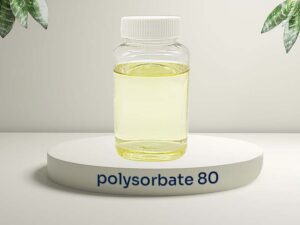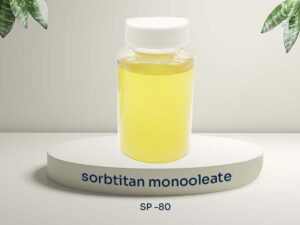

Removing fat from a food product is easy. Keeping the texture, mouthfeel, and shelf stability after you remove it — that is the hard part. Emulsifiers fill the gap that fat leaves behind: they coat the palate, stabilize air cells, and bind water that would otherwise leak out. At FoodEmul, we supply emulsifier systems specifically for low-fat and reduced-calorie formulations. This guide covers the strategies that work — from Span/Polysorbate blends to protein-stabilized emulsions.
Why Fat Is Hard to Remove
Fat performs not one but five distinct functions in food. When fat is reduced — say, from 10% to 3% in ice cream, or 8% to 2% in bread — all five functions degrade simultaneously:
| Fat Function | What It Does | What Happens When Fat Is Reduced |
|---|---|---|
| Texture & mouthfeel | Provides creaminess, richness, smooth coating on palate | Thin, watery, or dry sensation |
| Emulsion stability | Fat droplets contribute to stable O/W or W/O structure | Phase separation, oiling-off, creaming |
| Air cell stabilization | Solid fat crystals stabilize foam in cake and ice cream | Coarse crumb, poor overrun, collapse |
| Moisture retention | Fat slows water migration and evaporation | Dryness, rapid staling, crumb hardening |
| Flavor distribution | Carries fat-soluble flavor compounds, provides slow release | Flat flavor, poor flavor persistence |
No single emulsifier replaces all five functions. The formulation strategy is to identify which fat functions are most critical for the specific product and target those with the right emulsifier system. If you are new to emulsifier functionality, start with our guide to food emulsifier functions and applications.
How Emulsifiers Compensate for Reduced Fat
Emulsion Stabilization at Lower Oil Levels
When fat content drops, the oil-water interfacial area decreases — but the remaining interface still needs stabilization. High-HLB emulsifiers like Polysorbate 80 (HLB 15.0) and Polysorbate 20 (HLB 16.7) produce fine oil droplets (<5 µm) that remain suspended in low-fat O/W systems. A small Span fraction (10-20%) densifies the interfacial film for long-term stability.
Example: In a 3%-fat salad dressing, Polysorbate 80 at 0.1-0.3% combined with lecithin stabilizes the remaining oil into fine droplets that do not cream during months of shelf storage.
Rebuilding Creamy Mouthfeel
Creaminess perception correlates with the number and size of dispersed fat droplets — more, smaller droplets create a smoother sensation. Emulsifiers produce this droplet distribution. GMS (E471) contributes directly to creaminess by its melting behavior — it melts at mouth temperature (~58 °C), releasing a smooth fat-like sensation on the palate.
Span 60 (E491) contributes structure without calories: its stearic acid chain co-crystallizes with the small amount of remaining fat, creating a structured network that provides body even at low fat levels. See our Span & Polysorbate formulators guide for fat-structuring mechanisms.
Moisture Retention and Anti-Staling
In reduced-fat baked goods, moisture loss is accelerated because fat is no longer present to slow water migration from crumb to crust. DMG/GMS (E471) counteracts this by forming an insoluble complex with amylose — the linear starch fraction that otherwise recrystallizes (retrogrades) during storage, hardening the crumb and expelling water.
Dosage reference: DMG at 0.3-0.5% of flour weight can extend low-fat bread softness from 3-4 days to 7-10 days.
Aeration Without Fat-Stabilized Foam
In full-fat cakes, solid fat crystals stabilize air cells during baking. When fat is reduced, foam stability collapses. The Span 60 + Polysorbate 60 compound system replaces this function: Polysorbate 60 (HLB 14.9) drives rapid aeration during whipping; Span 60 (HLB 4.7) co-crystallizes with the remaining fat to create a heat-stable foam. At a 1:2 Span:Polysorbate ratio, this system maintains cake volume within 10-15% of full-fat benchmarks. Our Compound Emulsifiers guide covers the Span/Polysorbate foam system.
Emulsifier Selection by Low-Fat Application
Low-Fat Bakery (Bread, Cakes, Muffins)
| Emulsifier | Function | Dosage (% of flour) | Notes |
|---|---|---|---|
| DMG / GMS (E471) | Anti-staling, moisture retention, crumb softening | 0.3-0.5% | Most important single emulsifier for low-fat bakery |
| DATEM (E472e) | Dough strengthening, gas retention | 0.2-0.4% | Compensates for lost fat lubrication of gluten |
| SSL (E481) | Gluten strengthening + starch complexation | 0.2-0.5% | Combine with DMG for synergistic anti-staling |
| Span 60 (E491) | Fat crystal structuring, crumb uniformity | 0.1-0.3% | Provides fat-like structure at low dosage |
| Polysorbate 60 (E435) | Aeration aid in low-fat cakes | 0.1-0.3% | Works with Span 60 in low-fat cake gel systems |
Recommended blend for low-fat bread: DMG 0.4% + DATEM 0.25% + Span 60 0.1% (of flour weight). This trio covers anti-staling (DMG), dough strength (DATEM), and fat-like structure (Span 60). Our Bread Emulsifier Systems Guide provides full formulation details.
Low-Fat Ice Cream & Frozen Desserts
| Emulsifier | Function | Dosage (% of mix) | Notes |
|---|---|---|---|
| Polysorbate 80 (E433) | Controlled fat destabilization (partial coalescence) | 0.05-0.1% | Critical at low fat — without it, no body forms |
| Span 80 (E494) | Fat network reinforcement | 0.03-0.06% | Span 80 + Polysorbate 80 at 1:2 ratio |
| GMS (E471) | Overrun improvement, dry texture | 0.1-0.2% | Standard in all ice cream, essential in low-fat |
In low-fat ice cream (3-6% fat vs 10-14% in premium), the Span 80/Polysorbate 80 system drives the partial coalescence that builds body. Without emulsifiers, low-fat ice cream is icy, weak-bodied, and melts rapidly. Our Ice Cream guide covers the mechanism.
Low-Fat Dressings & Sauces
| Emulsifier | Function | Dosage (% of total) | Notes |
|---|---|---|---|
| Polysorbate 80 (E433) | High-HLB O/W stabilization at low oil | 0.1-0.3% | Fastest interfacial adsorption |
| Lecithin (E322) | Natural emulsifier option | 0.2-0.5% | Clean-label; combine with Polysorbate for stability |
| Xanthan gum | Body and viscosity without fat | 0.1-0.3% | Not an emulsifier, but essential texture partner |
In low-fat dressings (3-10% oil vs 30-50% in standard), Polysorbate 80 keeps oil droplets fine and suspended. Xanthan gum provides the body and cling that fat normally delivers. The combination is more effective than either ingredient alone.
Low-Fat Plant-Based Products
The fastest-growing application area. Plant-based dairy and meat alternatives often start from a lower fat baseline than their animal-derived equivalents, making emulsifier selection critical from the initial formulation.
| Emulsifier | Function | Dosage | Best For |
|---|---|---|---|
| Polysorbate 60 (E435) | O/W stabilization, mouthfeel | 0.1-0.3% | Plant-based creamers, yogurts |
| GMS (E471) | Creaminess, fat-mimetic texture | 0.2-0.5% | Plant-based milks, desserts |
| Span 60 (E491) | Fat structuring, body | 0.1-0.3% | Plant-based meat marbling simulation |
How to Build a Low-Fat Formulation Strategy
Step 1: Identify Which Fat Functions Matter Most
Not every product needs all five fat functions replaced. Prioritize:
| Product | Most Critical Fat Functions to Replace |
|---|---|
| Low-fat bread | Moisture retention > dough handling > crust softness |
| Low-fat cake | Aeration/foam stability > moisture retention > mouthfeel |
| Low-fat ice cream | Fat destabilization for body > mouthfeel > melt resistance |
| Low-fat dressing | Emulsion stability > mouthfeel/body |
| Low-fat plant milk | Emulsion stability > creaminess |
Step 2: Select the Primary Emulsifier for the #1 Function
Then layer on secondary emulsifiers for the #2 and #3 functions. Our Emulsifier Selection Framework provides the full selection methodology.
Step 3: Don’t Rely on Emulsifiers Alone
Emulsifiers work best alongside:
– Hydrocolloids (xanthan gum, guar gum, carrageenan) for body and viscosity
– Modified starches for water binding and gel structure
– Protein isolates (whey, soy, pea) for emulsion activity and satiety
– Polyols (sorbitol, glycerol) for humectancy
A formulation that uses only emulsifiers to replace fat will underperform one that combines emulsifiers with these complementary ingredients.
What Emulsifiers CANNOT Replace
Be realistic: emulsifiers compensate for fat functionality, but they don’t reproduce it completely.
| Fat Function | Can Emulsifiers Fully Replace It? | Reality |
|---|---|---|
| Caloric energy | No | Emulsifiers are used at <1%, contribute negligible calories |
| Flavor carry-through | Partially | Emulsifiers disperse flavors but don’t carry them the way fat does |
| Satiety | No | Fat triggers satiety hormones; emulsifiers do not |
| Browning / Maillard | No | Fat facilitates heat transfer for crust browning |
| Texture at very low fat (<1%) | Partially | Below 1% fat, even optimized emulsifier systems struggle; hydrocolloids become more important |
The best low-fat products are not fat-free products with emulsifiers added — they are products where fat is reduced to a realistic level (typically 25-50% of the original) and the remaining fat is used more efficiently through emulsifier-optimized dispersion and structuring.
Key Takeaways
- Fat performs 5 functions. Emulsifiers can replace 3-4 of them at meaningful levels. Identify which functions matter most for YOUR product.
- DMG/GMS (E471) is the workhorse of low-fat formulation — anti-staling in bakery, creaminess in dairy, fat structuring in spreads.
- The Span/Polysorbate pair is essential when fat crystal structure needs to be replaced — cake foam stability (Span 60 + Polysorbate 60), ice cream body (Span 80 + Polysorbate 80).
- Low-fat O/W emulsions need high-HLB Polysorbate (Polysorbate 80, Polysorbate 20) to stabilize the reduced interfacial area.
- Combine emulsifiers with hydrocolloids for body and viscosity that emulsifiers alone cannot provide.
- Start with the #1 fat function, layer on secondaries, and test. Low-fat formulation is iterative — there is no universal starting formula.
For product-specific low-fat formulation guidance, see our application guides for ice cream, bread, and beverages. For the science of emulsifier blending, see our Compound Emulsifiers guide.
Formulating low-fat products? We manufacture Span 60, Polysorbate 80, and the full sorbitan ester range — reach out for technical support or samples.