

Pick up any packaged food — bread, ice cream, chocolate, a plant-based latte — and emulsifiers are in there, doing work you never see. They keep oil and water from separating, hold air bubbles in cake batter, and stop ice cream from turning into a block of ice. At FoodEmul, we manufacture two of the most versatile emulsifier families in the industry: sorbitan esters (Span) and polysorbates (polysorbate). This article maps the full landscape — what food emulsifiers are, how they’re classified, and where each type fits in real production lines.
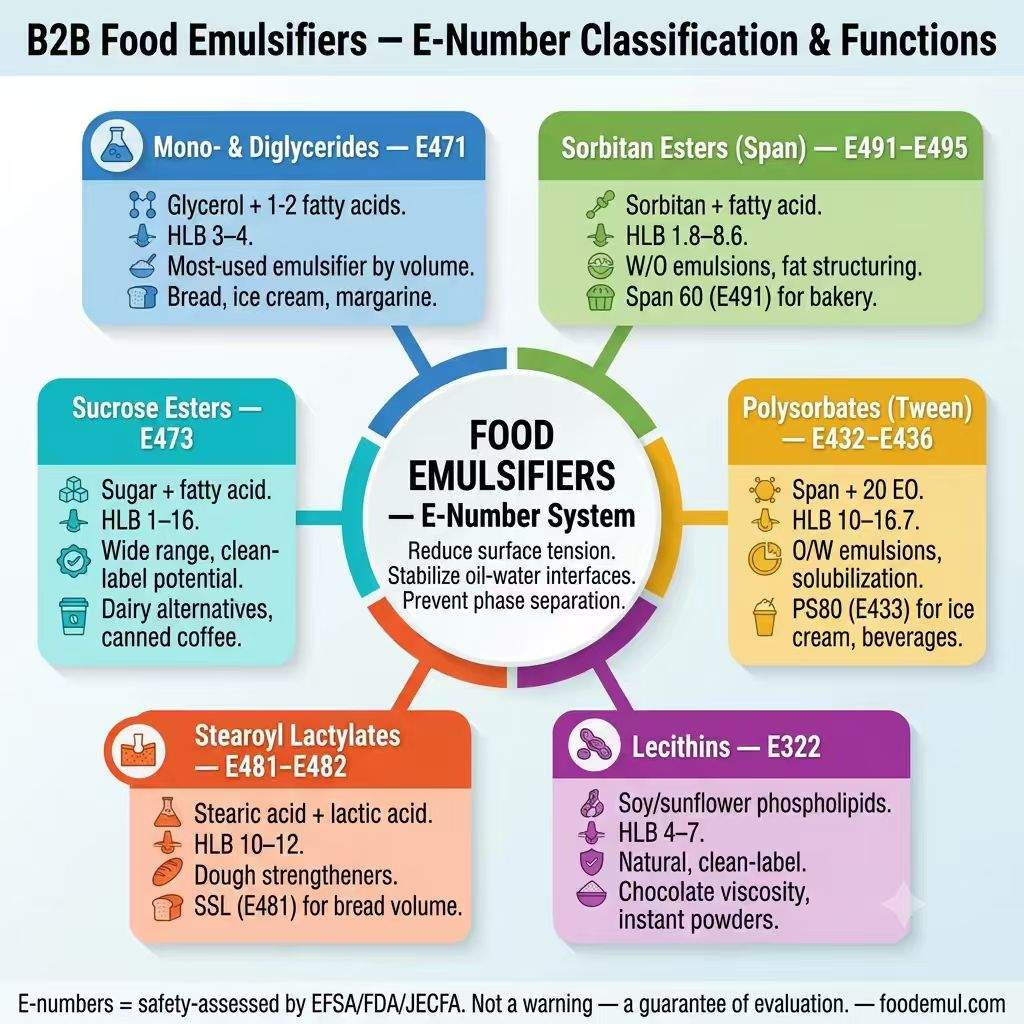
What Are Food Emulsifiers?
Emulsifiers reduce surface tension between two liquids that don’t normally mix — oil and water being the obvious pair. They work by dispersing one phase into the other as microscopic droplets, then forming a protective layer around each droplet so they don’t merge back together. Without this layer, your emulsion separates within minutes or hours.
Even though a finished emulsion looks uniform to the eye, it’s technically a heterogeneous system. The dispersed phase can be oil or water. The continuous phase is almost always water-based in food products.
Where Emulsifiers Show Up (and Their E-Numbers)
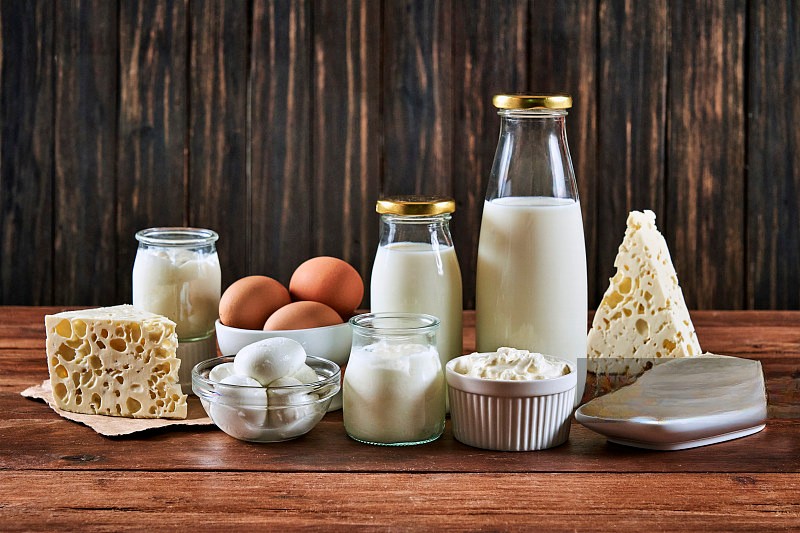
In modern food manufacturing, emulsifiers are tracked by their E-number — an international system that standardizes identity and safety. Here’s where you’ll find them in action:
- Baked goods (E471, E481): Strengthens dough, keeps bread soft by preventing starch retrogradation.
- Ice cream (E433, E471): Controls ice crystal growth and survives freeze-thaw cycles.
- Chocolate (E322, E492): Lowers viscosity during conching; stops fat bloom (those white patches).
- Margarine (E471, E322): Stabilizes water-in-oil emulsions for a smooth, spreadable texture.
- Plant-based beverages: Keeps protein dispersed and prevents sediment from settling.
Without emulsifiers, most of these products would separate, harden, or lose flavor stability within days.
Common Types of Food Emulsifiers
The food industry uses dozens of emulsifiers. The two main ways to group them: by E-number range (EU system) and by chemical family.
E-Number Classification of Major Food Emulsifiers
| E-Number Range | Chemical Family | Examples | Key Function |
|---|---|---|---|
| E322 | Lecithins | Soy lecithin, sunflower lecithin | Natural O/W emulsifier |
| E400–E405 | Alginates | Sodium alginate, propylene glycol alginate | Thickener + stabilizer |
| E406 | Agar | Agar-agar | Gelling agent |
| E407–E407a | Carrageenan | Kappa, iota, lambda carrageenan | Protein stabilizer (dairy) |
| E410–E419 | Plant gums | Locust bean gum, guar gum, xanthan gum | Thickener + stabilizer |
| E432–E436 | Polysorbates | Polysorbate 20 (E432), 60 (E435), 80 (E433) | High-HLB O/W emulsifier |
| E440–E445 | Pectins & esters | Pectin, glycerol esters of wood rosin | Gelling + weighting |
| E460–E469 | Cellulose derivatives | Methylcellulose, CMC | Thickener + bulking |
| E470–E477 | Fatty acid esters | Mono- and diglycerides (E471), DATEM (E472e) | Dough strengthener, aeration |
| E481–E482 | Stearoyl lactylates | Sodium stearoyl lactylate (SSL) | Dough conditioner |
| E491–E495 | Sorbitan esters (Span) | Span 60 (E491), Span 65 (E492), Span 80 (E494) | Low-HLB W/O emulsifier |
By HLB Value: Choosing the Right Emulsifier
The Hydrophilic-Lipophilic Balance (HLB) system ranks emulsifiers from 1 (oil-soluble) to 20 (water-soluble). For O/W emulsions, use high-HLB emulsifiers (8–18). For W/O emulsions, use low-HLB (3–6). The Span series (HLB 2–9) and Polysorbate series (HLB 10–17) are often blended to hit the exact target HLB for a formulation. See our Span & polysorbate Formulators Guide for blending calculations with worked examples.
Natural vs. Synthetic: What “Food Emulsifier” Really Means
Not all food emulsifiers come from a lab. Lecithin (E322) is extracted from soybeans or sunflowers — no synthesis involved. Mono- and diglycerides (E471) are made from vegetable oils and glycerol through a single esterification step. Polysorbates and sorbitan esters sit further along the synthesis chain, but they start from the same plant-based fatty acids. Our Natural vs. Synthetic Emulsifiers Guide breaks this down in detail.
Beyond Mixing: How Emulsifiers Interact with Starch and Protein
What separates basic emulsifiers from advanced ones is their ability to interact chemically with other food components.
- Starch Complexing: Emulsifiers like Distilled Monoglycerides (DMG) slip into the helical structure of amylose. This physically blocks starch from recrystallizing after baking — the mechanism that keeps bread soft for days instead of hours.
- Protein Interaction: In dairy and meat products, emulsifiers modify protein surfaces, improving water and fat binding. The result: juicier texture and better structural integrity through processing and storage.
Key Functions of Emulsifiers in Food Systems
| Function Type | What It Does | Examples |
|---|---|---|
| Surface Activity | Reduces interfacial tension; forms protective films | Lecithin (E322) |
| Emulsifying | Creates and stabilizes O/W or W/O emulsions | Polysorbate 80 (E433) |
| Anti-Staling | Interacts with starch to keep bread soft | Sorbitan Monostearate — Span 60 (E491) |
| Crystal Modification | Prevents fat bloom in chocolate | Sorbitan Tristearate — Span 65 (E492) |
| Foaming | Stabilizes air bubbles in whipped toppings | Polyglycerol Esters (E475) |
| Wetting | Helps powders (like cocoa) dissolve instantly | Polysorbates |
Safety and Regulatory Status
Are food emulsifiers safe? Short answer: yes. All food-grade emulsifiers supplied by FoodEmul — including sorbitan esters and polysorbates — are evaluated and approved by the FDA (U.S.) and EFSA (Europe). They carry GRAS (Generally Recognized As Safe) status and are metabolized by the body the same way natural fats are. We hold MUI Halal (Indonesia) and Kosher certifications; certificates are available on request.
FAQ: Frequently Asked Questions about Food Emulsifiers
1. What is the most common food emulsifier?
Lecithin (E322) and Mono- and Diglycerides (E471) are the most widely used, across everything from bread to chocolate.
2. Why are emulsifiers added to bread?
They condition the dough — improving loaf volume and keeping the crumb soft by binding to starch and blocking retrogradation.
3. Can emulsifiers be plant-based?
Yes. Many, including Sorbitan Monostearate (Span 60, E491), are derived from vegetable fatty acids (palm or coconut oil). They’re suitable for vegan and vegetarian formulations.
Where to Go From Here
Food emulsifiers account for roughly half of all food additives by volume — and for good reason. They touch texture, shelf life, processing efficiency, and mouthfeel. Whether you’re working on chocolate, plant-based beverages, or baked goods, choosing the right emulsifier has a direct impact on product quality and consumer satisfaction.
For deeper technical dives, start with the Sorbitan Esters & Polysorbates Overview, the Sorbitan Esters Guide, and the Polysorbate Emulsifiers Guide.
Need technical advice on your formulation? Reach out — we manufacture Sorbitan Monostearate (Span 60), Polysorbate 80, and the full sorbitan ester range.
